Quick Facts
Quick Facts
A telescope’s front lens or mirror is called the objective.
The objective collects and focuses light from distant objects.
The eyepiece magnifies the focused image.
Bigger telescopes usually reveal fainter objects because they collect more light.
Visual answer
How telescopes magnify objects
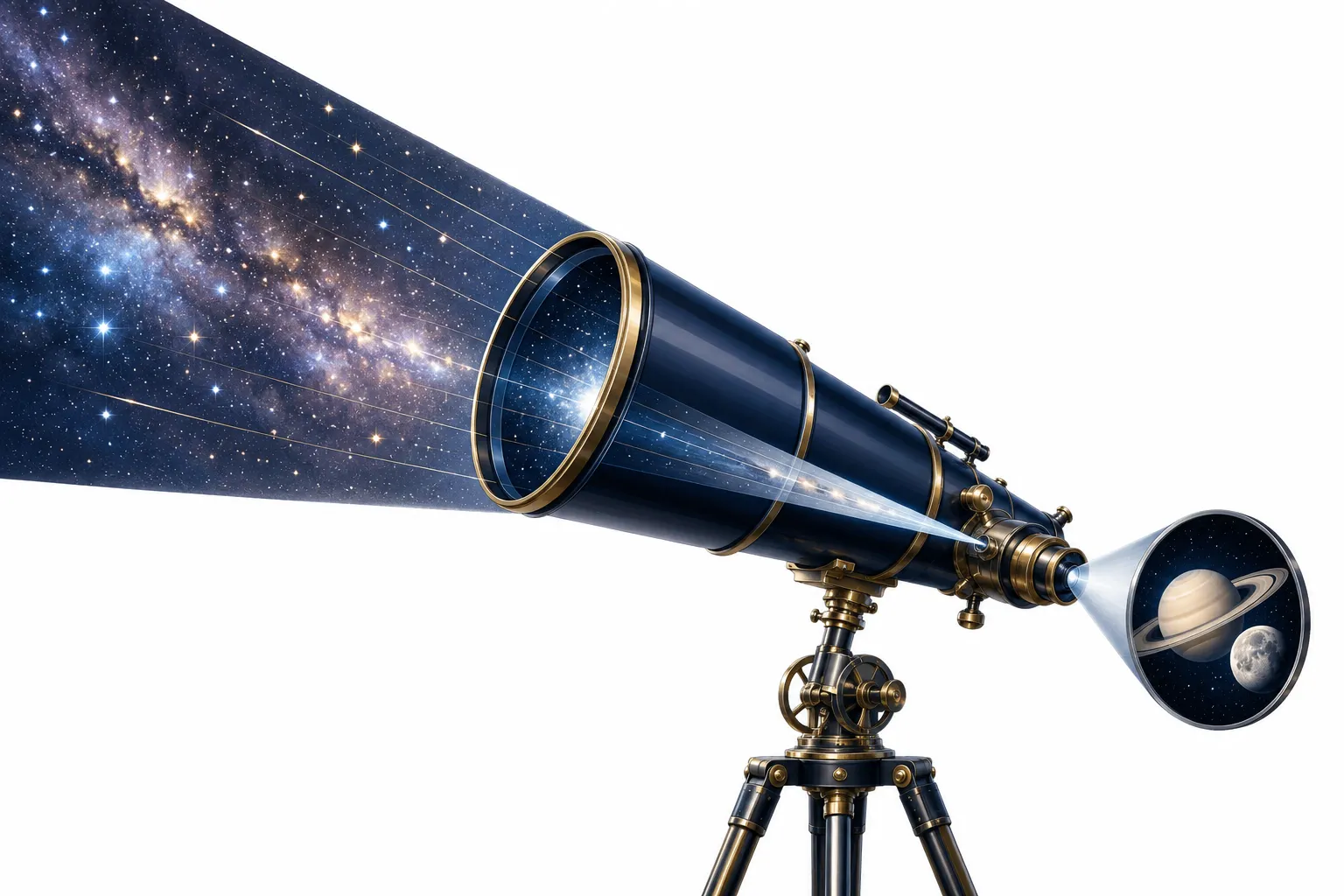
The diagram shows a telescope collecting light with a large lens or mirror, focusing it, and enlarging the image through the eyepiece.
Collect light
The objective lens or mirror gathers much more light than the eye.
Focus image
Incoming light is brought together into a small real image.
Magnify
The eyepiece enlarges that focused image for your eye.
Collecting Light
A Telescope Is Mostly A Light Bucket
When you look at a planet with your naked eye, your eye collects only the tiny amount of light that enters your pupil.
A telescope has a much larger opening. That means it gathers more light from the same distant object.
More light means a brighter image, and a brighter image can reveal details your eye would otherwise miss.
Focusing
The Lens Or Mirror Brings Light Together
Light from a distant object enters the telescope almost in parallel lines.
The telescope’s main lens or mirror bends or reflects those rays so they meet at a focus.
At that point, the telescope has created a small real image. The eyepiece then makes that image look larger to your eye.
Analogy
The Rain Bucket Analogy
The familiar part
If you place a cup outside during rain, you collect a little water. If you place a wide bucket outside, you collect much more.
How it applies
Light works similarly. A bigger telescope collects more light, just as a bigger bucket collects more rain.
Where the analogy breaks
Rain makes your socks wet. Starlight usually has the decency not to.
Curiosity Notes
Details Most People Miss
Why this still matters
Why This Still Matters
Telescopes changed humanity’s address book. Before them, the sky was mostly dots. After them, it became a place filled with worlds, moons, nebulae, galaxies, and evidence that Earth was not the center of everything.
Key Findings
- ✓Core findingTelescopes collect more light than the human eye.
- ✓Strong evidenceThe main lens or mirror focuses that light into an image.
- ⚠Main consequenceThe eyepiece magnifies the focused image.
- ✓Wider legacyA larger telescope usually shows fainter and more detailed objects.
Final insight
A Last Thought
A telescope is not a magic tube that drags Saturn closer. Saturn remains rudely far away. The telescope simply gathers more of Saturn’s light than your eye can manage, focuses it neatly, and lets you inspect the universe with a little more dignity.
Quick answers
Common questions
Does a telescope just zoom in? +
Not exactly. It collects and focuses light first. The eyepiece then magnifies the image.
Why do bigger telescopes see more? +
Because they collect more light, which makes faint objects brighter and allows finer detail to be seen.