Rheum is produced continuously during waking hours too, but it's normally so thin and gets swept away by blinking so effectively that you never notice it building up.
Body & Brain
Why do we get eye boogers?
Why Do We Get Eye Boogers?
Every single night, while you sleep, your eyes run a cleaning cycle you never asked for and never notice, and the eye booger is the leftover evidence in the morning.
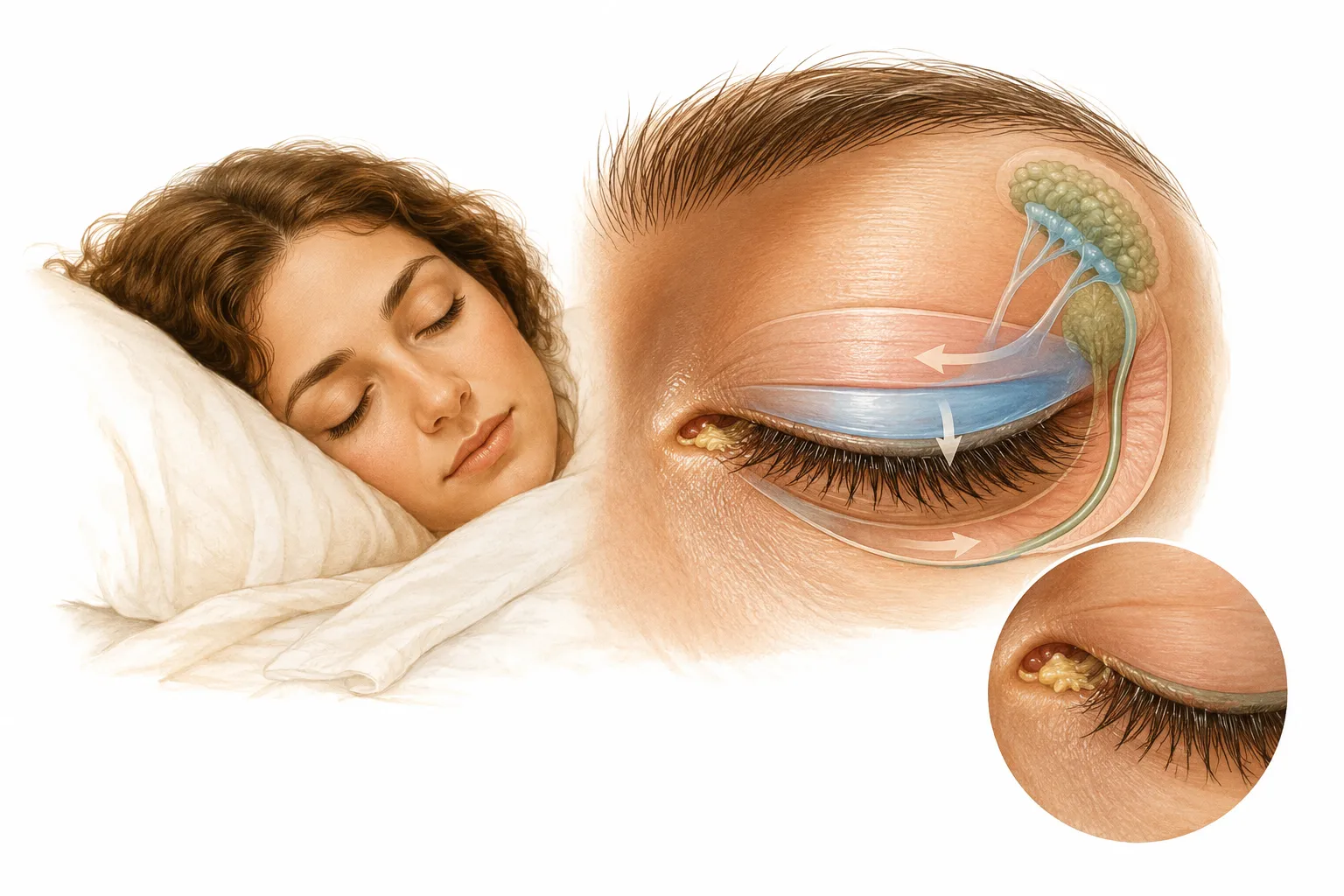
On this page
The short answer
Eye boogers, medically called rheum, form from a mix of mucus, oil, skin cells, and dust that your eyes naturally produce to stay lubricated and protected. Blinking usually clears it away during the day, but while you sleep, it accumulates in the corners of your eyes and dries out.
Your eyes are coated in a tear film made of three layers: an oily outer layer, a watery middle layer, and a mucus-like inner layer. Throughout the day, this film also traps dust, dead skin cells, and other debris. Blinking constantly redistributes and drains this mixture through tiny ducts in the corner of your eye, so it rarely builds up. At night, blinking stops and tear production slows, so the leftover mucus, oil, and debris settle in the inner corner of the eye and dry into the crusty or gooey substance you find when you wake up.
At a glance
Eye boogers start as a normal, healthy protective coating, not a waste product.
Eye discharge means your eyes are dirty and need more washing.
Your eyes produce this substance constantly, all day, every day. You just don't usually see it because blinking sweeps it away before it can build up.
Picture a windshield wiper running nonstop across a window that's also constantly getting a fine mist of oil and dust. During the day, the wiper keeps up. At night, the wiper stops, and the residue finally has time to collect in the corner.
Diagram
Why Do We Get Eye Boogers: the idea in one diagram
Rheum forms from the ongoing production of tear film components that are normally cleared by blinking but accumulate and dry out when blinking stops during sleep.
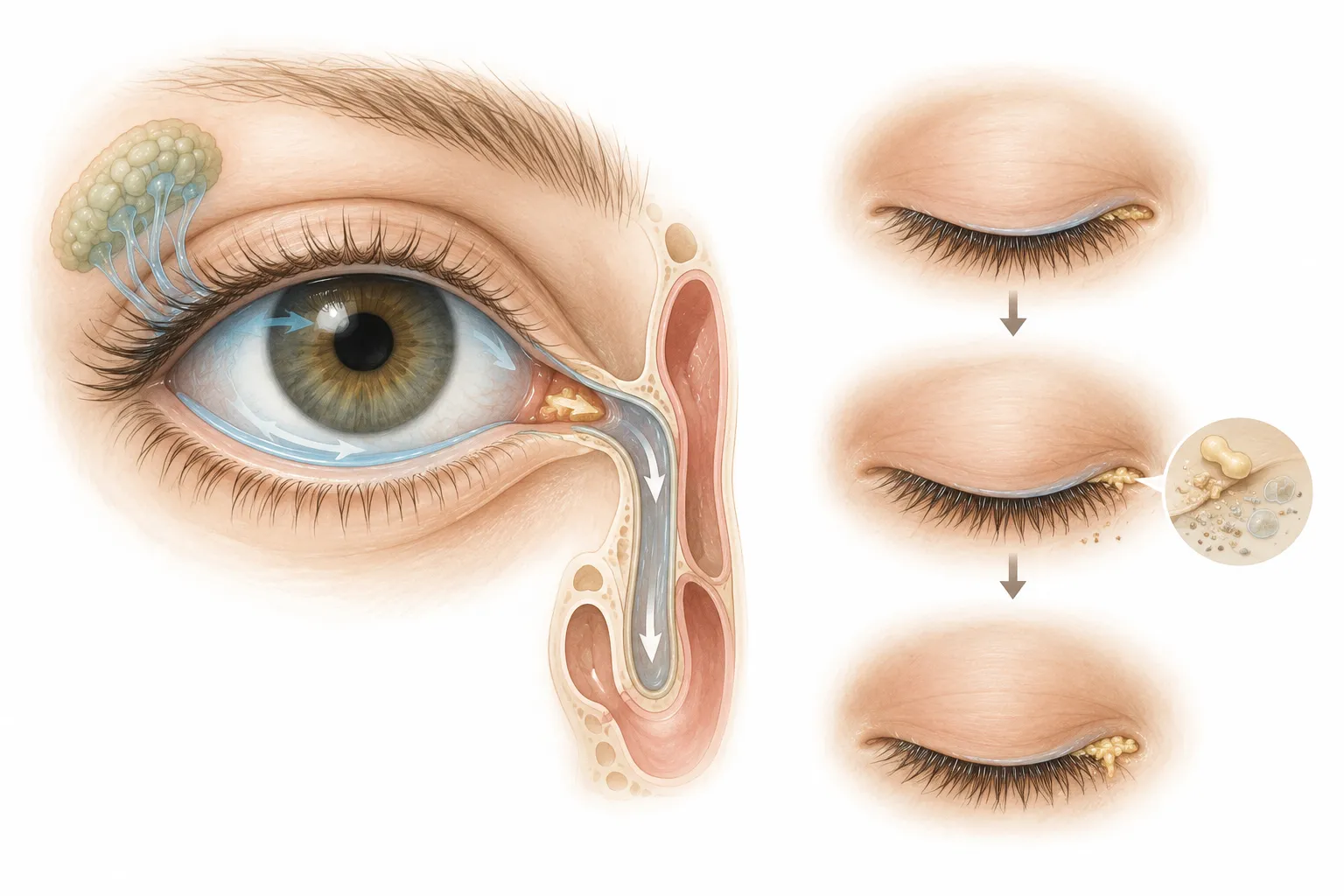
- 1Glands produce a three-layer tear film
Eye boogers start as a normal, healthy protective coating, not a waste product.
- 2Debris gets trapped in the film
The tear film is actively collecting debris, not just moisturizing.
- 3Blinking clears it during the day
You clear thousands of tiny doses of debris daily without ever noticing.
- 4Sleep stops the clearing process
Eye boogers are the direct result of the cleaning system pausing, not malfunctioning.
How it works
The mechanism
Rheum forms from the ongoing production of tear film components that are normally cleared by blinking but accumulate and dry out when blinking stops during sleep.
- Step 01
Glands produce a three-layer tear film
Meibomian glands produce an oily layer, lacrimal glands produce a watery layer, and goblet cells produce a mucus layer, all coating the surface of the eye.
Like three separate factories each contributing one ingredient to a shared product.
Eye boogers start as a normal, healthy protective coating, not a waste product.
- Step 02
Debris gets trapped in the film
Dust, dead skin cells, and other particles land on the eye throughout the day and get caught in the mucus layer of the tear film.
Like flies caught on flypaper.
The tear film is actively collecting debris, not just moisturizing.
- Step 03
Blinking clears it during the day
Each blink redistributes the tear film and drains excess fluid and debris through the tear ducts into the nasal cavity.
Like a windshield wiper paired with a drain.
You clear thousands of tiny doses of debris daily without ever noticing.
- Step 04
Sleep stops the clearing process
With blinking stopped for hours, the mixture pools in the inner corner of the eye and dries as tears evaporate, forming the crust you find in the morning.
Like sediment settling once a stream stops flowing.
Eye boogers are the direct result of the cleaning system pausing, not malfunctioning.
Surprises
Facts worth sitting with
Rheum is produced continuously during waking hours too, but it's normally so thin and gets swept away by blinking so effectively that you never notice it building up.
Surprising facts
What seems backwards
Worth comparing
In everyday life
Easy to get wrong
Pressure points
Where the simple answer gets interesting
Why is there more eye discharge in the morning than any other time of day?
Blinking is the main mechanism that clears the tear film's byproducts throughout the day. During sleep, blinking stops entirely for hours, so the debris that would normally be swept away instead settles in the inner corner of the eye and has time to dry out.
You're not producing more of it at night, you're just finally seeing what was there all along, because the cleanup crew clocked out.
When does eye discharge signal a real problem instead of a normal process?
Discharge that's thick, colored yellow or green, accompanied by redness, pain, or crusting so severe the eyelids stick shut, can indicate an infection like conjunctivitis and warrants seeing a doctor rather than being dismissed as normal rheum.
The same basic substance can be either completely harmless or a clear medical signal, depending entirely on its color, thickness, and how the eye around it looks.
Why do some people get noticeably more eye discharge than others?
Differences in tear film composition, allergy sensitivity, contact lens use, sleeping environment, and even how narrow someone's tear ducts are can all shift how much discharge accumulates.
A trait as small and universal as eye boogers still varies enough between individuals to reflect real underlying differences in eye anatomy and environment.
Behind the science
The story behind it
The clinical description of rheum in ophthalmology
Ophthalmologists formally categorize normal eye discharge as a routine finding, distinct from discharge caused by infection or blocked tear ducts, based on color, consistency, and accompanying symptoms.
Having a clear clinical distinction lets doctors quickly separate harmless morning crust from early signs of conjunctivitis or blocked tear ducts, especially in newborns.
Something almost universally dismissed as trivial still has a precise clinical definition, because at the edges, it matters for diagnosis.
Tear film layer analysis using interferometry
Researchers used light-based imaging techniques to measure the thickness and composition of each layer of the tear film in real time on living eyes.
The oily outer layer, previously assumed to be a passive coating, was found to play an active role in slowing tear evaporation, directly affecting how quickly discharge dries and crusts overnight.
Clarify
Myth and reality
Myth
Eye discharge means your eyes are dirty and need more washing.
Reality
Normal daily eye discharge is a sign the tear film and its debris-clearing function are working correctly, not a sign of poor hygiene.
Evidence
Ophthalmologists consistently describe small amounts of daily rheum as an expected, healthy finding during routine eye exams.
Looking closer
The deeper pattern
Eye boogers are only noticeable because a maintenance process paused, not because anything changed about what your body was doing.
One way to think about it
Systems that run continuously and invisibly only become visible the moment they stop, which means the things we notice as 'problems' are often just evidence a normally hidden process briefly went quiet.
What looks like a new issue is frequently just an old process finally showing its work.
Limits
Where the explanation bends
Newborns and blocked tear ducts.
Many infants are born with narrow or immature tear ducts, causing noticeably more discharge than typical, which usually resolves naturally within the first year as the ducts widen.
A completely normal developmental stage can look alarming to new parents simply because the volume of discharge is so much higher than what adults are used to seeing.
In daily life
What this helps you notice
Paying attention to changes in the color, thickness, or amount of eye discharge can serve as an early warning sign for eye infections or allergies.
A shift from the usual small amount of clear or light crust to thick yellow or green discharge is one of the clearest home signals that it's time to see a doctor about possible conjunctivitis.
Remember
Key takeaways
- 1
Eye boogers, or rheum, are made of oil, mucus, dead skin cells, and dust naturally collected by the tear film.
- 2
Blinking clears this mixture continuously during the day, which is why discharge is far more noticeable after sleep.
- 3
A small amount of morning eye discharge is completely normal and not a hygiene issue.
- 4
Newborns often produce more discharge due to immature tear ducts, which typically resolves within the first year.
- 5
Thick, colored, or painful discharge is different from normal rheum and can signal an infection worth checking with a doctor.
The gunk in the corner of your eye each morning is proof that your eyes never stopped protecting themselves, even while you were asleep and paying no attention at all.
It isn't residue from a broken system. It's a receipt from a system that never once clocked out, left in the one spot on your body where you're guaranteed to see it first thing every day.
Read around the idea
More questions with the same curious pull
Nearby doors from the TinyThat archive, chosen by topic, intent, and reader curiosity.
Body & Brain
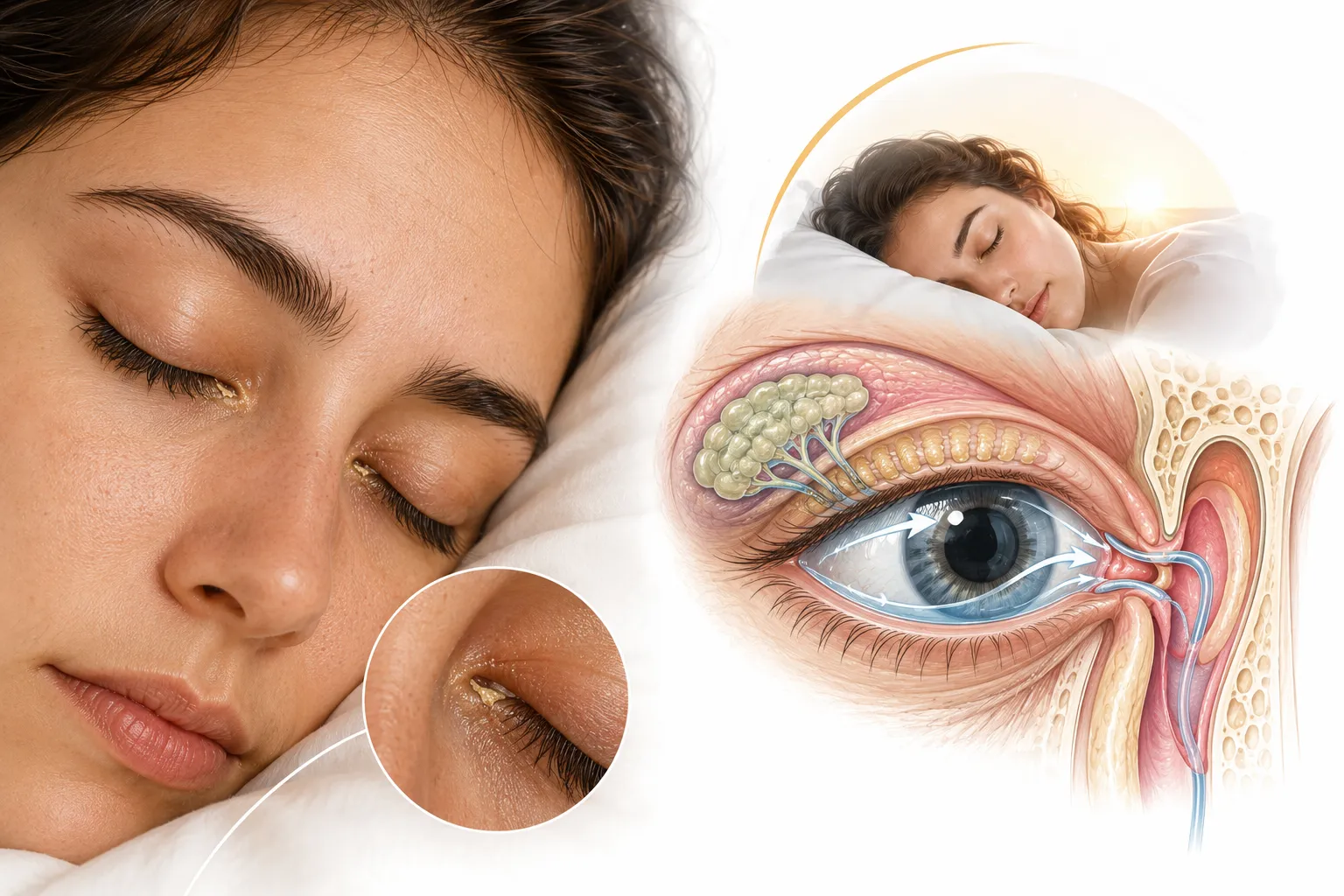
Why Do Eyes Get Crusty Overnight?
Because blinking, the main mechanism that clears tear film debris, stops entirely during sleep.
Body & Brain
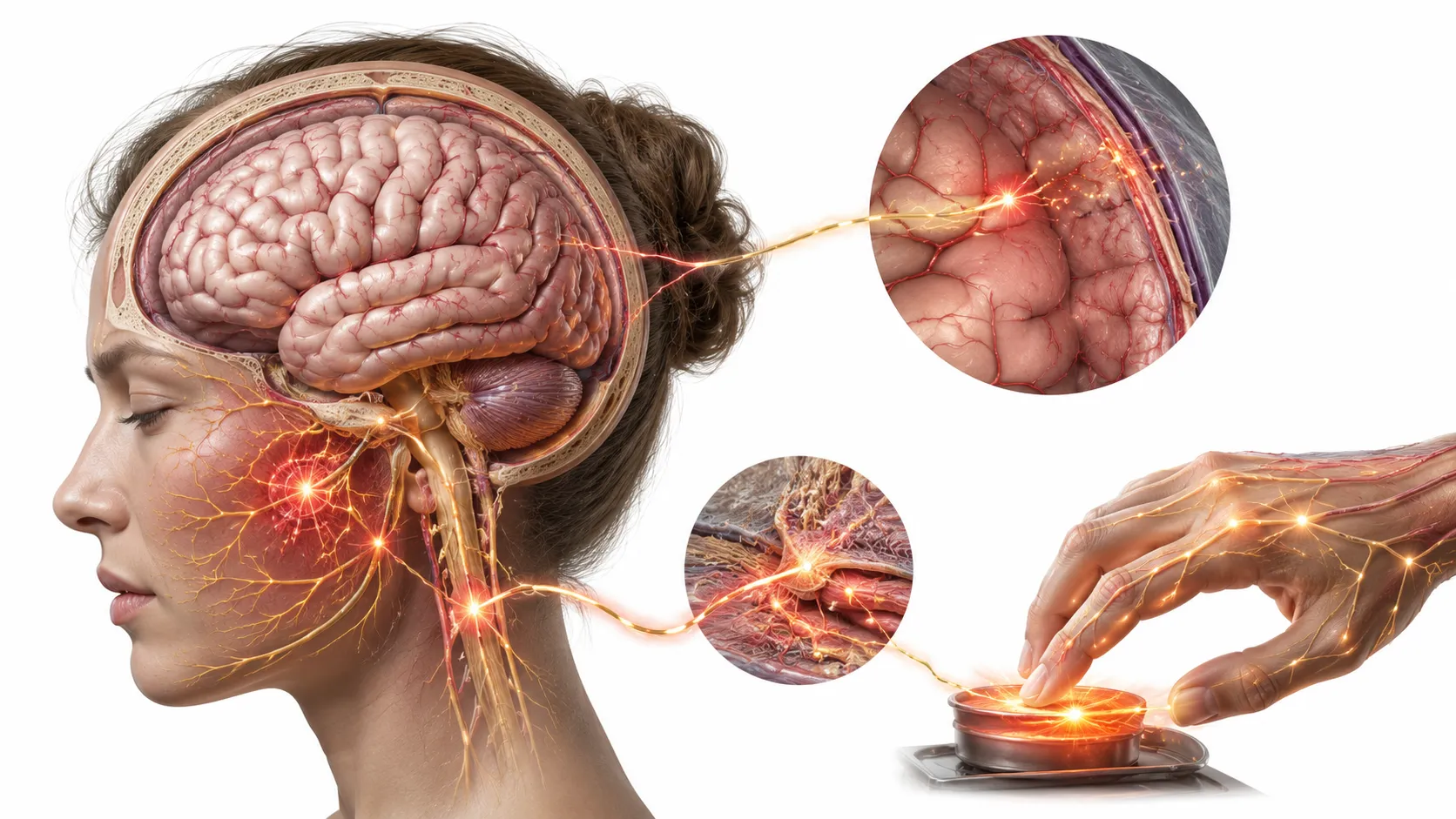
Can the Brain Feel Pain?
The brain controls all pain in your body, yet it cannot feel pain itself. Discover why, and what this strange fact re...

Body & Brain
Does Your Brain Eat Itself?
Your brain really does consume parts of itself. Learn about autophagy, synaptic pruning, and why self-consumption is...