The medical term for this dried material, rheum, is produced to some degree constantly, all day, but is normally invisible because blinking clears it before it can accumulate.
Body & Brain
Why do eyes get crusty specifically overnight, while sleeping?
Why Do Eyes Get Crusty Overnight?
You blink somewhere around fifteen to twenty times a minute all day long, and every single one of those blinks is quietly doing cleanup work you never think about, until you sleep and the cleanup crew clocks out for eight hours straight.
On this page
The short answer
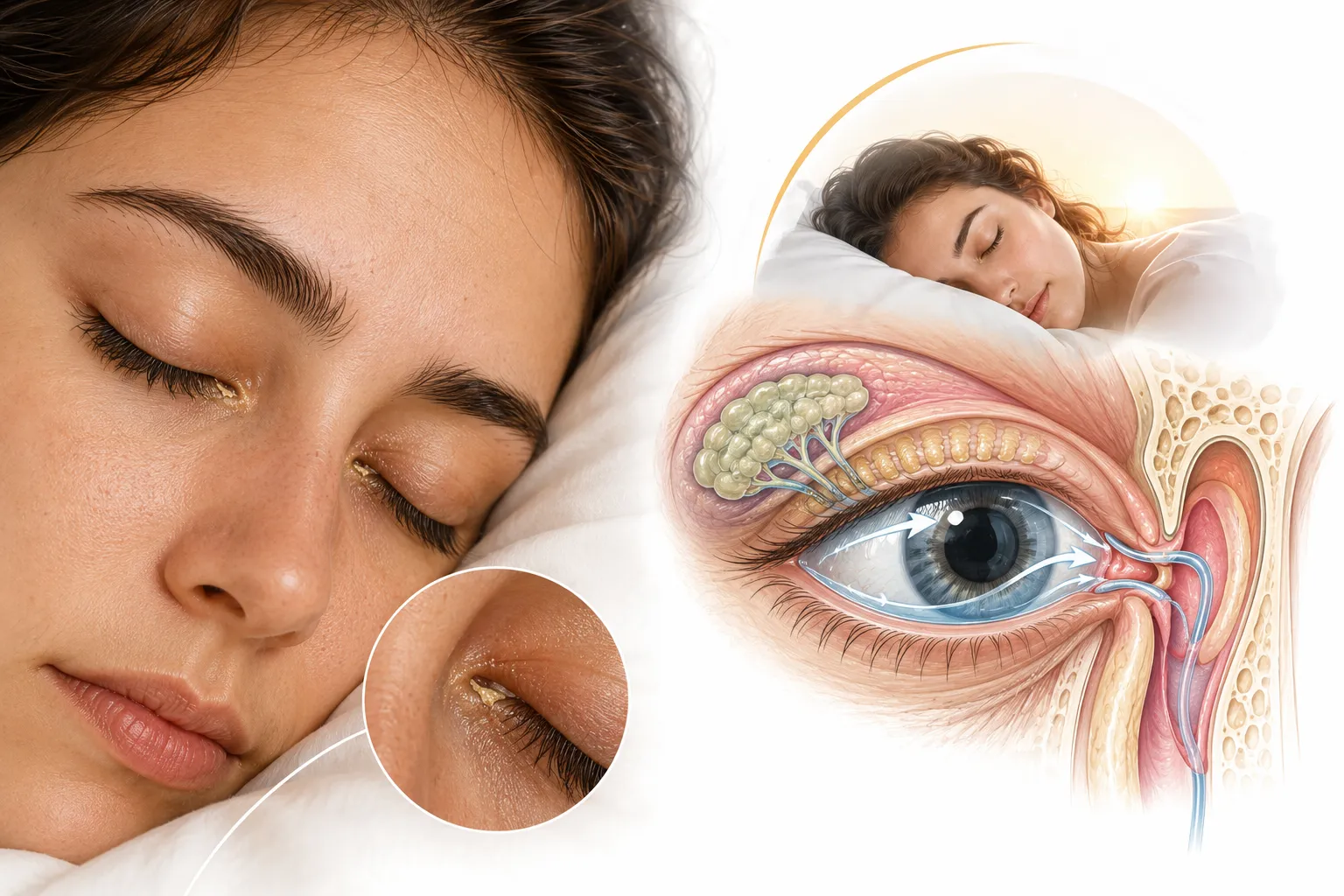
Eyes get crusty overnight because blinking, which normally clears mucus, oil, and debris from the tear film throughout the day, stops almost entirely during sleep. Without that constant clearing, the tear film's natural byproducts pool in the corners of the eyes and dry out over several uninterrupted hours.
The surface of your eye is coated in a tear film made of watery, oily, and mucus-like layers produced continuously by different glands. Throughout the day, blinking spreads this film evenly and drains excess fluid, along with trapped dust and dead cells, through tiny tear ducts in the inner corner of each eye. During sleep, both blinking and tear production slow dramatically, so the leftover material that would normally be swept away instead accumulates in the same spot for hours at a stretch. As the eyes stay closed and tears evaporate slightly around the edges, this leftover mucus and debris dries into the crust commonly found in the inner corners of the eyes upon waking, a direct byproduct of the daytime clearing process simply pausing overnight.
At a glance
Tear film production, and the debris it collects, never actually stops.
Morning eye crust means your eyes weren't properly cleaned or cared for the day before.
The specific reason it shows up overnight, rather than at any other extended stretch of not blinking, comes down to a very particular combination of stillness, warmth, and time.
Picture a street sweeper that runs continuously through the day, keeping a road spotless, and then gets parked for eight hours overnight while the same amount of dust and debris just keeps quietly settling in one spot.
Diagram
Why Do Eyes Get Crusty Overnight: the idea in one diagram
Morning eye crust forms because blinking, the primary mechanism for clearing tear film byproducts throughout the day, stops for hours during sleep, allowing debris to pool and dry.
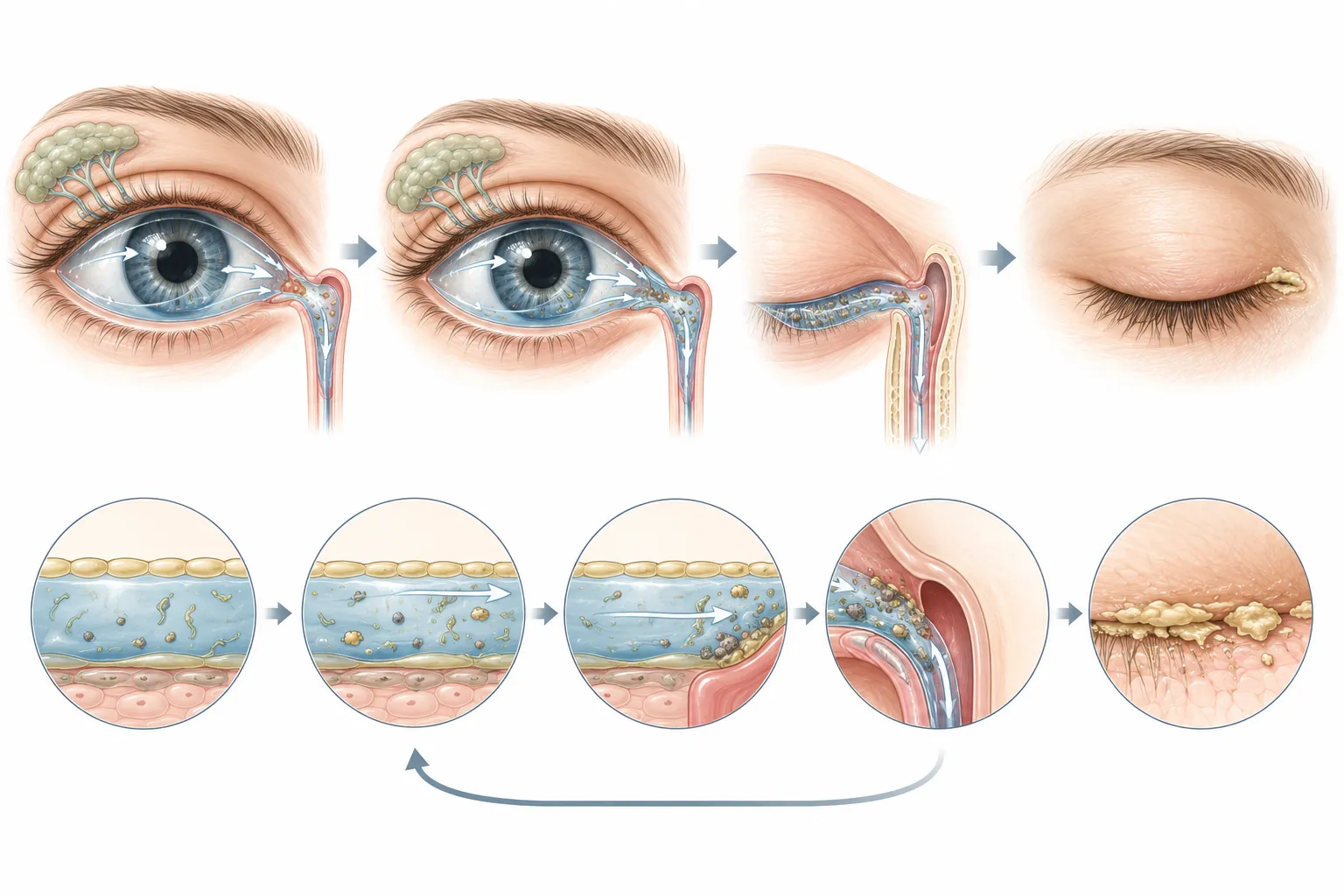
- 1Glands continuously produce tear film
Tear film production, and the debris it collects, never actually stops.
- 2Blinking clears debris during the day
Blinking is the only thing normally keeping this process invisible.
- 3Sleep halts the clearing mechanism
The buildup only becomes possible once the clearing mechanism pauses.
- 4Accumulated material dries into crust
Morning crust is simply the dried, concentrated version of an ordinary daily process.
How it works
The mechanism
Morning eye crust forms because blinking, the primary mechanism for clearing tear film byproducts throughout the day, stops for hours during sleep, allowing debris to pool and dry.
- Step 01
Glands continuously produce tear film
Multiple glands around the eye constantly produce the oily, watery, and mucus layers that make up the protective tear film covering the eye's surface.
Like several small factories running around the clock, day and night.
Tear film production, and the debris it collects, never actually stops.
- Step 02
Blinking clears debris during the day
Frequent daytime blinking spreads and drains the tear film through tiny ducts in the inner corner of the eye, preventing buildup.
Like a conveyor belt constantly moving material along before it can pile up.
Blinking is the only thing normally keeping this process invisible.
- Step 03
Sleep halts the clearing mechanism
During sleep, blinking and tear production both slow dramatically for hours at a stretch, so the tear film's natural byproducts have nowhere to go.
Like turning off the conveyor belt while the factory keeps running.
The buildup only becomes possible once the clearing mechanism pauses.
- Step 04
Accumulated material dries into crust
Over several hours, the pooled mucus, oil, and debris in the corner of the eye evaporates and hardens into the crust found upon waking.
Like a puddle drying out and leaving behind a residue once the water evaporates.
Morning crust is simply the dried, concentrated version of an ordinary daily process.
Surprises
Facts worth sitting with
The medical term for this dried material, rheum, is produced to some degree constantly, all day, but is normally invisible because blinking clears it before it can accumulate.
Surprising facts
What seems backwards
Worth comparing
In everyday life
Easy to get wrong
Pressure points
Where the simple answer gets interesting
Why is morning eye crust worse for some people than others?
Differences in tear film composition, sleeping environment humidity, allergy sensitivity, and how narrow or wide someone's tear ducts naturally are can all significantly affect how much crust accumulates overnight.
A trait as universal and overlooked as morning eye crust still varies meaningfully based on individual anatomy and environment.
Does eye crust indicate anything about sleep quality?
Not directly; crust formation is primarily linked to the duration of uninterrupted, low-blink sleep rather than sleep depth or quality, so its amount doesn't reliably reflect how well someone actually slept.
A morning ritual many people associate with waking up doesn't actually tell you much at all about how good that sleep really was.
When does morning eye crust signal something beyond normal accumulation?
Crust that's unusually thick, colored yellow or green, or accompanied by redness, swelling, or eyelids stuck completely shut can indicate conjunctivitis or another eye infection and is worth evaluating by a doctor.
The exact same substance can be either a completely unremarkable daily occurrence or an early clinical signal, and the difference lies entirely in its color and texture.
Behind the science
The story behind it
Clinical characterization of normal overnight rheum
Ophthalmologists have described and categorized typical overnight eye discharge as an expected, benign finding, distinguishing it clearly from discharge patterns associated with infection or blocked tear ducts.
This clear categorization helps both doctors and patients quickly distinguish routine morning crust from symptoms that actually warrant medical attention.
A near-universal daily experience still benefits from a formal medical definition, mainly so the exceptions can be reliably identified.
Tear film evaporation rate studies during prolonged eye closure
Researchers measured how quickly the tear film's components evaporate and concentrate when the eyes remain closed for extended periods, simulating sleep conditions.
The rate of evaporation and residue concentration closely matched the typical duration and intensity of the crust people report finding after a full night's sleep.
Clarify
Myth and reality
Myth
Morning eye crust means your eyes weren't properly cleaned or cared for the day before.
Reality
Morning eye crust is a normal, expected byproduct of the tear film's ongoing debris-clearing function simply pausing overnight, unrelated to how clean or well cared for your eyes were during the day.
Evidence
Ophthalmologists consistently describe small amounts of morning rheum as a healthy, universal finding during routine eye exams, unrelated to hygiene.
Looking closer
The deeper pattern
Morning eye crust exists only because a system that runs invisibly and continuously during the day gets paused for hours at a stretch, revealing work that was always happening but never had time to accumulate before.
One way to think about it
The visibility of a process often has nothing to do with how active it is; it has to do with whether the mechanism responsible for hiding its output ever stops running long enough to let it show.
Something being invisible day to day doesn't mean it's absent. It might just never have had the downtime to pile up before now.
Limits
Where the explanation bends
Nocturnal lagophthalmos, sleeping with eyes partially open.
People with this condition experience faster tear evaporation overnight because the eyes aren't fully sealed, which can lead to different patterns of dryness and crust, sometimes alongside eye irritation upon waking.
A subtle anatomical difference in how completely someone's eyelids close changes the entire overnight buildup process in a measurable, distinct way.
In daily life
What this helps you notice
Recognizing normal morning crust versus concerning discharge helps people know when a simple warm washcloth is sufficient versus when it's time to see a doctor.
A sudden shift from the usual light morning crust to thick, colored discharge is one of the clearest at-home signals that conjunctivitis or another infection may be developing.
Remember
Key takeaways
- 1
Morning eye crust forms from tear film byproducts that accumulate once blinking, the main daytime clearing mechanism, pauses during sleep.
- 2
This material is produced continuously throughout the day but normally never accumulates because blinking clears it away.
- 3
Sleeping environment humidity and individual tear duct anatomy both significantly affect how much crust forms.
- 4
A small amount of morning eye crust is a completely normal and healthy finding, unrelated to hygiene.
- 5
Thick, colored, or painful discharge is distinct from normal crust and can signal an infection worth checking with a doctor.
The crust in your eyes each morning isn't a sign the night went wrong. It's proof of a cleanup system that ran flawlessly all day and simply had nowhere to put its leftovers once it finally got to rest.
Wash it away, and you're not fixing anything. You're just finishing a job your eyes started hours earlier and had to leave paused the entire time you were asleep.
Read around the idea
More questions with the same curious pull
Nearby doors from the TinyThat archive, chosen by topic, intent, and reader curiosity.
Body & Brain
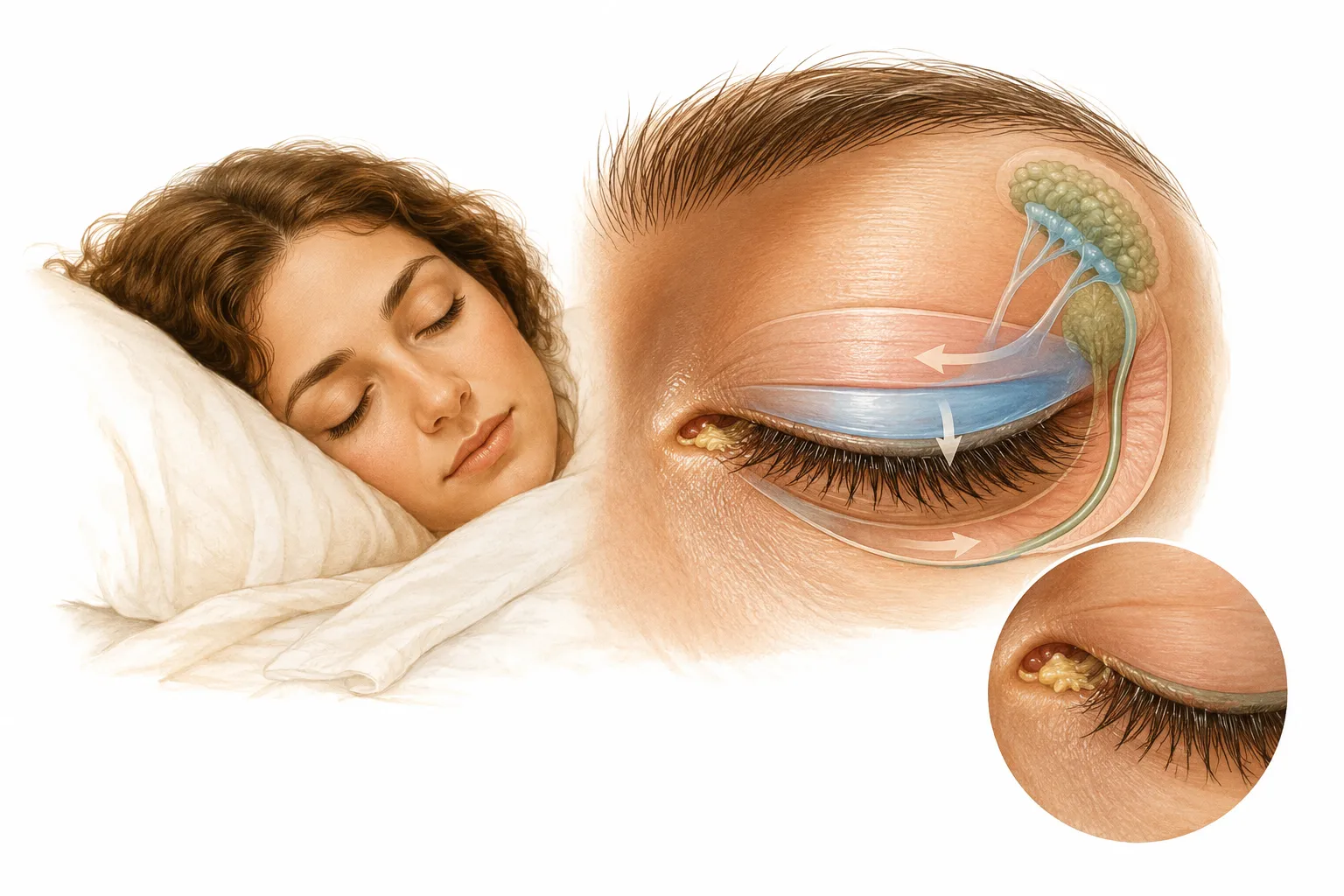
Why Do We Get Eye Boogers?
Eye boogers form from mucus, oil, and debris in the tear film that accumulates whenever blinking pauses.
Body & Brain
Can the Brain Feel Pain?
The brain controls all pain in your body, yet it cannot feel pain itself. Discover why, and what this strange fact re...
Body & Brain
Does Your Brain Eat Itself?
Your brain really does consume parts of itself. Learn about autophagy, synaptic pruning, and why self-consumption is...