In a 1996 study, researchers photographed veins of different depths and found the color shifted from blue to green to invisible depending purely on how far beneath the skin they sat, with the blood itself unchanged.
Body & Brain
Why do veins look blue even though blood is red?
Why Do My Veins Look Blue?
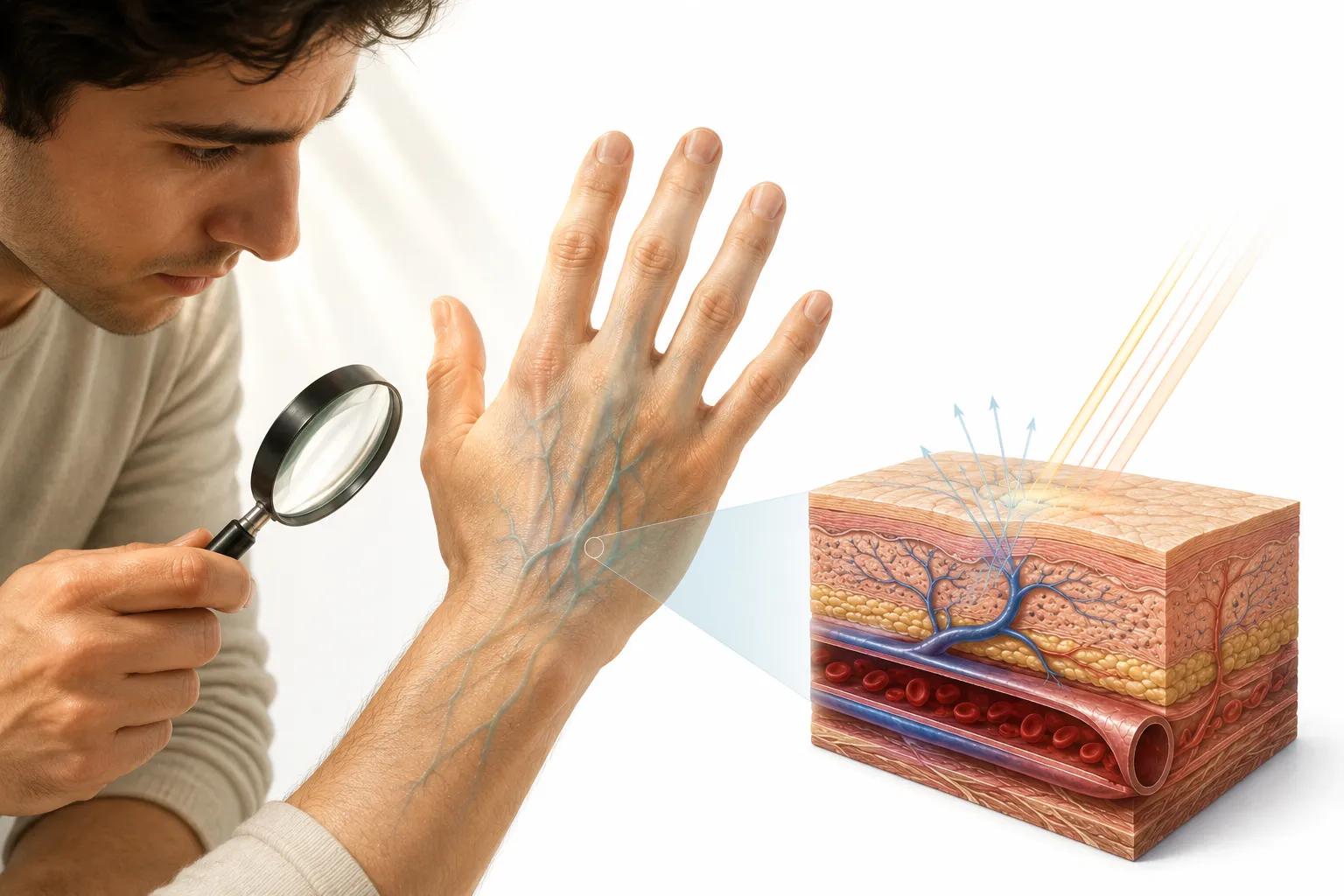
Hold your wrist up to the light. The veins running under your skin look distinctly, unmistakably blue. Now think about the last time you got a paper cut. The blood that came out was red.
On this page
The short answer
Veins look blue because of how light scatters through skin, not because the blood inside them is actually blue. Deoxygenated blood is dark red, and skin filters that red light so only blue-shifted wavelengths make it back to your eye.
Light entering skin is a mix of wavelengths. Red light penetrates deeper into tissue before bouncing back out, while blue light scatters closer to the surface. Veins sit just deep enough that the red wavelengths reflecting off them get absorbed by the tissue above before reaching your eye, while shorter blue wavelengths scatter back out efficiently. Your brain interprets that scattered light as the color of the vein itself, even though the vein is really carrying dark red blood the entire time.
At a glance
Not all light behaves the same once it enters tissue.
Deoxygenated blood is blue and turns red the instant it's exposed to air or oxygen.
Human blood is never blue. Not in your veins, not in your arteries, not anywhere in your body, at any oxygen level, ever. What you're seeing is not the color of the blood at all.
Think of your skin as a pane of frosted glass and your vein as a red wire behind it. The glass doesn't change the wire's color. It changes which wavelengths of light survive the trip to your eye.
Diagram
Why Do My Veins Look Blue: the idea in one diagram
Vein color is produced by differential light penetration and scattering through skin, not by any change in the blood's actual pigment.
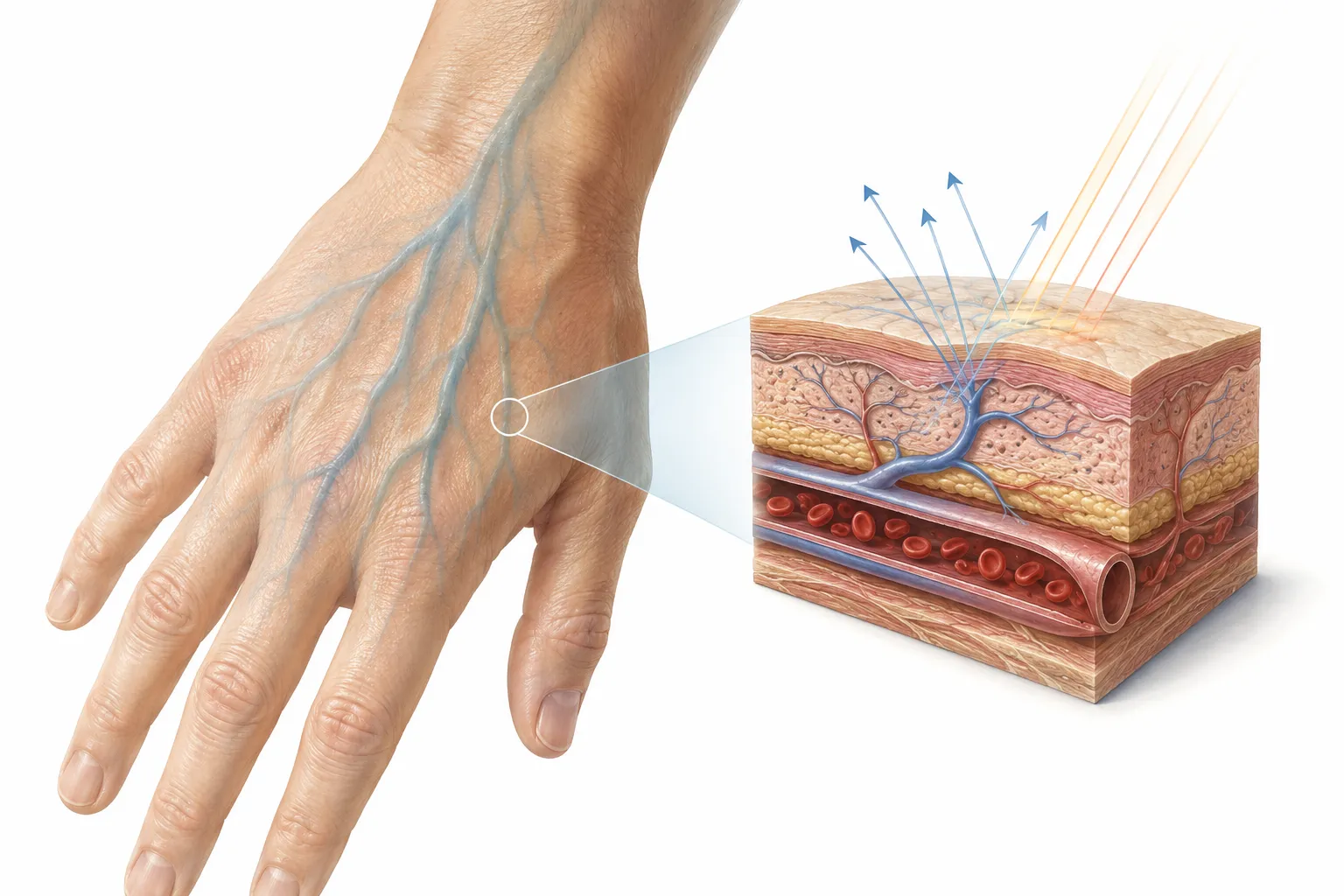
- 1Light hits the skin
Not all light behaves the same once it enters tissue.
- 2Red wavelengths penetrate deep and get absorbed
Deep-traveling red light rarely makes it back to your eye.
- 3Blue wavelengths scatter back near the surface
The vein appears blue because blue light survives the round trip better than red does.
How it works
The mechanism
Vein color is produced by differential light penetration and scattering through skin, not by any change in the blood's actual pigment.
- Step 01
Light hits the skin
Sunlight or ambient light contains a full spectrum of wavelengths that penetrate skin to varying depths.
Like different colored balls thrown into a pool, some sink deeper before bouncing back.
Not all light behaves the same once it enters tissue.
- Step 02
Red wavelengths penetrate deep and get absorbed
Red and longer wavelengths travel further into tissue, where blood and other structures absorb much of that light before it can scatter back out.
Like a long-range signal that fades out before it can return.
Deep-traveling red light rarely makes it back to your eye.
- Step 03
Blue wavelengths scatter back near the surface
Shorter blue wavelengths scatter more readily in the upper layers of skin and tissue surrounding the vein, sending more blue light back toward your eye.
Like a short-range echo that bounces back quickly and strongly.
The vein appears blue because blue light survives the round trip better than red does.
Surprises
Facts worth sitting with
In a 1996 study, researchers photographed veins of different depths and found the color shifted from blue to green to invisible depending purely on how far beneath the skin they sat, with the blood itself unchanged.
Surprising facts
What seems backwards
Worth comparing
In everyday life
Easy to get wrong
Pressure points
Where the simple answer gets interesting
If blood is never blue, why does the color myth persist in textbooks and diagrams?
Anatomical diagrams use blue and red as a color-coding convention to distinguish deoxygenated blood flowing to the lungs from oxygenated blood flowing to the body, purely for clarity. Over generations, many people absorbed that coding as a literal description of blood color rather than a visual shorthand.
A diagram meant to simplify anatomy accidentally became one of the most widespread biological misconceptions in modern science education.
Why do some veins look green instead of blue?
Green appears when a vein sits at a depth where a mix of blue and yellow-green wavelengths scatter back most efficiently, an effect strongly influenced by individual skin tone, thickness, and the exact depth of the vein.
The same underlying physics can produce a spectrum of visible colors depending on tiny anatomical differences from person to person.
Does blood ever actually look blue anywhere in nature?
Yes, in animals that use hemocyanin, a copper-based oxygen transport molecule, instead of hemoglobin. Horseshoe crab blood is genuinely, chemically blue because of the way copper binds oxygen and reflects light.
Human blue veins are an illusion, but a handful of animals have solved oxygen transport with a molecule that makes blue blood a chemical fact rather than an optical trick.
Behind the science
The story behind it
The 1996 vein-color depth study
Researchers investigating why vein color varied so much between people photographed veins at controlled, known depths beneath simulated skin layers and tracked exactly how the perceived color shifted with depth.
The study helped confirm quantitatively that vein color is a function of depth and light scattering rather than blood oxygenation, settling a debate that had lingered in both medical and popular explanations.
A question people assumed was already answered turned out to need careful measurement to resolve properly.
Controlled-depth skin and vein color modeling
By simulating veins at different depths beneath layers of skin-like material and measuring the light that scattered back, researchers demonstrated that color shifts from blue to green to invisible as depth changes, with no change to the simulated blood itself.
Depth alone, independent of any property of the blood, was enough to fully explain the range of vein colors people report seeing.
Clarify
Myth and reality
Myth
Deoxygenated blood is blue and turns red the instant it's exposed to air or oxygen.
Reality
Deoxygenated blood is dark red at all times, inside and outside the body. There is no color change caused by air exposure; any color change is subtle and due to oxygen binding to hemoglobin, not a blue-to-red transformation.
Evidence
Blood drawn for lab tests from veins is visibly dark red before it's ever exposed to air, confirmed constantly in any hospital blood draw.
Looking closer
The deeper pattern
The blue vein illusion persists because a plausible-sounding explanation, 'blue blood turns red when exposed to oxygen', requires no further scrutiny once it's accepted.
One way to think about it
Explanations that resolve curiosity quickly and don't conflict with anything else you believe rarely get re-examined, even when they're wrong, because there's no friction pushing you to check them.
The most durable misconceptions aren't the wild ones. They're the reasonable-sounding ones that never get tested.
Limits
Where the explanation bends
Deep vein thrombosis and vein visibility.
Veins affected by clotting or inflammation can change in prominence and sometimes color intensity, but the underlying blue appearance is still governed by the same light-scattering physics, not a special property of the clot.
Even medical conditions that change how veins look are working within the same optical rules, not overriding them.
In daily life
What this helps you notice
Understanding that vein color is an optical effect, not a reflection of blood oxygenation, helps explain why doctors use pulse oximeters and blood tests rather than visual vein color to assess oxygen levels.
A pulse oximeter clipped to your finger measures oxygen saturation using light absorption through actual tissue, a far more precise method than anything the human eye could judge from vein color alone.
Remember
Key takeaways
- 1
Blood is never blue inside the human body; it ranges from bright red to dark red depending on oxygen level.
- 2
Veins appear blue because of how skin scatters light, letting blue wavelengths bounce back while absorbing red ones.
- 3
Vein color depends heavily on depth beneath the skin, which is why the same person can have blue, green, or invisible veins in different spots.
- 4
A handful of animals, like horseshoe crabs, do have genuinely blue blood due to a copper-based oxygen carrier.
- 5
The red-blue color coding in anatomy textbooks is a teaching convention, not a literal description of blood color.
Your veins have never once carried blue blood, yet you've spent your entire life looking at genuine physical proof that they do.
Every time you glance at your wrist, you're not looking at your blood. You're looking at light that gave up trying to show you the truth and settled for the nearest color it could manage.
Read around the idea
More questions with the same curious pull
Nearby doors from the TinyThat archive, chosen by topic, intent, and reader curiosity.
Body & Brain
Can the Brain Feel Pain?
The brain controls all pain in your body, yet it cannot feel pain itself. Discover why, and what this strange fact re...
Body & Brain
Does Your Brain Eat Itself?
Your brain really does consume parts of itself. Learn about autophagy, synaptic pruning, and why self-consumption is...

Body & Brain
Why Does Brain Fog Happen?
Brain fog is not imaginary. Learn what actually causes that thick, cloudy feeling in your head and what science says...