A standard eye drop contains roughly three times more fluid than the eye can physically hold, meaning most of the dose is waste by design.
Body & Brain
How do eye drops actually work?
How Eye Drops Work
You tilt your head back, squeeze a drop into your eye, and blink. Thirty seconds later you can taste it in the back of your throat. Something has gone somewhere it was never supposed to go.
On this page
The short answer
Eye drops work by depositing a drug onto the ocular surface, from which it must penetrate the cornea to reach internal eye structures. Most of the drop washes away through the nasolacrimal duct, which is why you can taste it.
When a drop lands on the eye, it joins the tear film. The eye can hold approximately seven to ten microliters of fluid. A standard drop contains about thirty microliters, meaning most of it immediately overflows and drains through the puncta, tiny holes in the inner corners of the eyelids, down the nasolacrimal duct, and into the back of the throat. The remaining drug must cross the cornea, a selective barrier with tight cellular junctions, to reach the anterior chamber where most ocular conditions are treated.
At a glance
The eye can hold only a fraction of a standard drop.
Eye drops stay in the eye and work locally.
The eye is extraordinarily well-defended against anything entering it, including the medication you are deliberately trying to put there. Understanding the obstacles is more interesting than the solution.
Imagine trying to post a letter through a door with a self-closing brass flap, strong springs, and a wind machine installed specifically to blow letters away. That is the eye's relationship with your eye drop.
Diagram
How Eye Drops Work: the idea in one diagram
An eye drop must land on the tear film, survive overflow and blinking, avoid rapid drainage, and cross the cornea's layered chemical barriers before it can treat internal eye tissue.
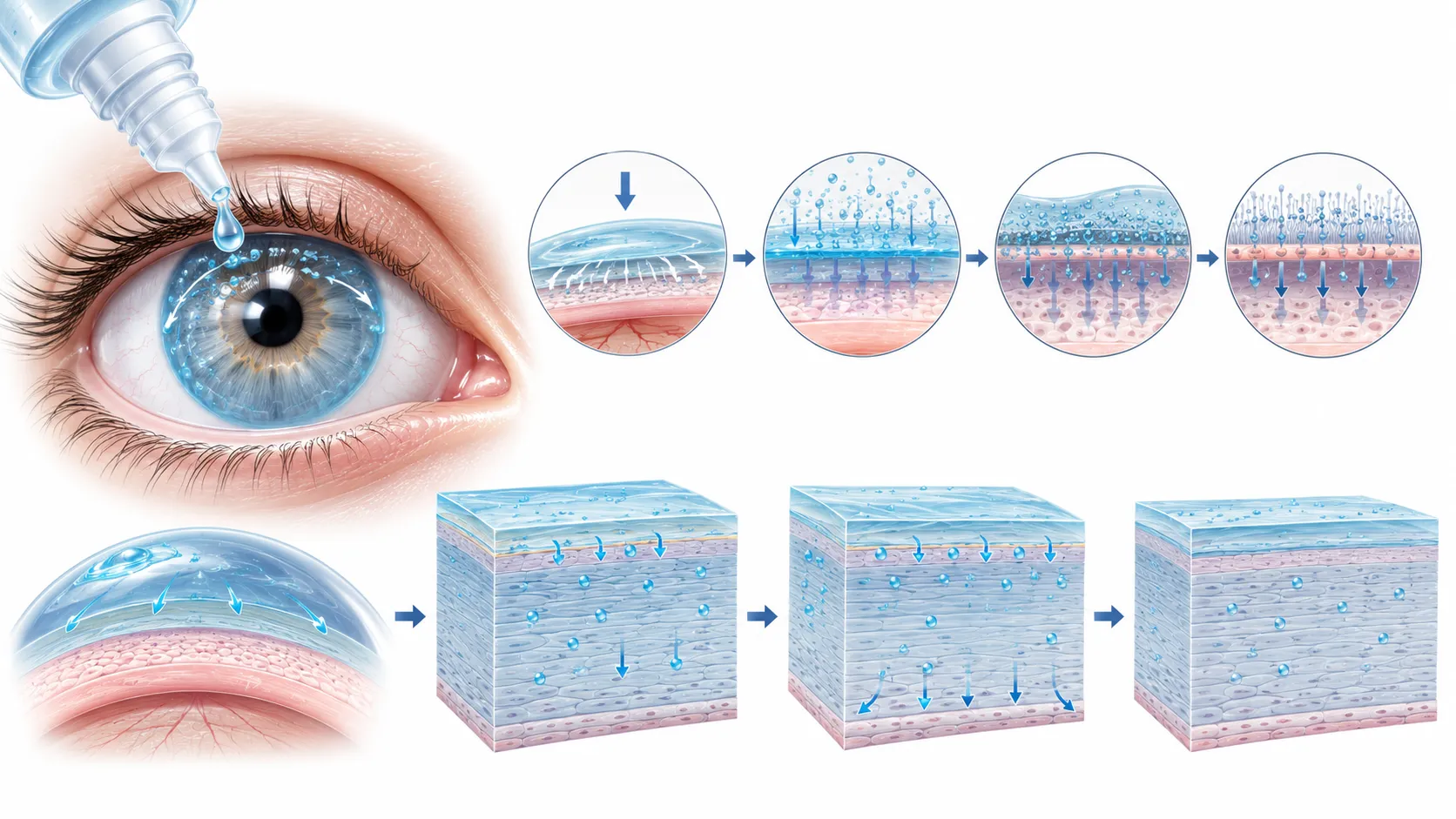
- 1The drop lands on the tear film
The eye can hold only a fraction of a standard drop.
- 2Most fluid drains away
Drainage explains both waste and the bitter throat taste.
- 3The drug crosses the cornea
Eye drop chemistry determines how much reaches the target.
How it works
The mechanism
An eye drop must land on the tear film, survive overflow and blinking, avoid rapid drainage, and cross the cornea's layered chemical barriers before it can treat internal eye tissue.
- Step 01
The drop lands on the tear film
The medication first mixes with the thin tear layer covering the cornea and conjunctiva.
A bucket of water poured onto a small sponge.
The eye can hold only a fraction of a standard drop.
- Step 02
Most fluid drains away
Extra fluid overflows or passes through the puncta into the nasolacrimal duct, then toward the nose and throat.
A sink with an open drain beside the target.
Drainage explains both waste and the bitter throat taste.
- Step 03
The drug crosses the cornea
The remaining drug must pass through lipid-loving and water-loving corneal layers in sequence.
Three passport checks with different entry rules.
Eye drop chemistry determines how much reaches the target.
Surprises
Facts worth sitting with
A standard eye drop contains roughly three times more fluid than the eye can physically hold, meaning most of the dose is waste by design.
Surprising facts
What seems backwards
Worth comparing
In everyday life
Easy to get wrong
Pressure points
Where the simple answer gets interesting
Why do eye drops taste in your throat?
Because the nasolacrimal duct, the drainage channel for tears and excess ocular fluid, empties into the nasal passage, which connects to the throat. Drug absorbed through the highly vascular nasal mucosa reaches the bloodstream, and drug that travels further reaches taste receptor areas in the posterior nasal and pharyngeal space.
The eye, the nose, and the throat are pharmacologically connected in a way most people never realize until they taste their own eye drops.
Why is the cornea such an effective drug barrier?
The cornea has three main layers with different chemical properties. The outer epithelium is lipophilic, preferring fat-soluble compounds. The middle stroma is hydrophilic, preferring water-soluble ones. The inner endothelium is lipophilic again. A drug must have the right balance of fat-solubility and water-solubility to cross all three layers in sequence.
The cornea has essentially evolved a passport control that checks lipid and water solubility at three separate checkpoints.
Could you ever design a drop that gets more than five percent into the eye?
Yes, and this is an active area of pharmaceutical research. Viscosity-enhancing agents slow drainage. Nanoparticle carriers improve corneal penetration. Mucoadhesive polymers help the drop stick to the ocular surface longer. Contact lens-based delivery systems that sit on the eye and release drug slowly have shown dramatically higher bioavailability in clinical trials.
The entire field of ocular drug delivery is essentially a multi-billion dollar engineering effort to outmaneuver an evolutionary mechanism the eye developed to expel foreign substances.
Behind the science
The story behind it
The Glaucoma Treatment That Changed Cardiology
When timolol, a beta-blocker, was introduced as an eye drop for glaucoma in the late 1970s, ophthalmologists began reporting unexpected cardiovascular and respiratory side effects. Patients were experiencing bradycardia and bronchospasm from a drug applied topically to the eye.
It demonstrated that the eye is not pharmacologically isolated from the rest of the body and forced a revision of how systemic absorption from eye drops was monitored.
A drug delivery route that seemed local turned out to be systemic, and the consequences were severe enough to change prescribing practice.
Nasolacrimal occlusion studies, 1970s and 1980s
Researchers demonstrated that pressing gently on the puncta after instilling eye drops significantly reduced systemic absorption and measurably increased the drug's duration in the eye.
A technique requiring no additional equipment or medication, just a finger pressed to the inner eye corner for two minutes, could double or triple the effective dose reaching the target tissue.
Clarify
Myth and reality
Myth
Eye drops stay in the eye and work locally.
Reality
A significant fraction of most eye drop doses enters the systemic circulation via nasolacrimal drainage, meaning eye drops can produce body-wide drug effects.
Evidence
Measurable plasma concentrations of eye drop drugs have been documented for beta-blockers, prostaglandin analogues, and antibiotics following standard topical instillation.
Myth
Using more drops more often improves treatment.
Reality
Exceeding recommended drop frequency rarely improves therapeutic effect and may increase systemic side effects by delivering more drug to the nasolacrimal drainage system.
Evidence
Corneal uptake reaches saturation quickly. Additional drops simply pass through drainage channels rather than penetrating ocular tissue.
Looking closer
The deeper pattern
Eye drop pharmacology illustrates a principle that applies far beyond medicine: the most direct route is rarely the most efficient one, and the target's own defenses often work against the very interventions meant to help it.
One way to think about it
The eye's elaborate defense systems, the tear film, the drainage ducts, the corneal barriers, all evolved to exclude foreign material. Medicine cannot simply override these systems. It must negotiate with them.
Effective intervention requires understanding a system's defenses well enough to work with them rather than against them.
Limits
Where the explanation bends
Eye drops in pediatric patients.
Because children have lower body weights, the proportion of a systemically absorbed eye drop dose relative to body mass is much higher than in adults.
The same drop that is unremarkable in an adult glaucoma patient becomes a dosing challenge in a child, simply because the systemic compartment is so much smaller.
In daily life
What this helps you notice
The simple technique of punctal occlusion, pressing on the inner corner of the eye for one to two minutes after instilling drops, meaningfully improves the efficacy of glaucoma and other long-term ocular medications while reducing systemic side effects.
Studies have shown punctal occlusion reduces systemic timolol absorption by up to 70 percent, potentially eliminating systemic side effects in sensitive patients while maintaining therapeutic intraocular pressure control.
Remember
Key takeaways
- 1
A standard eye drop is about three times larger than the eye can hold, so most overflows immediately.
- 2
Less than five percent of a typical eye drop reaches its target tissue inside the eye.
- 3
Drug draining through the nasolacrimal duct enters the bloodstream and can cause systemic side effects.
- 4
Pressing on the inner eye corner for two minutes after drops dramatically improves their effectiveness.
- 5
Eye drop drug chemistry must be calibrated to cross the cornea's triple-layer lipid-hydrophilic-lipid barrier.
The eye drop is perhaps the most inefficient drug delivery system in modern medicine, and medicine has known this for decades without finding a significantly better alternative for most patients.
You tilt your head, squeeze the bottle, and the eye does what it has always done: it tries to expel the foreign substance with all the biological enthusiasm evolution gave it. Medicine has learned to work around this. Mostly.
Read around the idea
More questions with the same curious pull
Nearby doors from the TinyThat archive, chosen by topic, intent, and reader curiosity.
Body & Brain
How the Eye Works
The eye converts light into electrical signals through a sophisticated optical and cellular system.
Body & Brain
Can the Brain Feel Pain?
The brain controls all pain in your body, yet it cannot feel pain itself. Discover why, and what this strange fact re...
Body & Brain
Does Your Brain Eat Itself?
Your brain really does consume parts of itself. Learn about autophagy, synaptic pruning, and why self-consumption is...