Visual answer
Why Raindrops Only Return Specific Colors to Your Eyes at Specific Angles
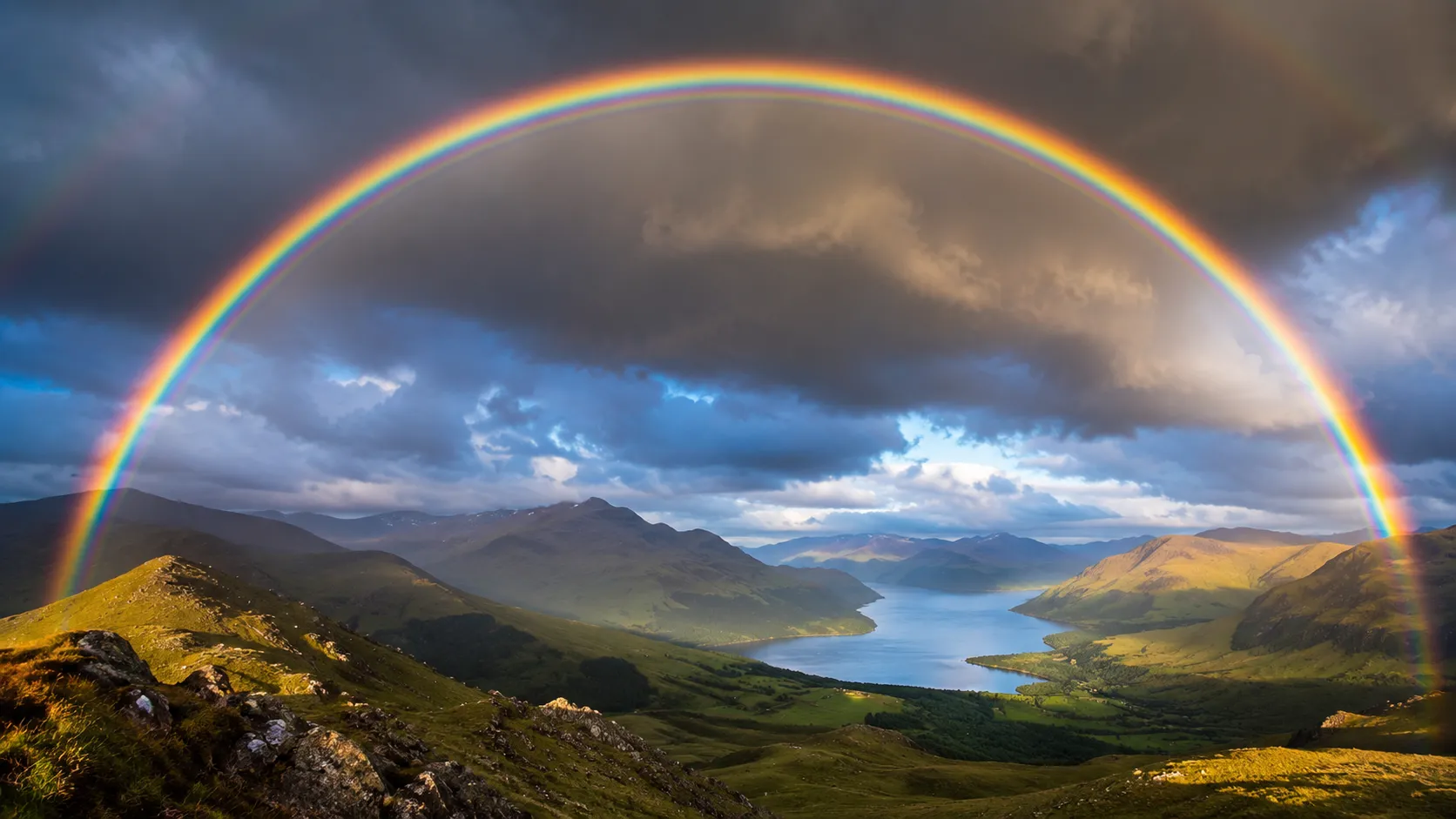
The geometry that forces every rainbow to be a circular arc centered on the antisolar point.
Light enters the raindrop and refracts
White sunlight hits the curved front surface of a raindrop. Different wavelengths (colors) refract at slightly different angles because the refractive index of water varies with wavelength.
Light reflects off the back of the drop
The separated colors reflect off the inside back surface of the spherical drop, staying inside the water. About 4 to 5 percent of light exits the back as a transmitted beam; the rest reflects.
Light exits at a specific angle for each color
The refracted and reflected light exits through the front of the drop. Due to the spherical geometry and the refractive properties of water, red exits at about 42 degrees and violet at about 40 degrees from the incoming light direction.
Only drops at the exact angle reach your eye
For red to reach your eye, the raindrop must be at exactly 42 degrees from your line to the antisolar point. All such drops form a circle around that point at that angle, creating the circular arc.
The antisolar point
The Shape of Every Rainbow Is a Consequence of Spherical Geometry
The antisolar point is always directly opposite the sun from your perspective. To find it, draw an imaginary line from the sun, through your head, and out the other side. That endpoint is the center of every rainbow you will ever see. Rainbows are always centered on this point, which is why the antisolar point is always below the horizon when the sun is above it, meaning you can only see the upper portion of the circle.
The radius of the arc is fixed at 42 degrees for the primary rainbow. This never changes because it is determined by the refractive index of water, which is a physical constant. You cannot see a rainbow of a different size or at a different angle from a rain shower because those geometric conditions do not exist for water.
Moonbows, which are rainbows produced by moonlight rather than sunlight, exist and have been photographed. They follow identical geometry and the same 42-degree rule. They appear white or very pale to the human eye because moonlight is too dim to activate color vision effectively, but long-exposure photographs reveal full color.
Myth vs reality
Myth vs Reality
What people think
Rainbows exist in the sky like physical objects
Rainbows have no fixed location. They are an optical phenomenon that appears at a specific angle relative to each individual observer. The drops forming your rainbow are different drops from those forming anyone else's rainbow, even if you are standing next to each other.
What actually happens
A rainbow is a personal optical experience produced in your line of sight
The rainbow is generated specifically for your viewpoint by the geometry of sunlight, your eye position, and the position of the water drops. Change your viewpoint by even a few feet and you are seeing a slightly different set of drops arranged at the required angle.
Quick answers
Common questions
Why does the sky inside a rainbow look brighter? +
Light that reflects once inside a raindrop exits in a range of angles below 42 degrees, not just at the rainbow angle. This scattered light fills the area inside the arc with diffuse illumination, making the interior look noticeably brighter than the sky outside the arc.
Why are the colors always in the same order? +
The order is fixed by the refractive index of water for each wavelength of light. Red refracts least and exits at the widest angle (42 degrees). Violet refracts most and exits at the narrowest angle (40 degrees). This always places red on the outside and violet on the inside.
Can you see a rainbow at noon? +
No. For a rainbow to be visible, the sun must be below 42 degrees above the horizon. If the sun is higher than 42 degrees, the 42-degree rainbow arc falls entirely below the horizon and is invisible from the ground. Rainbows are typically visible only in early morning or late afternoon.
What is a fogbow? +
A fogbow is produced by tiny fog droplets instead of raindrops. Because fog droplets are much smaller than raindrops, diffraction effects dominate over refraction and the colors blur together, producing a white or faintly colored arc slightly wider than a standard rainbow.
Why does the secondary rainbow have reversed colors? +
The secondary rainbow forms from light that reflects twice inside each raindrop before exiting. This second reflection reverses the geometry and the exit angles, placing red on the inside and violet on the outside, the opposite of the primary rainbow.