HIDDEN ORIGINS

Why Is It Called Murphy's Law?

The most famous law of pessimism in the English language was born out of one engineer's bad afternoon, not centuries of folk wisdom.

Illustration of Edward Murphy and a rocket sled experiment
Named After Edward A. Murphy Jr.Country United StatesYear 1949Category Eponym

QUICK ANSWER

Here is the origin in plain English.

Murphy's Law is named after Edward A. Murphy Jr., a U.S. Air Force engineer working on rocket sled experiments in 1949. When a set of sensors was wired backward by a technician, Murphy snapped that if there was a way to do something wrong, that technician would find it. A colleague turned the complaint into a general rule, and the name stuck.

THE STORY

The hidden story behind the word

01

The Hidden Story

Imagine being so annoyed for one afternoon that your name ends up describing the universe's general attitude toward human effort.

That, more or less, is what happened to Edward Murphy.

He was not a philosopher, and he was certainly not trying to coin a phrase that would outlive him by eighty years and counting. He was an engineer having a thoroughly bad day at an Air Force base in California, watching an expensive experiment fail because of a simple, avoidable wiring mistake.

Out of sheer frustration came a sentence. Out of that sentence came a law that now governs toast, traffic, Wi-Fi, and printers everywhere.

02

Who Was Edward Murphy?

Edward A. Murphy Jr.

Edward Murphy was an American aerospace engineer working on a 1949 U.S. Air Force project that tested how much sudden deceleration the human body could survive, using a rocket-propelled sled at Edwards Air Force Base.

Murphy had designed a set of sensors meant to measure the forces acting on the test subject, a flight surgeon named John Stapp. A technician wired every single sensor backward, so the entire set of readings came back useless.

Murphy, by most accounts not a patient man that day, remarked that if there was any way the technician could wire it wrong, he would. It was a complaint about one specific person, not a statement about the universe.

03

How His Name Became a Law

John Stapp, the flight surgeon who had just survived the rocket sled test, repeated Murphy's complaint at a press conference, but reshaped it into something punchier and more universal.

Stapp called it 'Murphy's Law' and phrased it as 'if there's more than one way to do a job, and one of those ways will result in disaster, then somebody will do it that way,' which journalists and engineers then sanded down further into the version everyone knows today.

The phrase spread through engineering culture first, then leapt into everyday speech, detaching almost completely from the specific rocket sled and the specific wiring mistake that started it all.

  1. 1949 A wiring error ruins Murphy's rocket sled experiment.
  2. Press Conference John Stapp names and rephrases the complaint.
  3. Engineering Culture The phrase spreads through aerospace and safety circles.
  4. Everyday Speech Murphy's Law becomes general shorthand for bad luck.
TIMELINE

Timeline

1918

Edward Murphy is born.

1949

The rocket sled wiring incident occurs.

1949

John Stapp names it 'Murphy's Law' publicly.

1950s

The phrase spreads through engineering and pop culture.

MEANING TODAY

What Does Murphy's Law Mean Today?

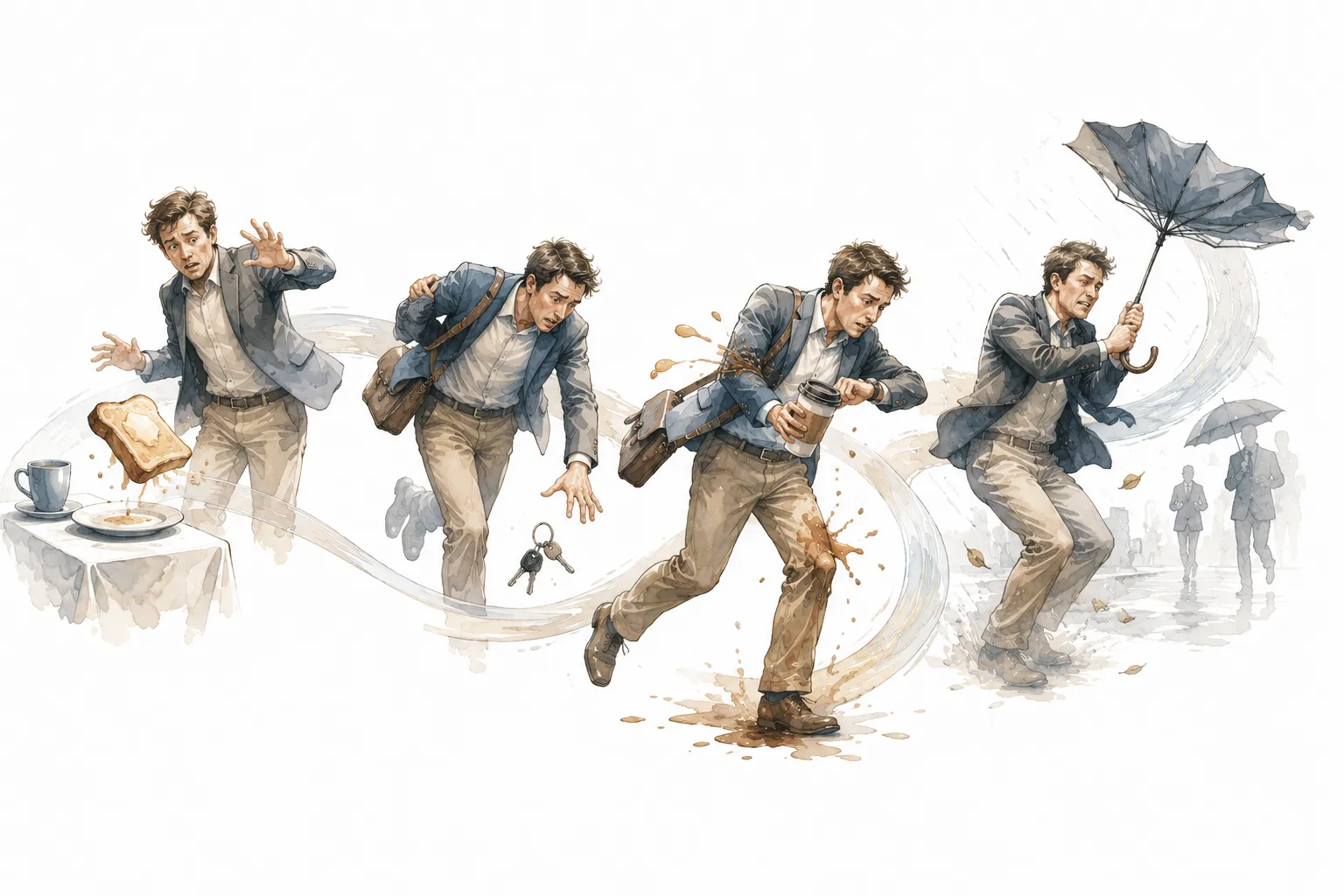
Murphy's Law is the humorous belief that if something can possibly go wrong, it eventually will.

Today the phrase has drifted a long way from rocket sleds and sensor wiring.

People invoke Murphy's Law when their flight gets delayed the one day they cannot afford it, when the printer jams right before a deadline, or when the only open lane at the grocery store grinds to a halt the second they join it.

It is less a scientific law and more a shared joke about how often life seems to time its inconveniences perfectly.

IN THE WILD

Examples You'll Recognize

Travel

Of course it started raining the moment we left the umbrella at home - Murphy's Law.

Used to describe an unlucky coincidence that feels almost inevitable in hindsight.

Technology

My laptop only freezes during important video calls. Murphy's Law strikes again.

A wry acknowledgment that technical failures seem to arrive at the worst possible moment.

Everyday

We brought a spare tire just in case Murphy's Law decided to show up.

Preparing in advance for the kind of bad luck the phrase has come to represent.

Did You Know?

  • Edward Murphy reportedly disliked how the phrase was rephrased and felt his original point had been distorted.
  • John Stapp, who survived the rocket sled tests, became known as 'the fastest man on Earth' after one record-breaking run.
  • Engineers sometimes use Murphy's Law seriously, as a design principle: build systems assuming someone, somewhere, will eventually use them incorrectly.

COMMON MISUNDERSTANDINGS

Common Misunderstandings

Murphy's Law is an ancient proverb.

It dates only to 1949 and traces to one specific, documented incident.

Murphy himself invented the famous phrasing.

Murphy made a narrower complaint about one technician; John Stapp generalized and popularized it.

TinyThat Insight

Most folk wisdom develops slowly over generations with no clear author. Murphy's Law is unusual because we know the exact afternoon, the exact project, and the exact grumpy sentence that started it.

FAQ

Quick answers to common questions.

Who was Murphy in Murphy's Law?

Edward A. Murphy Jr., a U.S. Air Force engineer who made the original remark in 1949 during a rocket sled experiment.

Is Murphy's Law a real scientific law?

No. It is a humorous folk principle, not a tested or provable scientific law.

What is the original wording of Murphy's Law?

John Stapp's version was that if there is a disastrous way to do a job, someone will eventually do it that way; this was later simplified into 'anything that can go wrong, will go wrong.'

Did Edward Murphy like having the law named after him?

By most accounts, he felt the popular phrasing distorted his original, more specific complaint.