01The Hidden Story
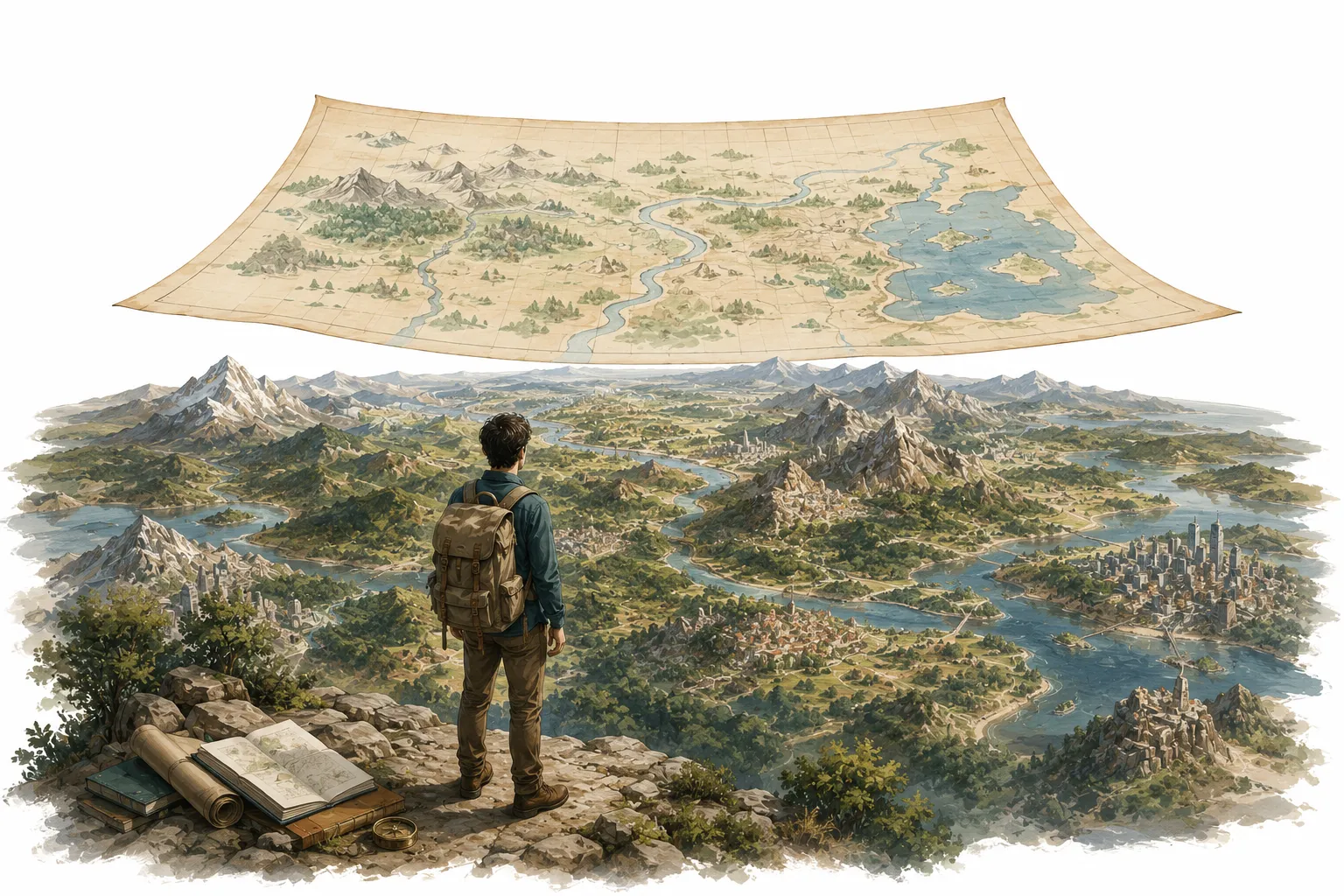
Imagine spending a career trying to fix how badly humans confuse their descriptions of the world with the world itself, and boiling the whole argument down to one sentence about paper maps.
That is what Alfred Korzybski set out to do.
Korzybski was troubled by how often people treated labels, categories, and abstractions as though they were the actual things being described. A word is not the object. A diagnosis is not the patient. A map, however detailed, is not the land it represents.
Rather than write an entire academic argument every time the confusion came up, he gave the world a single durable image: unfold the map all you like, you will never get your boots wet.
Who Was Alfred Korzybski?
Alfred Korzybski
Alfred Korzybski was a Polish-American independent scholar best known for founding the field of general semantics, which studies how language and abstraction shape human thought and behavior.
He introduced the phrase 'the map is not the territory' in his 1931 paper and later developed it further in his 1933 book 'Science and Sanity.'
Korzybski argued that much human conflict and confusion stems from mistaking our mental models, categories, and words for the reality they only ever partially represent.
How His Idea Became a Phrase
Korzybski's broader work in general semantics was dense and academic, but this one phrase proved instantly graspable: everyone understands that a paper map can never fully capture a real landscape.
The metaphor spread first through philosophy and linguistics, then into psychology, business strategy, and self-help writing, wherever people needed a quick way to caution against overconfident models.
It later became a foundational idea in fields like systems thinking and even artificial intelligence, where the gap between a model and the reality it represents is a constant, practical concern.
- 1931 Korzybski introduces the phrase in an academic paper.
- 1933 'Science and Sanity' expands the idea further.
- Mid-1900s The phrase spreads through philosophy and psychology.
- Modern Use It becomes a standard caution in business, science, and AI.