Science & Discovery

Why Was Penicillin Such a Breakthrough?

Before 1940, a scratch could kill you. After 1943, it almost certainly wouldn't. A contaminated petri dish revealed a mold that killed bacteria. Turning that observation into medicine took more than a decade.

Quick answer

Penicillin was the first widely useful antibiotic: a drug that could kill bacteria inside the body without killing the patient. The discovery was famous, but the breakthrough required the Oxford team that purified and produced it.
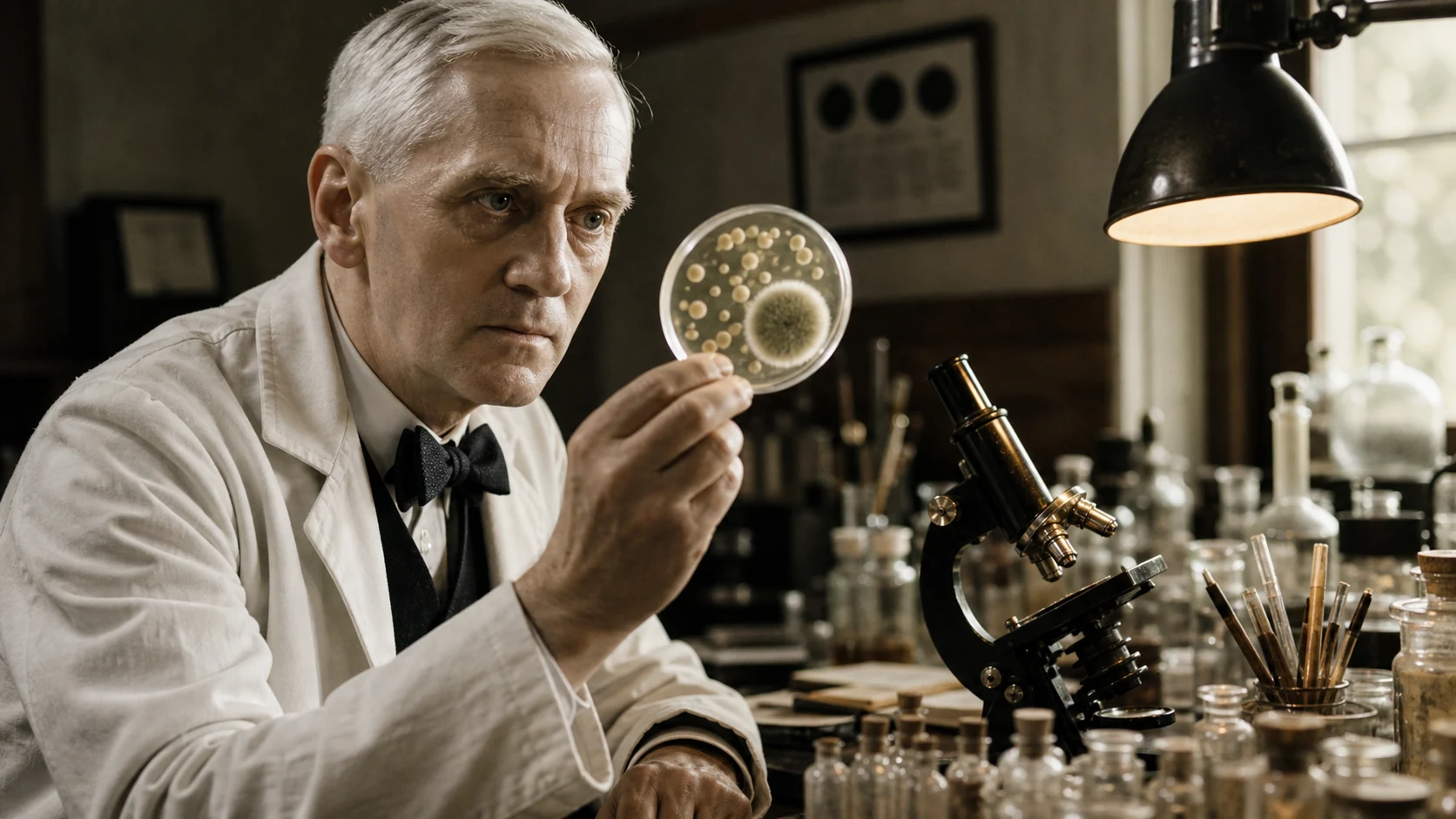
Why Was Penicillin Such a Breakthrough? hero image

The hook

Fleming observed the antibacterial mold in 1928.

The hidden mechanism

Florey and Chain made penicillin medically usable in the 1940s.

The twist

It targets bacterial cell walls, which human cells do not have.

Common mistake

Fleming did not immediately save the world by himself.

The Plate Fleming Almost Threw Away

Fleming noticed that bacteria had dissolved around a contaminating mold. Most failed plates are discarded; the breakthrough was noticing the empty zone before doing so.

He published in 1929, but could not purify penicillin into a stable medicine. The observation was real, but medicine had not yet arrived.

The Team That Made It Work

Howard Florey, Ernst Chain, and colleagues at Oxford turned penicillin from a laboratory curiosity into an injectable treatment.

The first dramatic human case showed both success and scarcity: the patient improved, the supply ran out, and he died. The drug worked; production had not caught up.

Why Penicillin Kills Bacteria Without Killing Us

Its power comes from selective toxicity.

1

Target the wall

Penicillin blocks enzymes bacteria use to build peptidoglycan cell walls.

2

Spare human cells

Human cells lack peptidoglycan walls, so the target is absent in us.

3

Fail against viruses

Viruses do not have bacterial cell walls, which is why antibiotics do not treat colds or flu.

The Deeper Change: Medicine Could Attempt More

Antibiotics made surgery, childbirth, wound care, and pneumonia treatment dramatically safer.

They also created selection pressure for resistance, a problem Fleming warned about early.

The Common Misunderstanding

Myth

Fleming discovered penicillin and immediately saved countless lives.

It is an easy explanation because it makes the story simpler than it really was.

Reality

Discovery, purification, testing, and mass production were separate stages spread across about fifteen years.

The real explanation is more interesting because it shows the system, pressure, and tradeoffs behind the event.

Why It Mattered

Immediate effect
Previously lethal infections became treatable.
Long-term effect
Modern surgery depends on antibiotic protection.
Modern echo
Antibiotic resistance is the shadow cast by antibiotic success.
Best way to remember it
Penicillin mattered because mold had evolved a bacterial weapon, and humans finally learned how to use it safely.

Worth noting

Key Takeaway

Penicillin mattered because mold had evolved a bacterial weapon, and humans finally learned how to use it safely.

Quick answers

Common questions

Why can't antibiotics treat viruses?

They target bacterial structures and processes that viruses do not have.

How does resistance happen?

Bacteria with resistance mutations survive antibiotic exposure and reproduce, spreading the trait.