Art & Mystery

Why Is the Mona Lisa Smiling?

The most analyzed expression in human history still has no agreed answer. That might be exactly the point. Millions of people travel to the Louvre every year to see a painting smaller than a typical laptop screen, behind bulletproof glass, viewed through a crowd of smartphones. Most people are surprised by how small it is. Almost none can say exactly what the expression means. That confusion is five centuries old. And it may be the greatest artistic achievement in the history of portraiture. The smile is not a mystery because we lack information. It is a mystery because Leonardo engineered it to be one.

Quick answer

The Mona Lisa's smile is ambiguous by design. Leonardo used sfumato - blurred transitions especially around the mouth - so the expression shifts depending on focus, angle, and light. Neuroscientists have confirmed that the smile triggers the same kind of processing loop as reading an ambiguous social situation in real life.
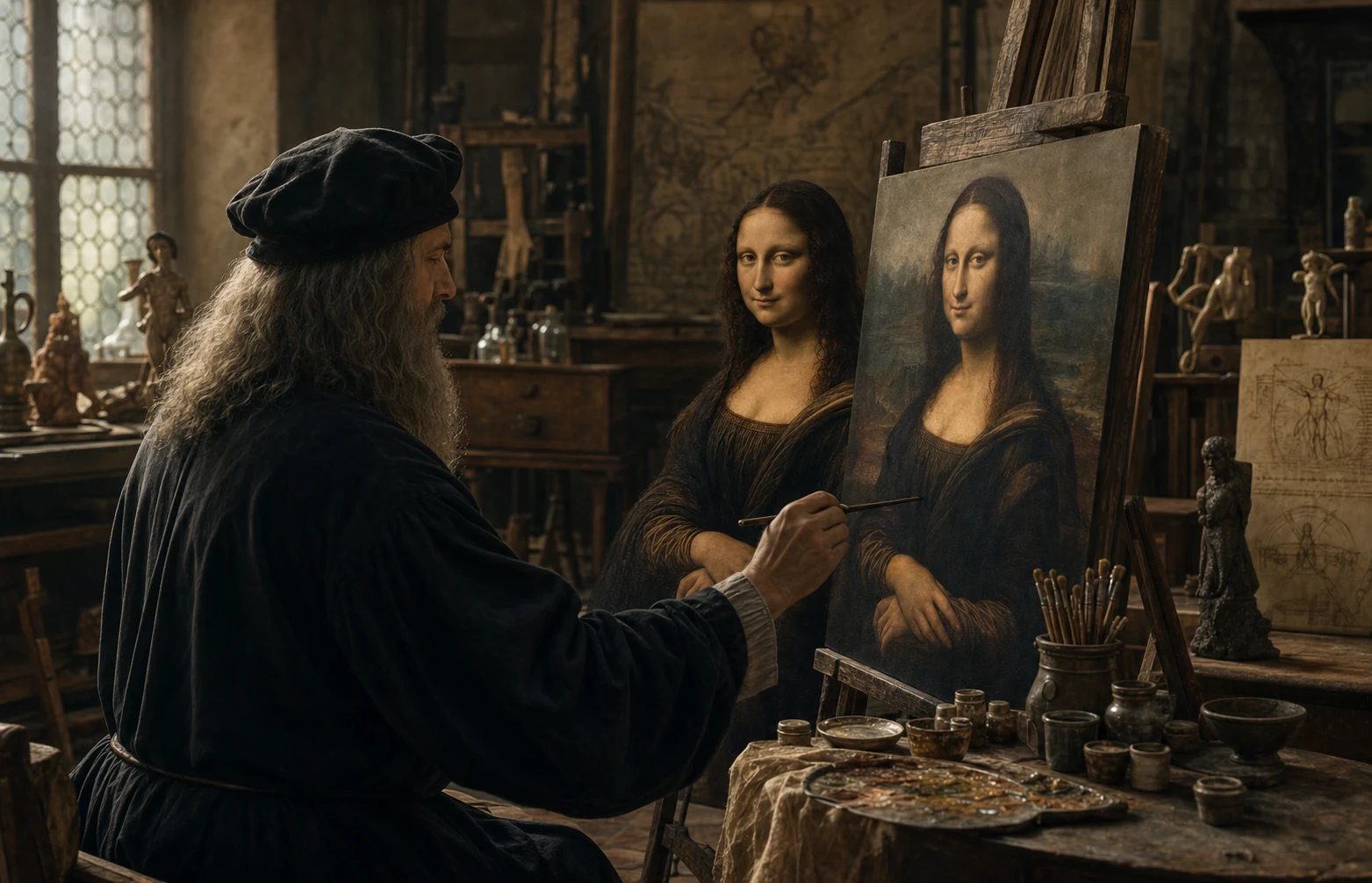
Why Is the Mona Lisa Smiling? hero image

The mystery

The smile is not a mystery because we lack information. It is a mystery because Leonardo engineered it to be one.

The short answer

The Mona Lisa's smile is ambiguous by design. Leonardo used sfumato - blurred transitions especially around the mouth - so the expression shifts depending on focus, angle, and light.

The twist

Neuroscientists have confirmed that the smile triggers the same kind of processing loop as reading an ambiguous social situation in real life.

Common mistake

Many people assume the Mona Lisa has been the world's most famous painting since Leonardo finished it.

The smile that moves

The Mona Lisa was probably painted between 1503 and 1519. The subject is almost certainly Lisa Gherardini, wife of Francesco del Giocondo. Leonardo never delivered the painting.

Sfumato: the technique of deliberate smoke

Sfumato comes from the Italian word for smoke. Leonardo layered ultra-thin glazes to create transitions between light and shadow with no hard edges. He eliminated outlines, especially around the mouth and eyes.

Those are exactly the areas the human visual system reads first when judging emotion. By making them ambiguous, Leonardo made the expression impossible to settle.

The smile is blurry on purpose, in a painting that is precise about almost everything else.

The fovea effect: why the smile disappears when you stare

Central vision is sharp but poor at reading soft shadow. Peripheral vision is better at tonal changes. When you look directly at the smile, it seems more neutral. When you look elsewhere, your peripheral vision catches the shadow at the mouth and the smile returns.

Harvard neuroscientist Margaret Livingstone helped explain this in 2000: Leonardo had intuitively discovered a property of human vision that science would not formally describe for centuries.

The Mona Lisa's smile is the only smile in art history that disappears when you look at it directly.

What she might have actually felt

If the sitter was Lisa Gherardini, she was a young Florentine woman sitting for hours in a Renaissance studio. Some historians see a restrained social smile; others see new motherhood, fatigue, or a staged expression kept alive by musicians and entertainers Leonardo supposedly used for sitters.

Leonardo probably wanted all of these readings to remain possible.

She may simply be doing what any sitter does after three hours in a chair: trying not to look bored.

How the ambiguity was engineered

The mystery comes from technical choices stacked on top of one another.

1

01. Sfumato at the mouth corners

The smile's clearest cues are painted as blurred shadow with no line to resolve.

2

02. The eyes tell a different story

The eyes and mouth do not resolve into one obvious emotion, so the brain keeps trying.

3

03. The landscape distortion

The background horizon is subtly uneven, making the whole image feel gently unstable.

4

04. No eyebrows, no eyelashes

Removing strong social cues makes the face more mask-like and harder to read.

Why ambiguity is the point

Leonardo was obsessed with boundaries: smoke, water, hair, shadow, and anything that refuses to hold still. The Mona Lisa is his solution to painting motion in a still image.

We pay more attention to things we cannot quite resolve. A clear smile is read and dismissed. An ambiguous smile keeps you looking.

What you did not know about the most famous painting alive

It was stolen for two years
In 1911, Vincenzo Peruggia walked out of the Louvre with the painting. The theft helped turn it into a global celebrity.
It has been attacked multiple times
The painting has been hit with a rock, splashed with acid, pelted with paint, and struck with a teacup.
It was once in Napoleon's bedroom
Napoleon had it hung in his bedroom at the Tuileries Palace before it returned to the Louvre.

Wait, wasn't the smile always considered special?

Myth

Many people assume the Mona Lisa has been the world's most famous painting since Leonardo finished it.

Its fame feels so total and old that it is hard to imagine a time before it.

Reality

Its extraordinary public fame accelerated after the 1911 theft, which made the painting international news.

Its extraordinary public fame accelerated after the 1911 theft, which made the painting international news.

The smile in the real world

Facial recognition software
Emotion-recognition systems often disagree about the Mona Lisa, making it a useful test case for ambiguity.
Advertising
Slightly ambiguous expressions often hold attention longer than obvious happiness.

The painting that taught us how faces work

The Mona Lisa matters because it is one of the most sophisticated studies of human facial expression ever painted.

Every portrait since has had to face the same question: can a living expression be captured in a static image?

Worth noting

The smile that science still cannot settle

She is the most examined face in history, and still refuses to say definitively what she is feeling. She is the most examined face in history, and she is still not telling.

Quick answers

Common questions

Does the Mona Lisa really follow you with her eyes?

Yes, but almost any forward-facing portrait does this. The mouth is the truly unusual feature.

Has the painting changed color?

Yes. Yellowed varnish has shifted the surface toward golden-brown tones.