Everyday Science

Why Does Microwave Food Get Hot Unevenly?

The science behind the burning-hot edge and the frozen center that ruins everything. You heat a meal in the microwave, reach in, and discover that the outside is practically volcanic while the center is still cold. You put it back in. The center remains cold. The edges are now generating smoke. This is not a random failure. It is physics working exactly as it should, just not helpfully. The answer involves standing wave patterns, edge effects, and why rotating turntables exist despite not fully solving the problem.

Quick answer

Microwave food heats unevenly because microwaves form standing wave patterns inside the oven cavity, creating fixed hot and cold spots, while food edges and corners receive microwaves from multiple angles simultaneously and heat faster than central areas. The rotating turntable was specifically added to microwave ovens to address uneven heating, and it helps, but the fundamental standing wave problem means hot and cold spots can never be completely eliminated.
Why Does Microwave Food Get Hot Unevenly? hero image

The mystery

The answer involves standing wave patterns, edge effects, and why rotating turntables exist despite not fully solving the problem.

The short answer

Microwave food heats unevenly because microwaves form standing wave patterns inside the oven cavity, creating fixed hot and cold spots, while food edges and corners receive microwaves from multiple angles simultaneously and heat faster than central areas.

The twist

The rotating turntable was specifically added to microwave ovens to address uneven heating, and it helps, but the fundamental standing wave problem means hot and cold spots can never be completely eliminated.

Common mistake

Many assume heating longer will eventually produce even temperature throughout.

Standing waves create a map of hot and cold

A microwave oven's interior is less a uniform heating environment and more a complex landscape of varying energy intensity.

Microwaves bounce around and interfere with themselves

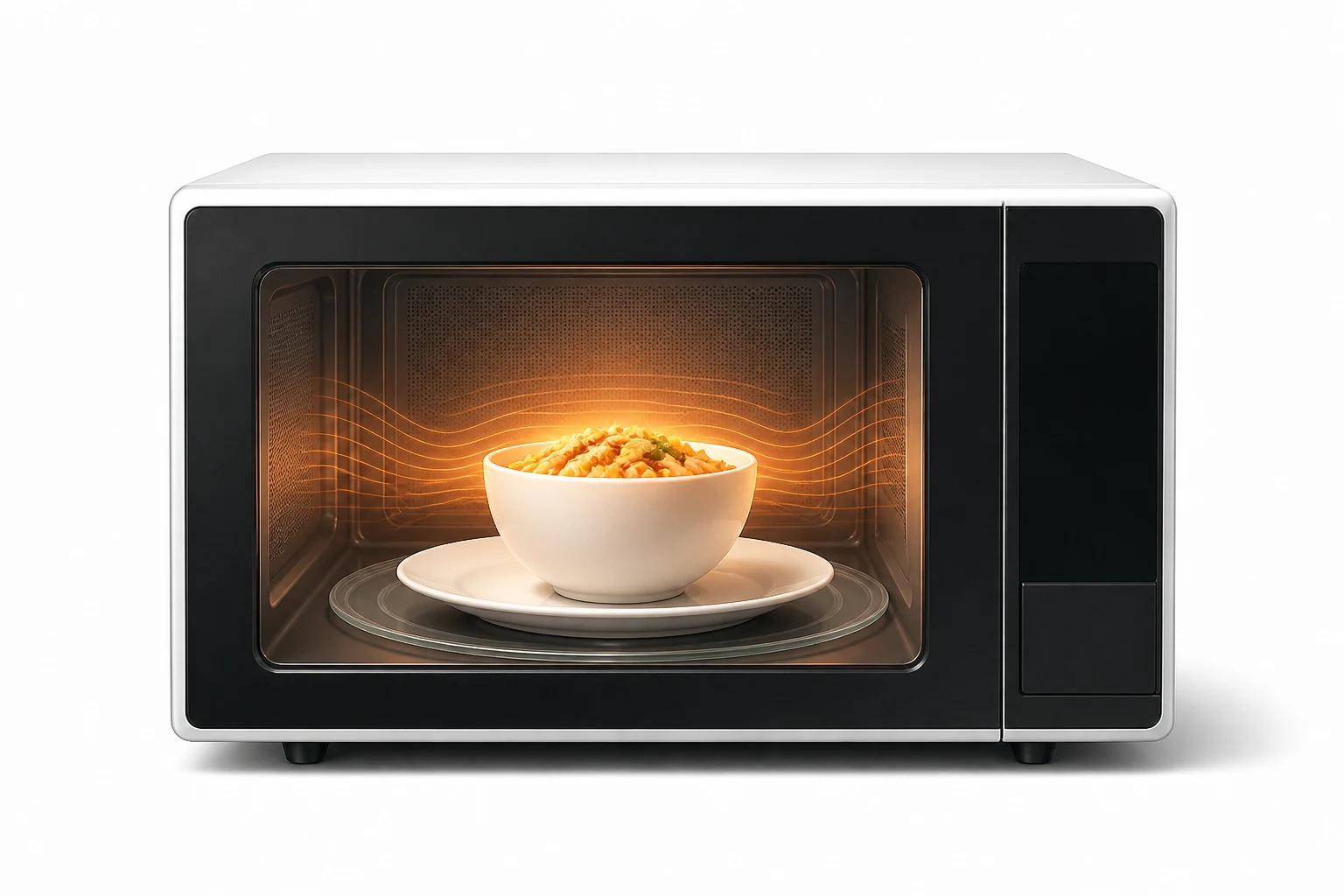
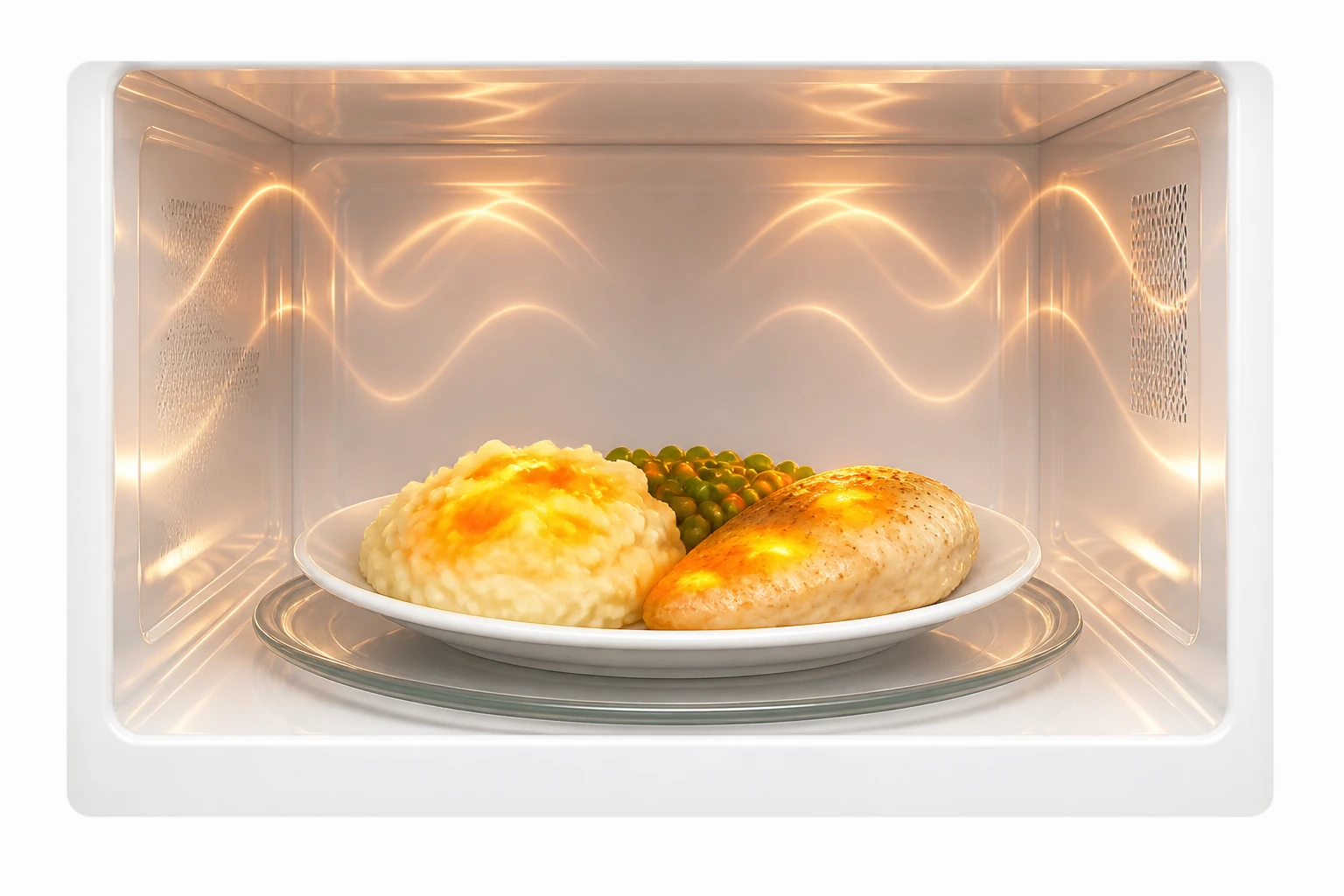
Inside a microwave, waves reflect off the metal walls and interfere with each other, creating standing wave patterns with fixed positions of high and low energy.

These nodes and antinodes produce predictable hot and cold spots in a stationary food item.

A microwave's interior is an invisible topography of energy peaks and valleys, and your food sits in it like a landscape.

Edges and corners receive energy from multiple directions

The outer edges of food can receive microwaves from multiple angles simultaneously, including reflection from nearby walls, receiving more total energy than the center.

Central areas receive primarily direct radiation without these reflected contributions.

The corner of your food is being heated from several directions at once while the middle waits for energy that is busy elsewhere.

The turntable helps but does not solve it

Rotating food continuously moves it through the standing wave pattern, averaging out exposure across the food's volume over time.

However, the spatial averaging is imperfect and the edge-versus-center geometry problem persists regardless of rotation.

The turntable is an honest attempt at a solution to a physics problem that does not have a clean engineering fix.

From microwave to uneven heat

A short sequence explains how a sealed metal box creates inconsistent heating.

1

01. Microwaves enter the oven cavity

Waves are emitted from the magnetron and fill the interior.

2

02. Reflected waves create standing patterns

Interference between direct and reflected waves produces fixed hot and cold zones.

3

03. Food edges receive more energy than centers

Geometric factors concentrate microwave energy at exterior surfaces.

4

04. The turntable averages but does not equalize

Rotation reduces but does not eliminate the hot/cold variation.

Why microwave ovens have not solved this yet

Perfectly uniform microwave heating would require either completely eliminating standing waves, which requires fundamental changes to cavity geometry, or using multiple frequencies simultaneously, which is technically complex and expensive.

Some commercial microwave ovens do use variable frequency or multiple emitter designs, but consumer models balance cost against heating uniformity differently.

Surprising microwave heating facts

Some microwaves do not have turntables
Some models use mode stirrers, rotating antenna-like elements that shift the standing wave pattern instead of moving the food.
Standing time helps distribute heat
Letting food rest after microwaving allows thermal conduction to equalize temperatures between hot and cold regions.

Does a longer microwave time guarantee even heating?

Myth

Many assume heating longer will eventually produce even temperature throughout.

More energy intuitively suggests more uniform distribution, but the spatial pattern of microwave energy does not work that way.

Reality

Longer heating intensifies hot spots before it equalizes cold ones - the standing wave pattern ensures this.

Longer heating intensifies hot spots before it equalizes cold ones - the standing wave pattern ensures this.

Where standing wave patterns matter

Wi-Fi dead spots
Radio waves from a Wi-Fi router reflect off walls and create standing wave interference patterns that produce strong and weak signal spots in a room.

Why this kitchen physics matters

Understanding standing waves explains both why microwaves heat unevenly and what practical steps actually help - resting food and stirring midway through cooking.

It also informs the design of microwave-safe containers intended to mitigate edge-heating through controlled geometry.

Worth noting

A physics lesson served lukewarm

Every unevenly heated microwave meal is a direct encounter with wave physics, geometry, and the limits of what a rotating plate can fix. The cold center of your microwaved soup is where wave physics decided to take a break.

Quick answers

Common questions

Does dish shape affect microwave heating uniformity?

Yes - round dishes produce somewhat more uniform heating than square ones because they reduce the corner-geometry problem.

Everyday Science

Related questions

Moisture near cold spots can still evaporate from hot regions conducted along the food surface while the interior remains cool.

The accidental inventor of the microwave

Percy Spencer

The Raytheon engineer who discovered microwave cooking accidentally in 1945 and developed it into a commercial product.

Where standing wave patterns matter

Wi-Fi dead spots

Radio waves from a Wi-Fi router reflect off walls and create standing wave interference patterns that produce strong and weak signal spots in a room.

Does a longer microwave time guarantee even heating?

Longer heating intensifies hot spots before it equalizes cold ones - the standing wave pattern ensures this.

Longer heating intensifies hot spots before it equalizes cold ones - the standing wave pattern ensures this.