Everyday Engineering

Why Does a Lock Open with a Key?

A mechanism so elegantly simple that it has barely changed in 4,000 years. Every day you push a small metal object into a cylinder, turn it, and gain access to a building, a vehicle, or a cabinet. The mechanism involved is so reliable that most people never think about it. The pin tumbler lock is one of humanity's most successful mechanical designs - and understanding it makes the humble act of unlocking a door feel considerably more interesting. The answer involves spring-loaded pins, a shear line, and a design so effective that an ancient Egyptian version worked on essentially identical principles.

Quick answer

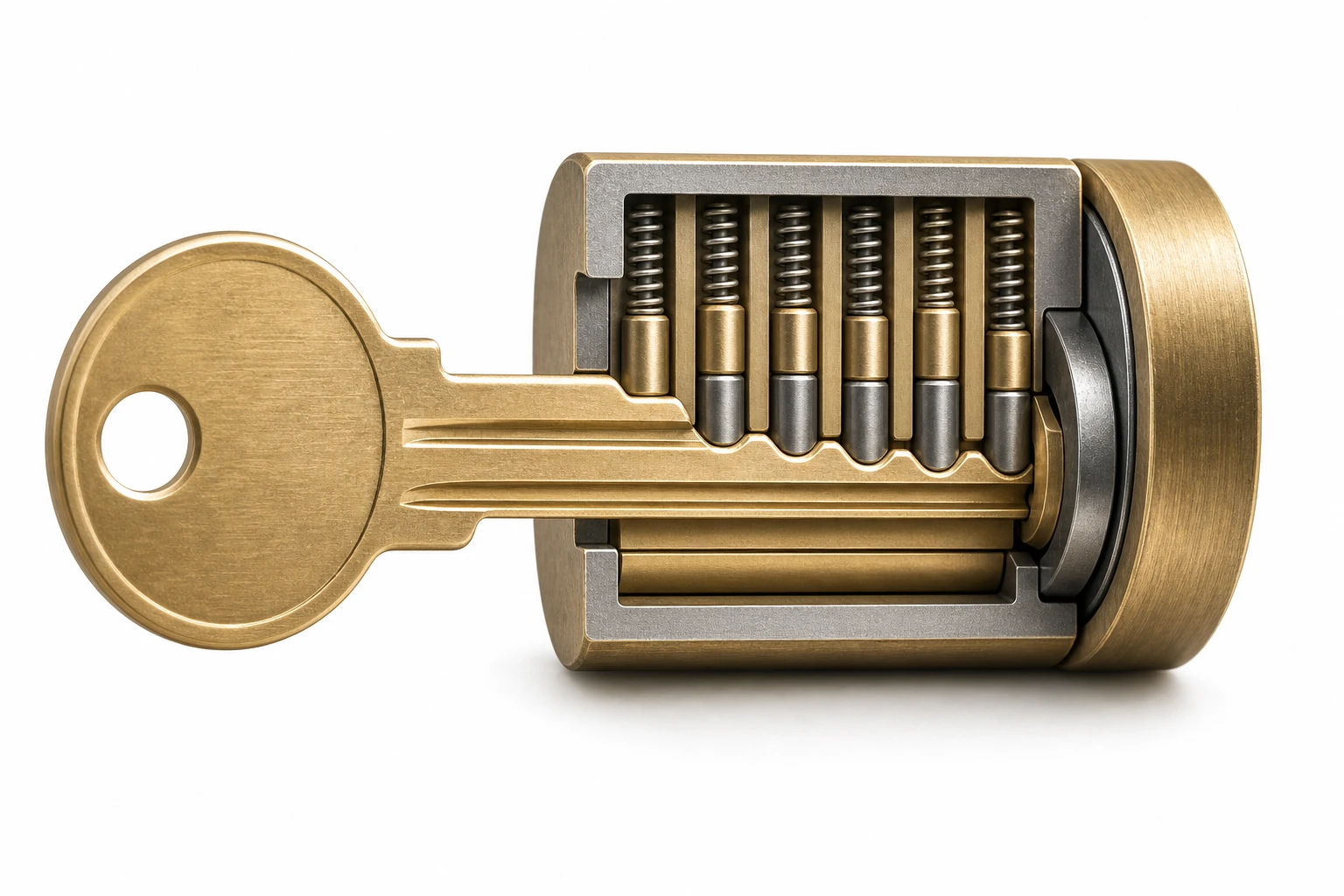
A pin tumbler lock works by using a series of spring-loaded pins of varying heights that block the cylinder from rotating. The correct key pushes each pin to exactly the right height, aligning all pin gaps along a single line called the shear line, which allows the cylinder to rotate freely and operate the lock mechanism. The pin tumbler lock was invented in ancient Egypt using wooden pins, and the principle has remained essentially unchanged for over 4,000 years despite vastly different manufacturing materials and methods.
Why Does a Lock Open with a Key? hero image

The mystery

The answer involves spring-loaded pins, a shear line, and a design so effective that an ancient Egyptian version worked on essentially identical principles.

The short answer

A pin tumbler lock works by using a series of spring-loaded pins of varying heights that block the cylinder from rotating. The correct key pushes each pin to exactly the right height, aligning all pin gaps along a single line called the shear line, which allows the cylinder to rotate freely and operate the lock mechanism.

The twist

The pin tumbler lock was invented in ancient Egypt using wooden pins, and the principle has remained essentially unchanged for over 4,000 years despite vastly different manufacturing materials and methods.

Common mistake

Most people assume a more complex key profile means a more secure lock.

Pins, springs, and a line that everything must align on

A pin tumbler lock is a deceptively simple device that encodes information as physical geometry.

Pins block rotation until the correct key arrives

Inside a pin tumbler lock cylinder, a series of pairs of pins separated by springs sit in vertical channels. The bottom pin sits in the rotating cylinder, the top pin in the fixed outer housing.

In the resting state, these pins cross the shear line between rotating and fixed parts, preventing rotation.

At rest, a pin tumbler lock is simply a series of small metal pillars blocking a door from moving. The key's job is to negotiate precisely with each one.

The key's cuts lift each pin pair to a specific height

A key's distinctive notched profile pushes each bottom pin upward by a precisely calibrated amount, determined by the depth of each cut.

The correct key pushes every bottom pin to exactly the height needed so the gap between each pin pair aligns precisely at the shear line.

A key does not open a lock by brute force; it opens it by correctly answering a set of simultaneous geometric questions.

Alignment at the shear line allows rotation

When all gaps align at the shear line simultaneously, the rotating cylinder can turn freely without any pin crossing the boundary.

This rotation operates the lock mechanism, whether retracting a bolt, releasing a catch, or turning a cam.

The shear line is the lock's definition of the correct answer, and only one key provides it.

From key insertion to open door

A short sequence explains the mechanical sequence of unlocking.

1

01. Key is inserted into the cylinder

The key's profile contacts each bottom pin.

2

02. Each cut lifts the corresponding pin pair

Different cut depths push each pair to different heights.

3

03. All gaps align at the shear line

The correct key achieves simultaneous alignment across all pin pairs.

4

04. The cylinder rotates and operates the lock

With no pin crossing the shear line, the cylinder turns freely.

Why this design has lasted 4,000 years

The pin tumbler principle is mechanically sound, scalable to any security level by adding more pins or using more complex pin geometries, manufacturable cheaply in mass production, and pickable only by someone with significant skill and time.

These combined properties have made it the dominant lock mechanism worldwide despite many alternative designs being developed.

Surprising lock facts

Ancient Egyptian locks used the same principle in wood
Egyptian pin tumbler locks date to around 2000 BCE and used wooden pins dropped into holes in a wooden key.
Most household locks can be picked with basic tools
Standard pin tumbler locks can be opened with a tension wrench and pick by a trained locksmith in seconds.
High-security locks use additional pin geometries
Security pins with complex cross-sections make picking significantly more difficult by providing false shear lines.

Is a more complex key always more secure?

Myth

Most people assume a more complex key profile means a more secure lock.

A visually complex key looks like it should be harder to replicate or pick, though both are limited more by lock quality than key complexity.

Reality

Security depends more on pin quality, tolerances, and pin geometry types than on key complexity alone.

Security depends more on pin quality, tolerances, and pin geometry types than on key complexity alone.

Where pin tumbler mechanics appear

Car locks
Modern car locks often use variations of pin tumbler mechanisms with additional security features like rotating elements.
Padlocks
Standard padlocks use the identical pin tumbler mechanism in a portable housing.

Why understanding this matters

Knowing how a lock works clarifies what makes locks more or less secure, which has practical implications for home and property security decisions.

It also explains why locksmith services can enter properties without a key and when this capability creates security vulnerabilities.

Worth noting

Geometry as security

A lock is simply an encoded geometry question, and a key is the physical answer - a design so effective that humans have been using essentially the same version since ancient Egypt. Few objects carry as much implicit trust as a small notched piece of metal that has been answering the same question correctly, every day, for years.

Quick answers

Common questions

Why does a worn key sometimes fail to open a lock?

Key wear changes cut depths, causing pins to miss the shear line by small but critical amounts.

Everyday Engineering

Related questions

They manipulate the pins individually using a tension wrench and pick, setting each pin at the shear line one at a time.

The inventor of the modern pin tumbler lock

Linus Yale Jr.

An American inventor who patented the small-format pin tumbler lock in 1861, essentially creating the modern key and lock as we know them.

Where pin tumbler mechanics appear

Car locks

Modern car locks often use variations of pin tumbler mechanisms with additional security features like rotating elements.

Where pin tumbler mechanics appear

Padlocks

Standard padlocks use the identical pin tumbler mechanism in a portable housing.

Is a more complex key always more secure?

Security depends more on pin quality, tolerances, and pin geometry types than on key complexity alone.

Security depends more on pin quality, tolerances, and pin geometry types than on key complexity alone.