1
01. Weight shifts onto three legs
A resting horse typically shifts most of its weight onto three legs, letting the fourth relax and rest the tip of its hoof on the ground.
Animal Facts
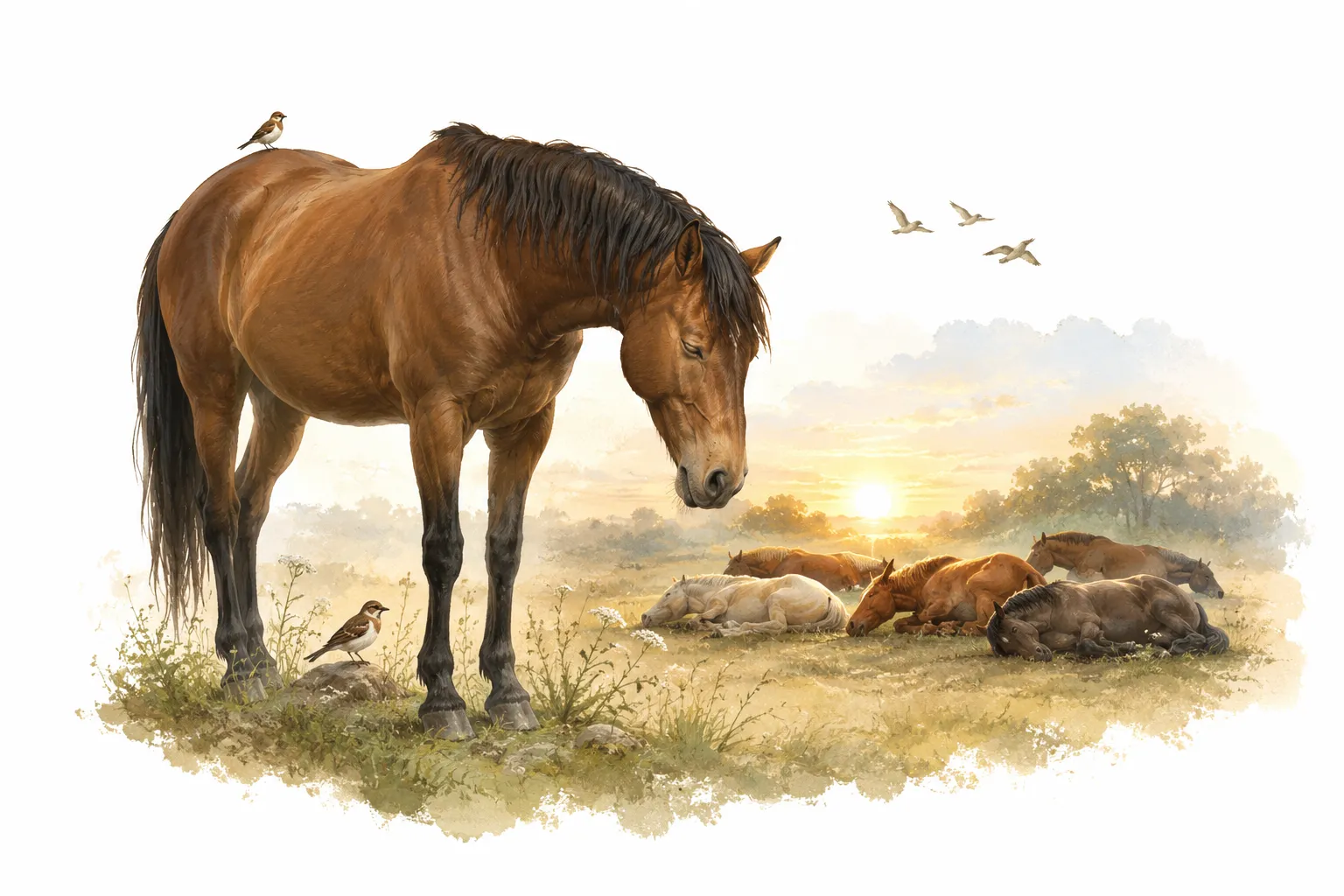
The strange leg mechanism that lets a half-ton animal doze off without falling over. Picture a horse asleep in a field. It is standing perfectly upright, head low, eyes half closed, weight balanced on four thin legs, and it is not, contrary to how this looks, one gust of wind away from toppling over. Horses have quietly solved a problem that would defeat most large animals: how to relax completely while remaining on your feet, ready to run from a predator at a moment's notice. The trick involves a locking mechanism in the legs that works something like a folding chair clicking into place.
Quick answer
Horses can sleep standing up because of a set of tendons and ligaments called the stay apparatus, which locks their leg joints in position without requiring muscular effort. But standing sleep is only ever a light doze. For deep, dream-filled sleep, a horse still has to lie down, and it needs its herd to feel safe enough to do it.
The mystery
The trick involves a locking mechanism in the legs that works something like a folding chair clicking into place.
The short answer
Horses can sleep standing up because of a set of tendons and ligaments called the stay apparatus, which locks their leg joints in position without requiring muscular effort.
The twist
But standing sleep is only ever a light doze. For deep, dream-filled sleep, a horse still has to lie down, and it needs its herd to feel safe enough to do it.
Common mistake
Many people assume horses sleep exclusively standing up and essentially never lie down.
Animal Facts
Yes — evidence of REM sleep during their lying-down rest periods suggests horses likely experience dreams, though what they dream about remains unknown.
The naturalist who documented equine rest patterns
An early naturalist whose broader work on animal adaptation helped set the stage for later scientists to study specialized anatomical traits like the horse's stay apparatus.
Where this adaptation matters most
In predator-rich environments, the ability to sleep while standing lets herd members stay alert and mobile, with a few animals often remaining more watchful while others doze.
Where this adaptation matters most
Horses that travel frequently or stand in unfamiliar environments, like show or competition horses, rely heavily on standing rest since they may not feel secure enough to lie down away from home.
Do horses never lie down at all?
Horses do lie down regularly, just briefly — typically for short stretches totaling under a few hours a day, reserved for the deep REM sleep standing rest can't provide.
Continue learning