History Myths

Did People in the Middle Ages Think the Earth Was Flat?

One of history's most confident myths - about a myth that never existed. The schoolbook story says people believed Earth was flat until Columbus proved them wrong. It is clean, satisfying, and almost entirely false. Medieval Europeans had known the Earth was round for nearly two thousand years. The flat-Earth Middle Ages myth was invented later, by people with specific reasons for doing so.

Quick answer

No. Medieval Europeans broadly accepted a spherical Earth. It was Greek science, university curriculum, Church astronomy, and standard educated knowledge. The myth was largely popularized in the 19th century by writers arguing that religion had suppressed science.
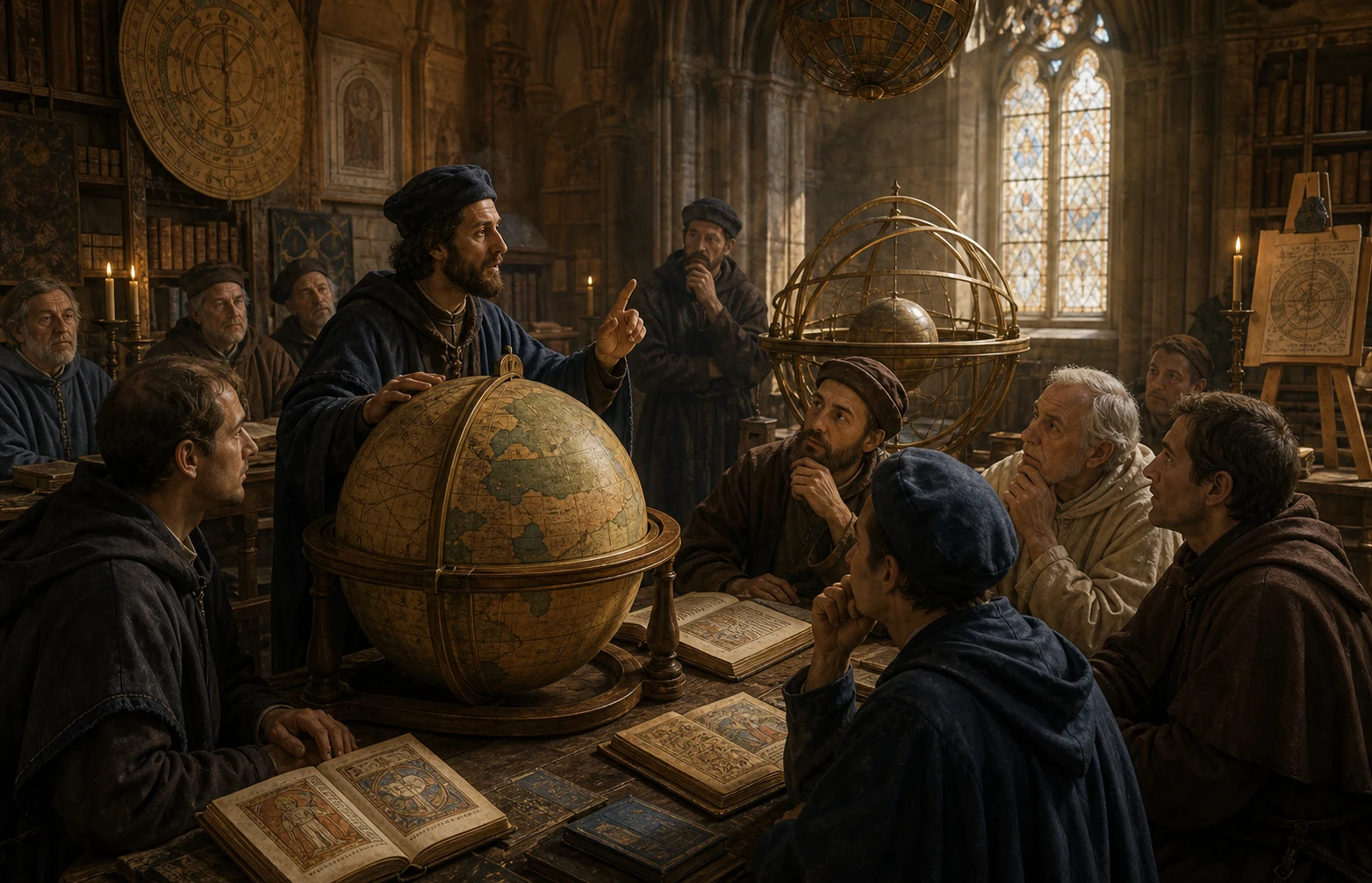
Did People in the Middle Ages Think the Earth Was Flat? hero image

The mystery

The flat-Earth Middle Ages myth was invented later, by people with specific reasons for doing so.

The short answer

No. Medieval Europeans broadly accepted a spherical Earth. It was Greek science, university curriculum, Church astronomy, and standard educated knowledge.

The twist

The myth was largely popularized in the 19th century by writers arguing that religion had suppressed science.

Common mistake

Surely there must have been a major flat-Earth tradition somewhere in medieval Europe.

What medieval people actually believed

Greek thinkers argued for a spherical Earth centuries before Christianity, and medieval scholars inherited that knowledge.

What medieval scholars actually said

Universities taught Aristotle's natural philosophy, which assumed a spherical Earth. Sacrobosco's Treatise on the Sphere was a standard textbook for centuries.

Thomas Aquinas, Roger Bacon, and Dante all assumed a round Earth.

Medieval scholars had a textbook on the spherical Earth that was used in universities for four centuries.

Who invented the flat-Earth Middle Ages

John William Draper and Andrew Dickson White popularized the idea in the 19th century while arguing for a conflict between science and religion.

On this point, their influential books were wrong.

The flat-Earth medieval myth was invented to win a 19th-century argument about religion.

What Columbus's opponents actually argued

Columbus's opponents did not think the Earth was flat. They thought he had underestimated its size, which he had.

He survived only because the Americas were in the way.

Columbus's opponents thought the Earth was round. They just thought it was bigger - and they were right.

How the myth was built and maintained

The myth spread through books, textbooks, and emotional appeal.

1

01. Influential books with agendas

Draper and White told a compelling conflict story that textbooks repeated.

2

02. Textbooks repeat each other

Once in curricula, the error reproduced without checking primary sources.

3

03. The myth is emotionally satisfying

It makes us feel smarter than our ancestors.

The real scientific debate in the Middle Ages

Medieval cosmology was not flat. It was geocentric: a spherical Earth at the center of celestial spheres.

That model was wrong in important ways, but not in the way the flat-Earth myth claims.

Round Earth evidence hiding in plain sight

The orb in royal portraits
Kings often hold a spherical globe of the world, which makes no sense in a flat-Earth culture.
Easter calculation used astronomy
Church calendar work depended on sophisticated astronomical calculation.

But weren't there some flat-Earth believers?

Myth

Surely there must have been a major flat-Earth tradition somewhere in medieval Europe.

The myth has been repeated so often that it feels like cultural memory.

Reality

There is no evidence of a significant medieval European flat-Earth tradition.

There is no evidence of a significant medieval European flat-Earth tradition.

The myth in the real world

Modern flat-Earth belief
Modern flat-Earth communities are driven by institutional distrust, not medieval inheritance.

Getting our ancestors right

The myth makes past people seem stupider than they were, which makes us less alert to our own errors.

The same simplified conflict narrative distorted many stories about science and religion.

Worth noting

The myth about the myth

Medieval people did not believe in a flat Earth. Their actual cosmology was wrong in other, more interesting ways. Our ancestors were not ignorant about the Earth's shape.

Quick answers

Common questions

Did ancient Greeks know Earth was round?

Yes. Aristotle listed evidence, and Eratosthenes calculated the circumference.

What shape did medieval people think Earth was?

A sphere at the center of a geocentric cosmos.