Visual answer
Orb Web Construction
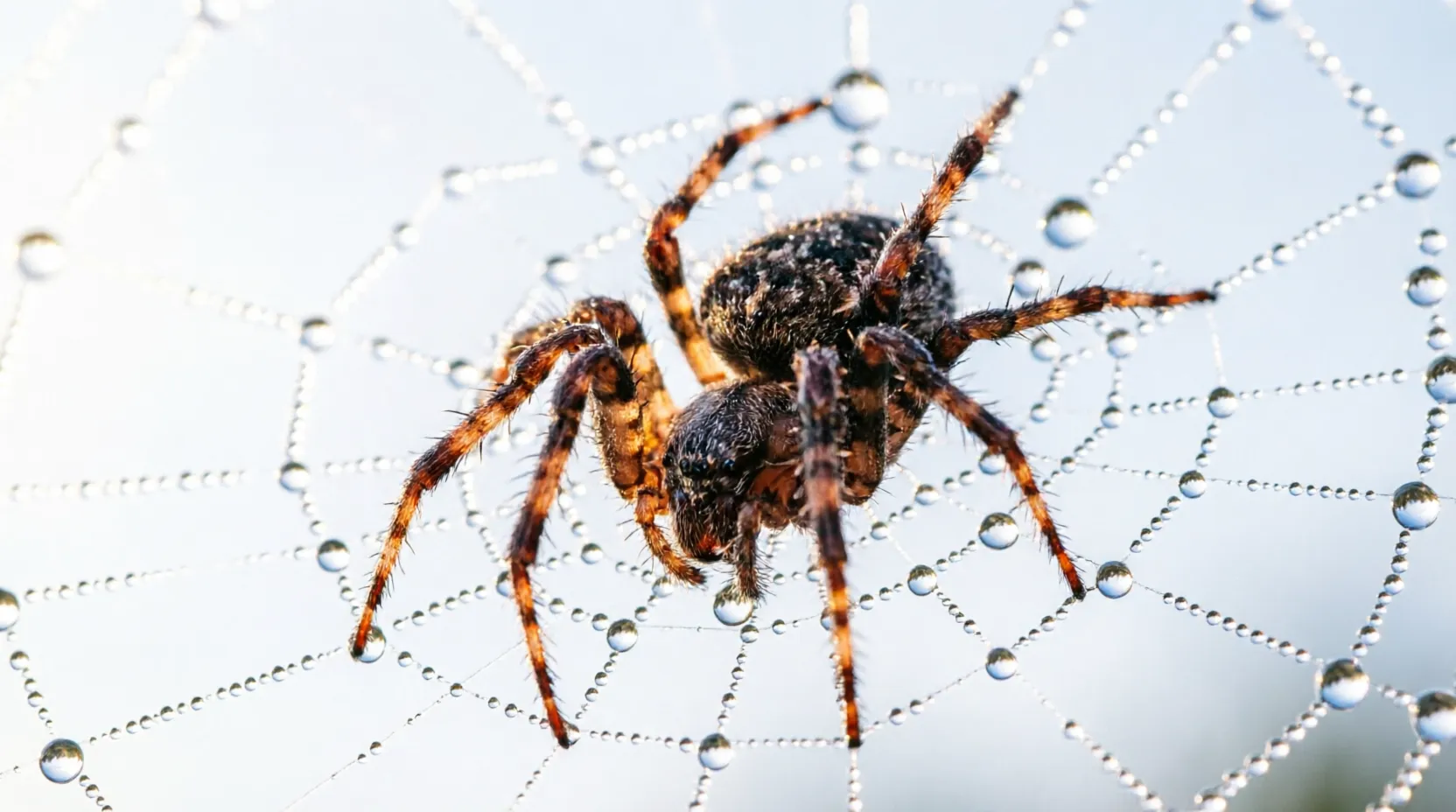
A spider builds an orb web in six stages: bridge, frame, radii, temporary spiral, sticky spiral, hub.
Bridge thread
Spider releases a thread into the wind; when it catches, the spider reinforces it.
Frame and radii
Spider builds outer frame and radial spokes from hub to frame.
Temporary spiral
Non-sticky spiral stabilizes radii during construction.
Sticky spiral
Spider replaces temporary spiral with viscid (sticky) silk, eating the temporary spiral as it goes.
Liquid to solid
The Mystery: How Does Spun Liquid Become the World's Toughest Natural Fiber?
The transformation from liquid silk to solid fiber happens inside the spinneret duct. As the protein solution is drawn through the narrowing duct, pH drops and ions shift, causing the silk proteins (spidroins) to assemble from a disordered liquid into aligned, crystalline nanofibers. The combination of crystalline regions (strength) and amorphous regions (elasticity) gives spider silk its unmatched combination of toughness and flexibility - a property no synthetic material has yet fully replicated.
Seven kinds of silk
The Mechanism: Seven Kinds of Silk
Spiders can produce up to seven types of silk, each from a different gland, each with different mechanical properties for different construction tasks.
Key components: Major Ampullate Silk (dragline and web frame - strongest type), Minor Ampullate Silk (temporary scaffolding), Viscid (Capture) Silk (sticky spiral for trapping prey), Tubuliform Silk (egg sac construction), and Spinnerets (extrusion organs that control thread thickness and combination).
Building an orb web
Building an Orb Web Step by Step
1. Bridge thread - The spider releases a silk thread into the breeze. When it catches on a surface, the spider reinforces it by walking across and laying additional threads - creating a horizontal bridge.
2. Y-frame - From the midpoint of the bridge, the spider descends on a loose thread, creating the first radial spoke and the three-armed 'Y' foundation of the web.
3. Radial spokes - More spokes are added from the hub (center) to the outer frame, like wheel spokes, creating the web's structural skeleton.
4. Temporary spiral - Starting at the hub, the spider lays a non-sticky temporary spiral outward to stabilize the radials during construction.
5. Sticky spiral - Working inward from the outer edge, the spider replaces the temporary spiral with viscid (sticky) silk, eating the temporary spiral as it goes.
6. Hub reinforcement - The spider reinforces the center hub with additional silk and often positions itself there - detecting prey vibrations transmitted through all the radial spokes.
Why silk?
Why Did Spiders Evolve Silk?
Silk almost certainly predates webs - early spiders likely used silk for egg cases and draglines before orb webs evolved. Different web architectures evolved independently multiple times in different spider lineages, as the energy investment in a well-placed web pays large dividends in captured prey.
Benefits include: Prey capture (sticky spiral web is an efficient passive trap), Communication and mating (males pluck web threads to signal females; the web acts as an extension of the spider's sensory system), and Protection (vibrations from approaching predators travel through web threads to alert the spider).
Web types
Types of Spider Webs
Orb Web
Classic wheel-shaped web; radial spokes with sticky capture spiral; efficient for flying insects.
Cobweb (Tangle Web)
Irregular 3D web; vertical trip-lines send walking insects into sticky sheet; less material-intensive.
Funnel Web
Flat horizontal sheet with funnel-shaped retreat; spider hides and rushes out when prey falls on sheet.
Sheet Web
Horizontal sheet of silk; spider hangs underneath and bites through to pull prey down.
Examples
Remarkable Spider Web Types
Orb Web: The classic wheel-shaped web of garden orb-weavers - geometrically regular, with radial spokes and a sticky capture spiral. Highly efficient for catching flying insects.
Cobweb (Tangle Web): The irregular, three-dimensional webs of house spiders. Vertical trip-lines catch walking insects, sending them into the sticky sheet below.
Funnel Web: A flat horizontal sheet with a funnel-shaped retreat at one end. The spider hides in the funnel and rushes out when prey falls on the sheet.
Darwin's Bark Spider Web: Discovered in Madagascar, these spiders spin webs up to 25 meters across - the largest known spider webs - anchored to both banks of rivers. Their silk is the toughest biological material ever tested.
Myths vs reality
Myth vs Reality: Spider Webs
What people think
Spiders get stuck in their own webs
A spider would be trapped if it touched the sticky parts of its web.
What actually happens
Spiders navigate sticky webs by walking on non-sticky spokes
Spiders coat their leg tips with an oily substance and walk only on the radial threads, avoiding the sticky spiral.
Surprising facts
Surprising Facts About Spider Webs
Many spiders eat their own webs daily. Recycling the protein-rich silk is more efficient than discarding it. Some spiders consume and rebuild their entire orb web in under an hour.
Not all spiders spin webs. Roughly half of all spider families are 'free-roaming' hunters - jumping spiders, wolf spiders, and crab spiders actively pursue prey and use silk only for draglines and egg sacs.
Spider silk has been used to make a full-size cape. A garment made entirely of golden silk from over a million golden silk orb-weavers was exhibited at the Victoria & Albert Museum in 2012 - the largest piece of spider-silk textile ever created.
Quick answers
Common questions
What is spider silk made of? +
Spider silk is made of proteins called spidroins (spider fibroins). When extruded through spinnerets, these proteins assemble into fibers with crystalline regions (strength) and amorphous regions (elasticity).
How strong is spider silk? +
Dragline spider silk has tensile strength comparable to high-grade steel (1.1-1.4 GPa) but is about five times lighter. In toughness (energy absorbed before breaking), it exceeds Kevlar by a factor of two.
Why do spiders spin webs? +
Webs serve multiple purposes: passive prey capture, communication (vibration transmission), shelter, and reproduction (egg sacs). Silk is also used as a dragline safety line and for ballooning dispersal.
Do spiders feel vibrations through their webs? +
Yes. The web acts as a highly tuned vibration detector. Spiders can distinguish between trapped prey, predators, mates, and wind damage by vibration frequency and pattern.
Can scientists copy spider silk? +
Researchers have produced recombinant spider silk proteins using bacteria, yeast, and transgenic animals. However, fully replicating the mechanical properties of natural silk remains a challenge.