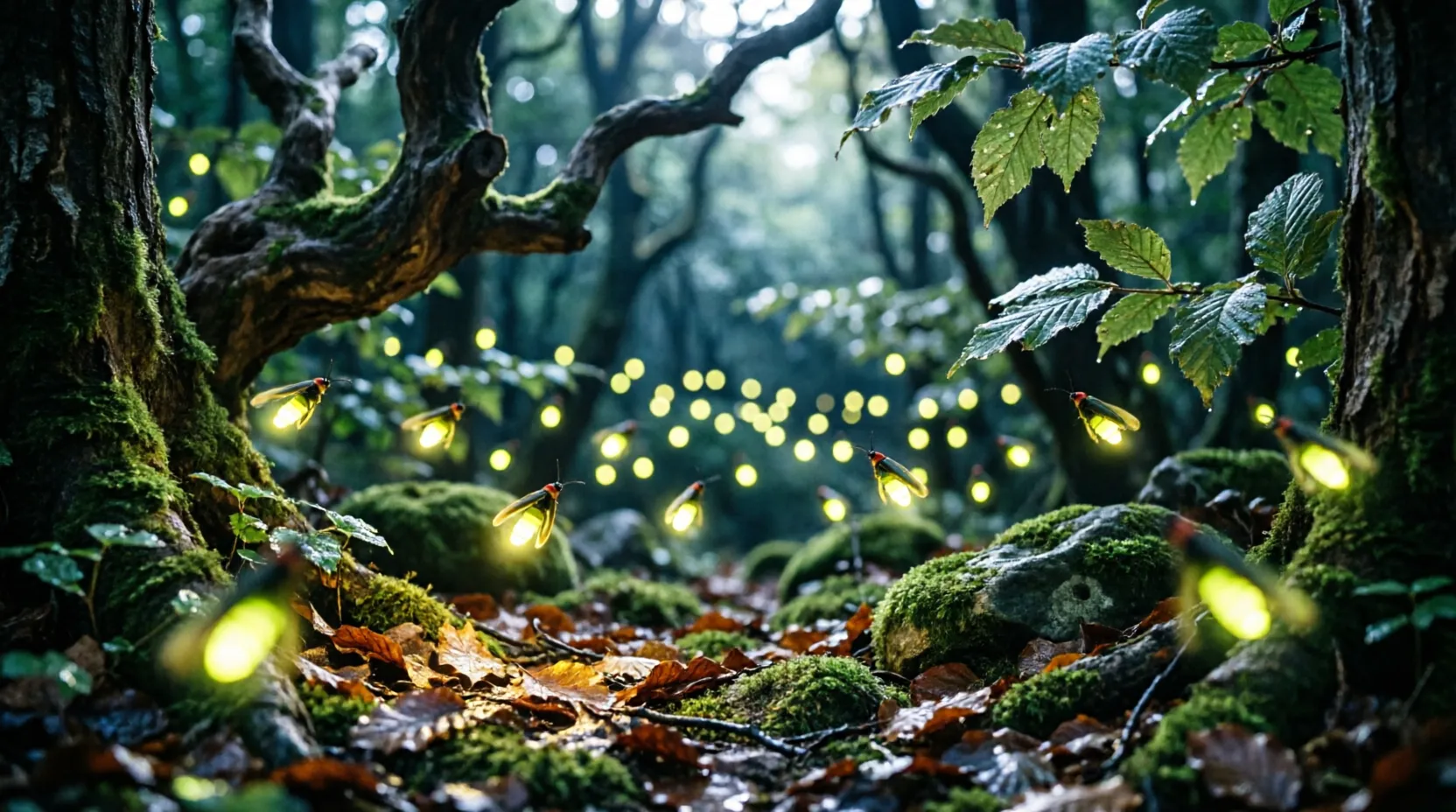
Visual answer
The Luciferin-Luciferase Reaction
When oxygen enters the photocyte, luciferin is oxidized with help from luciferase and ATP, producing excited oxyluciferin that releases a photon of light.
Luciferin + ATP
Luciferin is activated by ATP (cellular energy) with the help of luciferase.
Oxygen enters
When nitric oxide signals, mitochondria release oxygen into the photocyte.
Oxidation reaction
Oxygen reacts with activated luciferin, producing excited-state oxyluciferin.
Photon emission
Excited oxyluciferin returns to ground state, releasing a visible photon of light (yellow-green).
Flash control mystery
The Mystery: How Is the Flash Controlled So Precisely?
For decades, scientists could not explain how a firefly produces flashes as precise as a tenth of a second, fast enough to encode a species-specific signal, when chemical reactions are generally too slow and imprecise for such timing.
The answer, discovered relatively recently: nitric oxide (NO) gas. When the firefly's nervous system wants to flash, it triggers release of nitric oxide in the light organ. NO binds to mitochondria in the photocytes, displacing oxygen from their surfaces and allowing it to flow to the luciferin reaction. When NO production stops, mitochondria recapture the oxygen and the light goes out.
The chemistry
The Chemistry of Cold Light
Bioluminescence in fireflies is an enzyme-catalyzed oxidation reaction that converts chemical energy directly to light with extraordinary efficiency.
The key components: Luciferin (the light-emitting substrate), Luciferase (the catalytic enzyme), ATP (energy source), Oxygen (oxidant and flash trigger), Nitric Oxide (flash control signal), and Photocytes with reflector cells (light production and direction).
Firefly luciferin produces yellow-green light; the specific wavelength depends on the luciferase variant. Scientists widely use luciferase as a reporter gene in genetic research.
Flash step-by-step
How a Firefly Produces a Flash
1. Nervous system triggers NO release: The firefly's brain sends a neural signal to the light organ, triggering production of nitric oxide gas.
2. NO binds mitochondria: Nitric oxide binds to the surface of mitochondria in photocytes, preventing them from consuming oxygen, releasing free oxygen into the cell.
3. Luciferin reaction ignites: Free oxygen reaches luciferase-bound luciferin and ATP. Luciferin is activated by ATP, then oxidized by oxygen via luciferase to produce excited-state oxyluciferin.
4. Photon emission: Excited oxyluciferin returns to ground state, releasing energy as a photon of visible light, typically yellow-green in North American species.
5. NO degrades, light off: Nitric oxide degrades very quickly. As NO concentration falls, mitochondria recapture oxygen, cutting off supply to the luciferin reaction. The flash ends in milliseconds.
6. Species-specific flash pattern: The timing, duration, and number of flashes is genetically programmed per species. Males broadcast the species code; conspecific females respond with a species-specific delay and pattern.
Evolutionary purpose
Why Did Bioluminescence Evolve?
Bioluminescence almost certainly evolved first as a defense mechanism, the chemicals may have been toxic or distasteful to predators, and glowing warned predators away. In most modern firefly species, the primary function of adult flashing has shifted to mating, the light is a species-specific sexual signal. Larval fireflies (glowworms) still use their glow primarily for predator warning.
Benefits include: Mate finding (species-specific flash patterns allow precise identification), predator warning (toxic steroids called lucibufagins taste bitter, glowing advertises this defense), and aggressive mimicry (females of the genus Photuris mimic other species' flashes to lure and eat males, absorbing their chemical defenses).
Flash strategies
Firefly Flash Strategies
Photinus pyralis (Big Dipper)
Males fly a J-shaped path while flashing a half-second pulse every 5.5 seconds. Females respond 2 seconds later with a single flash.
Synchronized fireflies (Great Smoky Mountains)
Photinus carolinus: thousands of males flash in near-unison for 6 flashes, then go dark for 6–8 seconds, repeating. Synchronization achieved by each male adjusting to neighbors.
Photuris (Femme Fatale)
Females mimic flash responses of at least 11 other species to lure males, then eat them, absorbing defensive chemicals.
Asian glowing mangroves
Male Pteroptyx fireflies synchronize flashes along entire mangrove trees, entire trees flashing in unison for hours.
Myths vs reality
Myth vs Reality: Firefly Glow
What people think
All fireflies flash to attract mates
People assume every glowing firefly is sending a mating signal.
What actually happens
Larval fireflies glow as a warning, not for mating
Larval fireflies (glowworms) and some adults glow continuously to warn predators about their toxic chemistry. The mating flash behavior evolved later in some lineages.
Surprising facts
Surprising Facts About Firefly Glow
Some frogs that eat too many fireflies begin to glow themselves: Luciferin and luciferase accumulate in the frog's tissues; the biochemical conditions of the frog's cells can sustain a faint bioluminescent glow, a literal case of 'you are what you eat.'
Luciferase is one of the most widely used tools in genetic research: Scientists attach the luciferase gene to genes of interest; when the target gene activates, the cell glows, a real-time visual readout of gene expression in living cells, used in thousands of labs worldwide.
Firefly populations have declined significantly over recent decades: Light pollution, habitat loss, and pesticide use have reduced firefly populations. Light pollution is particularly damaging, artificial lights disrupt flash-pattern communication, effectively silencing the species-specific signals.
Quick answers
Common questions
What makes fireflies glow? +
A bioluminescent chemical reaction in specialized photocyte cells: luciferin is oxidized by oxygen with the help of luciferase and ATP, producing an excited intermediate that releases energy as visible light. Nitric oxide controls the oxygen supply and thus each flash.
Why do fireflies flash? +
Primarily as a mating signal: each species has a species-specific flash pattern; males broadcast the code while flying, and females respond with a species-matched answer. Secondarily, glow serves as a warning signal to predators about the firefly's chemical defenses.
How do fireflies control their flashing? +
Through nitric oxide (NO) signaling. The firefly's nervous system triggers NO production in the light organ. NO temporarily binds to mitochondria, releasing oxygen to fuel the luciferin reaction (flash on). When NO degrades, mitochondria recapture oxygen and the flash ends.
Is firefly light hot? +
No, firefly light is 'cold light.' Nearly 100% of the energy is released as visible light, with negligible heat production. Incandescent bulbs release ~90% as heat.
Are fireflies endangered? +
Many populations are declining due to light pollution (disrupts flash communication), habitat loss, and pesticide use. Some species are considered vulnerable.