COGNITIVE BIAS

What Is the Framing Effect? How Words Change Your Decisions

A surgery has a 90% survival rate. Or a 10% mortality rate. Same surgery. Same risk. Different decision. The framing effect explains why.

Editorial illustration of two frames showing the same information with different results
Creator Amos Tversky, Daniel KahnemanOrigin PsychologyYear 1980sCategory Psychology, Cognitive Bias

QUICK ANSWER

Here is the idea in plain English.

The framing effect is a cognitive bias where people make different decisions based on how information is presented. It was identified by Amos Tversky and Daniel Kahneman in the 1980s. The bias explains why the same information can lead to different choices depending on whether it is framed positively or negatively. It is used in marketing, politics, and medicine. The frame changes the decision.

If you remember only a few things, remember these.

The basic move

The framing effect is simple: the way information is presented changes your decision. The same facts can lead to different choices depending on the frame.

Why it matters

A surgery has a 90% survival rate. You choose the surgery. A surgery has a 10% mortality rate. You avoid the surgery. Same surgery. Different frame. Different decision.

Use it deliberately

When presenting information, frame it positively. Positive frames lead to better outcomes.

CORE IDEA

The concept in its simplest useful form.

What Does the Framing Effect Mean in Simple Terms?

The framing effect is simple: the way information is presented changes your decision. The same facts can lead to different choices depending on the frame.

A surgery has a 90% survival rate. You choose the surgery. A surgery has a 10% mortality rate. You avoid the surgery. Same surgery. Different frame. Different decision.

The effect is subconscious. You do not realize you are being influenced. That is what makes it so powerful.
The small mechanism underneath the big idea.

01

The Story Behind the Framing Effect

In the 1980s, Amos Tversky and Daniel Kahneman were studying how people make decisions under risk. They found that people are not rational. The way information is presented changes the decision.

They presented the same information in two different ways. One was positive. One was negative. People chose differently. The positive frame led to risk-seeking. The negative frame led to risk-aversion.

The discovery was groundbreaking. It showed that the same information can lead to different decisions. The frame matters more than the facts.

02

Why the Framing Effect Became Famous

The framing effect became famous because it shows that people are not rational. The way information is presented matters more than the facts. This is a challenge to classical economics.

The concept was popularized by Tversky and Kahneman's research. It became a cornerstone of behavioral economics.

Today, the framing effect is one of the most recognized cognitive biases. It is used in marketing, politics, and medicine.

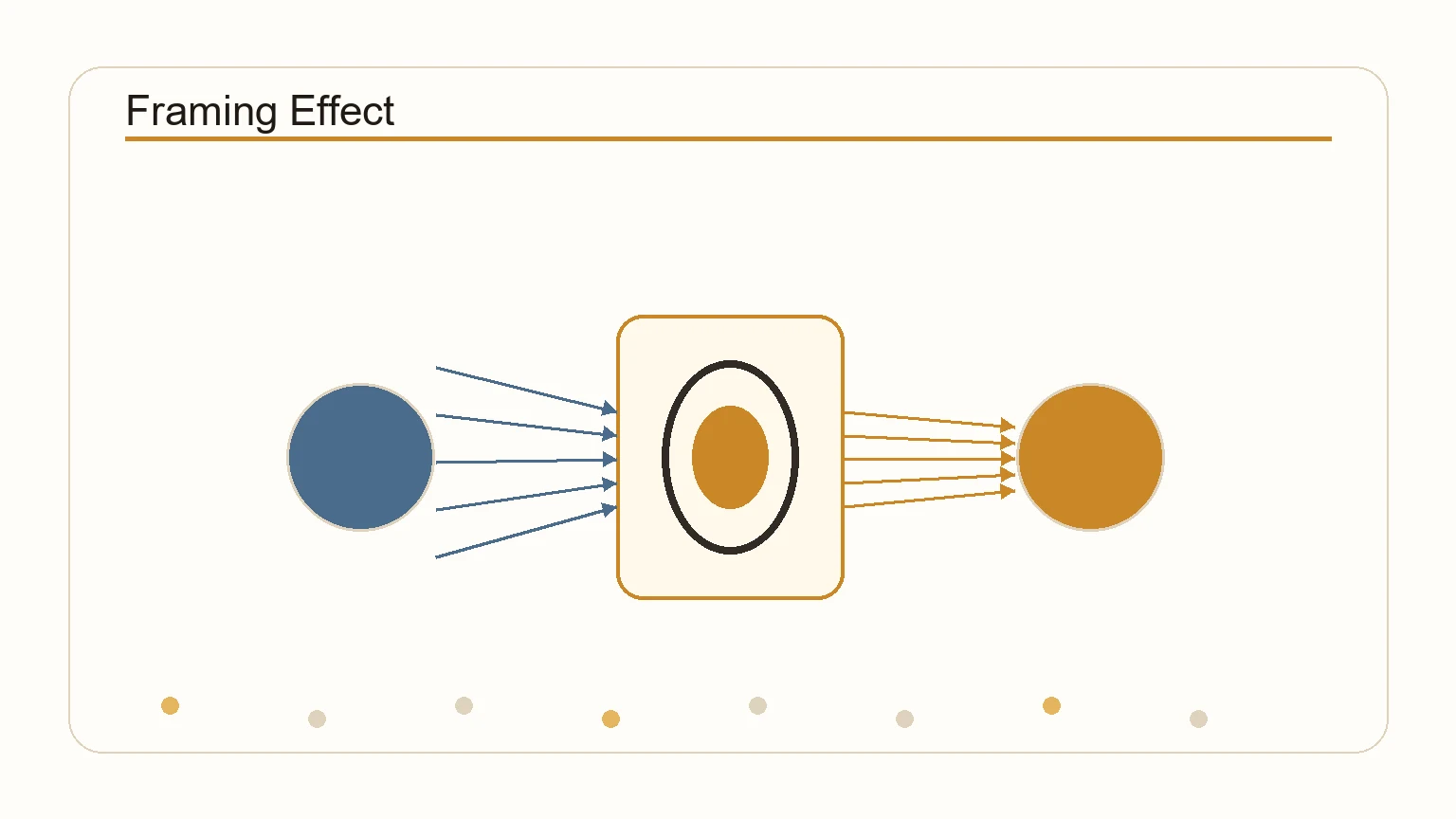
Diagram showing how the same information framed positively or negatively leads to different decisions
A diagram showing the same information framed positively and negatively, leading to different decisions.

Where this idea shows up outside the textbook.

Medicine

A surgery has a 90% survival rate. Patients choose the surgery. A surgery has a 10% mortality rate. Patients avoid the surgery. Same surgery. Different frame.

Marketing

A product is 90% fat-free. Or 10% fat. Same product. Different frame. The positive frame sells more.

Politics

A policy creates 90% employment. Or 10% unemployment. Same policy. Different frame. The positive frame is more popular.

Everyday Life

You have a 90% chance of success. You try. You have a 10% chance of failure. You avoid. Same odds. Different frame.

CONCEPT MAP

Every idea has neighbors. This is where the current concept sits in the TinyThat knowledge graph.

Current concept

Framing Effect

The way information is presented changes decisions.

What people often get wrong about this idea.

The framing effect is a form of manipulation.

No. It is a cognitive bias. It is not intentional. It is a feature of how the brain works.

You can avoid the framing effect by being rational.

No. The effect is subconscious. You cannot simply think your way out of it.

The framing effect only applies to risk.

No. It applies to everything: pricing, marketing, politics, and everyday decisions.

Useful ideas become dangerous when they are stretched too far.

Criticisms and Limitations of the Framing Effect

The framing effect is a powerful concept, but it has limitations. The effect varies across contexts and individuals. It is not universal.

The concept can be overused. Not every frame changes a decision. Sometimes people are rational.

The concept is a heuristic, not a law. It is a guide, not a rule.

Three simple ways to apply the idea without turning it into a slogan.

1

When presenting information, frame it positively

When presenting information, frame it positively. Positive frames lead to better outcomes.

2

When evaluating information, ask: am I being influenced by the frame? What would I think without the frame?

When evaluating information, ask: am I being influenced by the frame? What would I think without the frame?

3

Be aware of the frame

Be aware of the frame. It is a bias, not a fact.

EXPLORE NEXT

The best next ideas to read after this one.

Quick answers to common questions.

What is the framing effect in simple terms?

The way information is presented changes your decision. The same facts can lead to different choices depending on the frame.

What is an example of the framing effect?

A surgery has a 90% survival rate. You choose it. A surgery has a 10% mortality rate. You avoid it. Same surgery. Different frame.

How do you avoid the framing effect?

Be aware of the frame. Ask: what would I think without the frame? The frame is a bias, not a fact.

Why is the framing effect a problem?

It leads to different decisions based on presentation, not facts. The frame matters more than the information.