SOCIAL CONCEPT

What Are Unintended Consequences? Why Good Intentions Backfire

You try to help. You make things worse. Unintended consequences explain why good intentions often backfire.

Editorial illustration of a person trying to fix a problem and creating a bigger one
Creator Robert K. MertonOrigin SociologyYear 1936Category Sociology

QUICK ANSWER

Here is the idea in plain English.

Unintended consequences are the unexpected and often negative results of actions. The concept was popularized by sociologist Robert K. Merton in 1936. Unintended consequences explain why well-intentioned policies backfire, why interventions fail, and why the world is so hard to change. The concept is a warning about the complexity of social systems.

If you remember only a few things, remember these.

The basic move

Unintended consequences are simple: actions have unexpected results. You try to help. You make things worse. The result is not what you intended.

Why it matters

The problem is complexity. Systems are interconnected. You cannot predict all the effects of your actions.

Use it deliberately

When making a decision, ask: what are the potential side effects? What could go wrong?

CORE IDEA

The concept in its simplest useful form.

What Do Unintended Consequences Mean in Simple Terms?

Unintended consequences are simple: actions have unexpected results. You try to help. You make things worse. The result is not what you intended.

The problem is complexity. Systems are interconnected. You cannot predict all the effects of your actions.

The solution is to think before you act. Consider the second-order effects. Anticipate unintended consequences.
The small mechanism underneath the big idea.

01

The Story Behind Unintended Consequences

In 1936, sociologist Robert K. Merton wrote about unintended consequences. He observed that actions often have unexpected results. The results can be positive, negative, or perverse.

The classic example is the Cobra Effect. The British government offered a bounty for dead cobras. People bred cobras. The problem got worse. The solution backfired.

Today, unintended consequences are a foundational concept in sociology and public policy.

02

Why Unintended Consequences Became Famous

Unintended consequences became famous because they explain why the world is so hard to change. Well-intentioned policies often backfire.

The concept is widely used in public policy, economics, and sociology.

Today, unintended consequences are a foundational concept in understanding social systems.

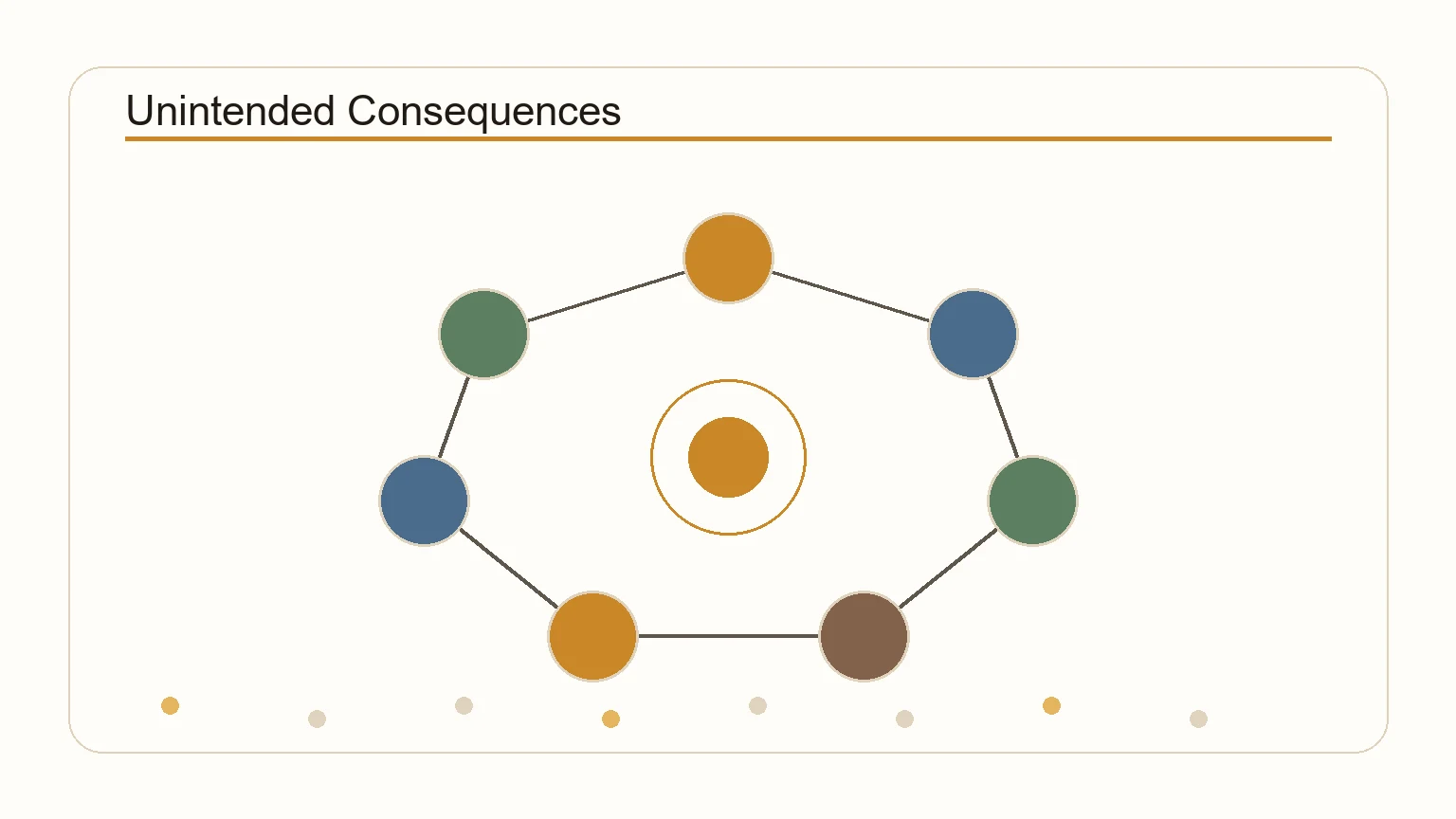
Diagram showing unintended consequences and the chain of effects
A diagram showing how actions create chains of effects, including unintended consequences.

Where this idea shows up outside the textbook.

History

The Cobra Effect is the classic example. The solution made the problem worse.

Policy

A policy intended to help people can have negative side effects. Unintended consequences are the cause.

Everyday Life

You try to help a friend. You make things worse. Unintended consequences are the cause.

Business

A company makes a change. The change has unexpected effects. Unintended consequences are the cause.

CONCEPT MAP

Every idea has neighbors. This is where the current concept sits in the TinyThat knowledge graph.

Current concept

What Are Unintended Consequences

Unintended consequences are the unexpected and often negative results of actions. The concept was popularized by sociologist Robert K. Merton in 1936. Unintended consequences explain why well-intentioned policies backfire, why interventions fail, and why the world is so hard to change. The concept is a warning about the complexity of social systems.

What people often get wrong about this idea.

Unintended consequences are always negative.

No. They can be positive or neutral. The term is neutral. It just means unexpected.

Unintended consequences are caused by bad intentions.

No. They are caused by complexity. Even good intentions can have negative consequences.

You can eliminate unintended consequences.

You cannot eliminate them. You can only anticipate them. The goal is to be aware of the risk.

Three simple ways to apply the idea without turning it into a slogan.

1

When making a decision, ask: what are the potential side effects? What could go wrong?

When making a decision, ask: what are the potential side effects? What could go wrong?

2

Think about second-order effects

Think about second-order effects. The first effect is not the only effect.

3

Be humble

Be humble. You cannot predict everything. Be prepared to adjust.

EXPLORE NEXT

The best next ideas to read after this one.

Quick answers to common questions.

What are unintended consequences in simple terms?

Actions have unexpected results. You try to help. You make things worse. The result was not intended.

What is an example of unintended consequences?

The Cobra Effect is the classic example. The solution made the problem worse.

How do you avoid unintended consequences?

Think before you act. Consider the second-order effects. Be humble. You cannot predict everything.

Why are unintended consequences a problem?

They lead to negative outcomes. Well-intentioned actions can backfire. The effects are unexpected.