Word Origins

Why Is It Called Sisyphean?

A boulder, a hill, forever. Almost everyone knows the image. Almost nobody remembers what Sisyphus actually did to deserve it — and one philosopher's rewrite of the ending changed how we use the word entirely.

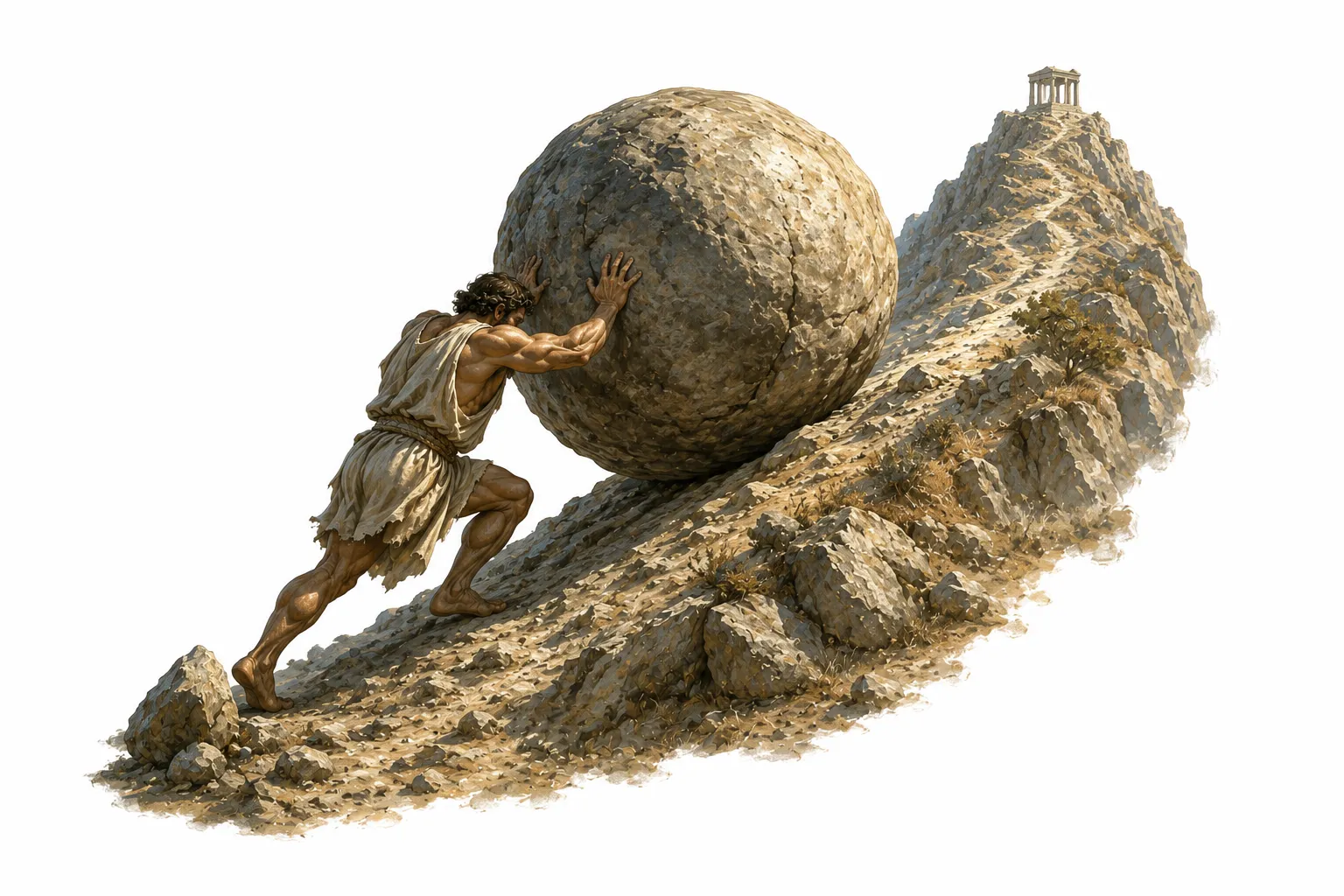
A lone figure pushing a large boulder up a steep, rocky hill
Source Greek mythology, referenced in Homer's OdysseyPunishment for Cheating death, twice, through trickeryLocation of punishment Tartarus, in the underworldFamous reinterpretation Albert Camus, 'The Myth of Sisyphus' (1942)

QUICK ANSWER

Here is the idea in plain English.

'Sisyphean' describes a task that's endless and ultimately futile, from the Greek myth of Sisyphus, a king condemned in the underworld to eternally push a boulder up a hill, only to watch it roll back down every time he neared the top — a punishment for repeatedly cheating death.

If you remember only a few things, remember these.

The basic move

The horror of the Sisyphus myth isn't physical exhaustion — it's that nothing accumulates. Every version of human effort assumes progress: you push, and something changes, even a little. Sisyphus's punishment specifically removes that assumption. The work resets, exactly, every single time.

Why it matters

That's the precise mechanism 'Sisyphean' captures that words like 'exhausting' or 'endless' don't: it's not just that a task is hard or long, it's that completing it produces no permanent result at all.

Use it deliberately

Reserve 'Sisyphean' for tasks that specifically reset rather than merely repeat — a job you redo from scratch every time, not just one that takes a long time. That distinction, resetting versus repeating, is the whole point of the myth.

CORE IDEA

The concept in its simplest useful form.

The Punishment Isn't the Effort. It's the Erasure.

The horror of the Sisyphus myth isn't physical exhaustion — it's that nothing accumulates. Every version of human effort assumes progress: you push, and something changes, even a little. Sisyphus's punishment specifically removes that assumption. The work resets, exactly, every single time.

That's the precise mechanism 'Sisyphean' captures that words like 'exhausting' or 'endless' don't: it's not just that a task is hard or long, it's that completing it produces no permanent result at all.

The small mechanism underneath the big idea.

01

The King Who Outsmarted Death Twice

Sisyphus, king of Corinth in Greek myth, wasn't punished for laziness or arrogance in the usual sense — he was punished for being too clever. In one version, he chains up Thanatos, the personification of Death itself, so that no one on earth can die while Death is imprisoned. In another, after finally dying, he tricks his way back to the world of the living by convincing the underworld's rulers to let him return briefly to arrange his own funeral rites — and then simply doesn't go back.

By the time the gods finally settle accounts with him for good, they don't just punish him with death. They design something more precise: an eternity spent pushing a massive boulder up a steep hill in the underworld, always just short of the top before it slips loose and rolls all the way back down, forcing him to start again — forever.

02

Camus Turned the Punishment Into a Philosophy

The myth stayed a fairly straightforward cautionary tale for over two thousand years. Then in 1942, the French philosopher Albert Camus published 'The Myth of Sisyphus,' using the story as a central metaphor for his philosophy of the absurd — the idea that life inherently lacks ultimate meaning, and the only honest response is to keep living and working anyway, without needing the boulder to ever actually stay at the top.

Camus reframed the descent — the walk back down the hill to fetch the boulder again — as the moment Sisyphus is actually free, fully conscious of his fate and unbroken by it. That reading is why 'Sisyphean' carries a slightly different weight in modern usage than a pure tragedy would: it's futile, but the word doesn't necessarily mean defeated.

Circular diagram of a boulder being pushed uphill and rolling back to the start
A circular diagram showing a figure pushing a boulder up a slope on one side, with an arrow curving back down the other side to the starting point, forming an unbroken loop.

Where this idea shows up outside the textbook.

In everyday work

Any job where the same problem resets constantly — dishes, inbox management, weeding a garden.

In philosophy

Central to Camus's absurdist framework as a metaphor for the human condition itself.

In bureaucracy

Used for administrative processes that never seem to actually resolve anything.

In sports and games

Describing repeated near-misses that never quite convert to a win.

CONCEPT MAP

Every idea has neighbors. This is where the current concept sits in the TinyThat knowledge graph.

Current concept

Why Is It Called Sisyphean

'Sisyphean' describes a task that's endless and ultimately futile, from the Greek myth of Sisyphus, a king condemned in the underworld to eternally push a boulder up a hill, only to watch it roll back down every time he neared the top — a punishment for repeatedly cheating death.

What people often get wrong about this idea.

Sisyphus was punished for being lazy or foolish.

He was punished specifically for cheating death through cunning trickery, not for any failure of effort or intelligence — the opposite, really.

'Sisyphean' always implies despair.

Since Camus's 1942 essay, the word is often used with a note of stoic defiance rather than pure hopelessness, following his reading of the myth.

Three simple ways to apply the idea without turning it into a slogan.

1

Reserve 'Sisyphean' for tasks that specifically reset rather than merely repeat — a job you redo from scratch every time, not just one that takes a long time

Reserve 'Sisyphean' for tasks that specifically reset rather than merely repeat — a job you redo from scratch every time, not just one that takes a long time. That distinction, resetting versus repeating, is the whole point of the myth.

Quick answers to common questions.

What did Sisyphus do to deserve his punishment?

In most versions, he cheated death twice — once by trapping Death itself, and again by tricking his way back from the underworld after finally dying.

Why did Camus write about Sisyphus?

He used the myth as the central metaphor for his 1942 essay on absurdism, arguing that the endless, resetting struggle mirrors the human condition, and that meaning comes from facing it consciously rather than from ever finishing it.

Does 'Sisyphean' always mean hopeless?

Not necessarily — in modern usage it often carries Camus's reframing, implying a task that's endless but faced with clear-eyed persistence rather than despair.