Word Origins

Why Is It Called a Sandwich?

People have been putting meat between bread since bread existed. Only one of them got a whole meal named after him, and the story of why is probably a slight exaggeration.

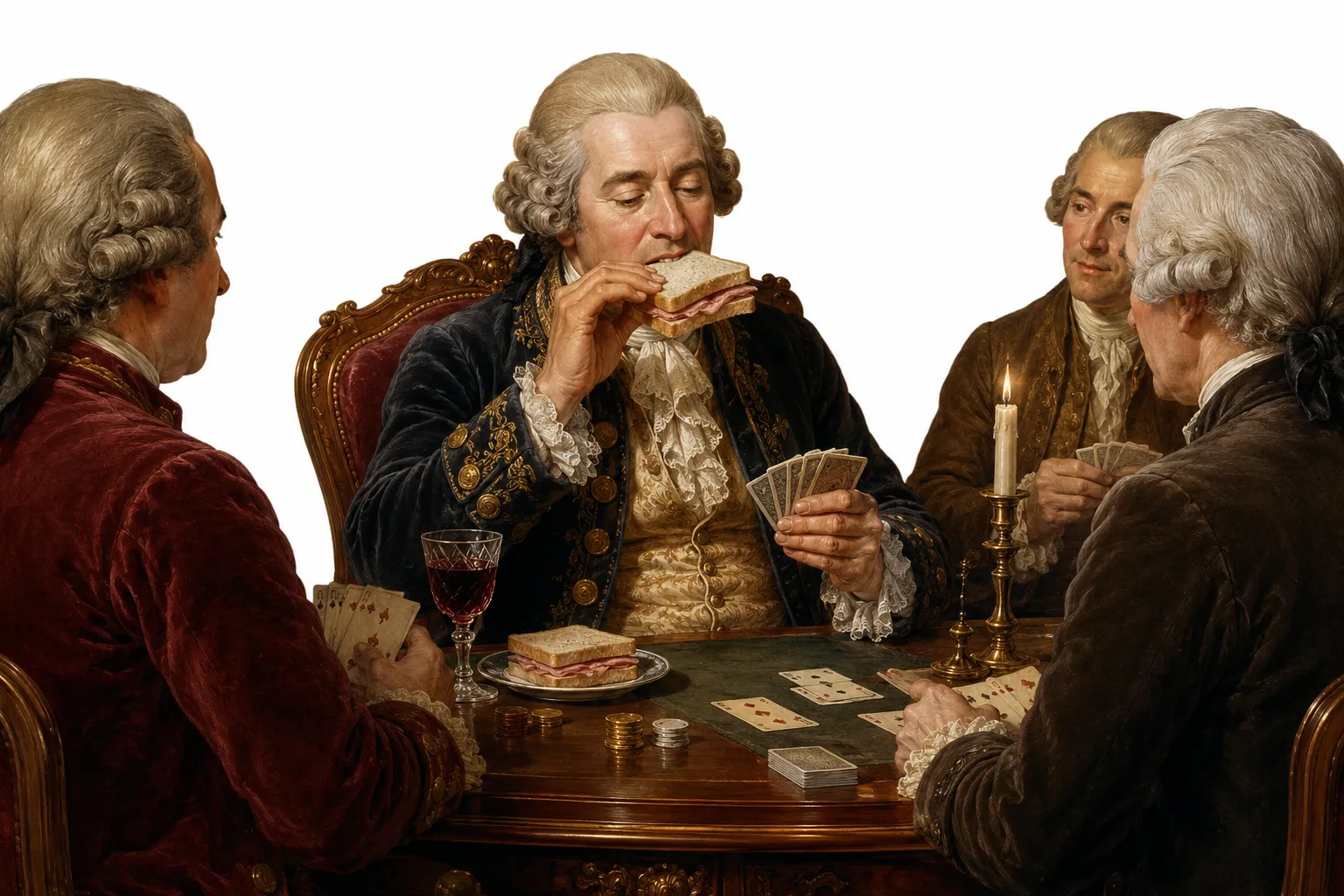
A wedge of bread and meat resting beside a set of 18th-century playing cards
Named after John Montagu, 4th Earl of SandwichFirst recorded use 1762Popular story Wouldn't leave a gambling tableMore likely story Ate at his desk while working

QUICK ANSWER

Here is the idea in plain English.

The sandwich is named after John Montagu, the 4th Earl of Sandwich, who by the 1760s was known for eating meat between slices of bread so he could keep working — or, in the more famous but disputed version, so he wouldn't have to leave a card game. The word first appears in print in 1762.

If you remember only a few things, remember these.

The basic move

Meat wrapped or layered in bread is ancient — cultures across the world had versions of it long before the 1760s. What Montagu actually contributed wasn't the food; it was giving fashionable London society a single, catchy word for 'food you can eat without cutlery, without stopping what you're doing.'

Why it matters

That's the real mechanism behind why this stuck as an eponym and so many similar foods across history didn't: it wasn't the dish that was novel, it was that a titled, socially visible person made eating it in public seem elegant rather than crude, and the newly London-fashionable crowd needed something to call it.

Use it deliberately

When telling this one, it's worth including both versions — the card table legend and the desk-work correction — because the gap between them is itself the most interesting part of the story, not a flaw in it.

CORE IDEA

The concept in its simplest useful form.

The Idea Wasn't New. The Word Was.

Meat wrapped or layered in bread is ancient — cultures across the world had versions of it long before the 1760s. What Montagu actually contributed wasn't the food; it was giving fashionable London society a single, catchy word for 'food you can eat without cutlery, without stopping what you're doing.'

That's the real mechanism behind why this stuck as an eponym and so many similar foods across history didn't: it wasn't the dish that was novel, it was that a titled, socially visible person made eating it in public seem elegant rather than crude, and the newly London-fashionable crowd needed something to call it.

The small mechanism underneath the big idea.

01

The Card Table Story, and the Problem With It

The famous version goes like this: John Montagu, the Earl of Sandwich, was such a devoted gambler that he refused to interrupt a card game for a proper meal, so he ordered meat tucked between two slices of bread and ate one-handed at the table, cards in the other. Other gamblers, wanting the same convenience, started ordering 'the same as Sandwich.'

The story comes almost entirely from one source: a 1770 travel account by the Frenchman Pierre-Jean Grosley, describing a visit to London — written secondhand, based on gossip he'd picked up, not from watching it happen.

Modern historians tend to favor a less colorful version: Montagu held serious government posts, including First Lord of the Admiralty, and was known as a genuinely hard worker who often ate at his desk rather than take a formal meal break. The bread-and-meat habit was likely about administrative efficiency, not card-table addiction — just a less quotable story.

02

A Word for the Menu, Not Just the Man

Within a few decades of Grosley's account being translated into English, 'sandwich' had become the standard word across English-speaking cookery, entirely detached from Montagu's actual life or reputation — most people who order one today couldn't tell you a single other fact about him.

Montagu, for what it's worth, had a fairly controversial political career; the food name is by far the most durable thing attached to him now, an odd kind of immortality for a naval administrator.

Timeline illustration converging global bread-and-filling foods into the 1762 English word sandwich
A timeline illustration showing informal bread-and-filling foods across several centuries and cultures on one side, converging into the single English word 'sandwich' appearing in 1762 London.

Where this idea shows up outside the textbook.

In everyday food

The basic bread-and-filling meal eaten worldwide, called by this name specifically in English.

In language

'Sandwiched between' — used generally now for anything squeezed between two other things, meetings included.

In debate over classification

Ongoing, semi-serious arguments over whether hot dogs, tacos, or burritos technically count as sandwiches.

In business

The 'sandwich generation' — adults simultaneously caring for aging parents and their own children.

CONCEPT MAP

Every idea has neighbors. This is where the current concept sits in the TinyThat knowledge graph.

Current concept

Why Is It Called a Sandwich

The sandwich is named after John Montagu, the 4th Earl of Sandwich, who by the 1760s was known for eating meat between slices of bread so he could keep working — or, in the more famous but disputed version, so he wouldn't have to leave a card game. The word first appears in print in 1762.

What people often get wrong about this idea.

The Earl of Sandwich invented the sandwich.

Bread-wrapped fillings existed across many cultures well before the 1760s; Montagu popularized the English name, not the concept.

The gambling story is confirmed fact.

It rests on one secondhand 1770 travel account, not a firsthand or contemporary source, and many historians consider it likely exaggerated.

Three simple ways to apply the idea without turning it into a slogan.

1

When telling this one, it's worth including both versions — the card table legend and the desk-work correction — because the gap between them is itself the most interesting part of the story, not a flaw in it

When telling this one, it's worth including both versions — the card table legend and the desk-work correction — because the gap between them is itself the most interesting part of the story, not a flaw in it.

Quick answers to common questions.

Did the Earl of Sandwich really invent the sandwich because of gambling?

That's the popular story, but it comes from a single secondhand 1770 account; many historians think it's more likely he simply ate at his desk while working.

When was the word 'sandwich' first used in print?

The earliest known printed use dates to 1762, in reference to the Earl's eating habit.

Is the food itself older than the word?

Yes — versions of bread-wrapped fillings existed in many cultures long before the English word was coined.