Word Origins

Why Is It Called Panic?

It sounds like a description of a feeling. It started as the name of a god who specialized in causing that exact feeling in strangers who wandered somewhere he didn't want them.

A dense, shadowy forest clearing evoking the ancient Greek wilderness associated with Pan
Named after Pan, Greek god of the wildGreek term Panikon deima — 'panic fear'Famous legend Battle of Marathon, 490 BCEDomain Wild places, shepherds, sudden fear

QUICK ANSWER

Here is the idea in plain English.

'Panic' comes from Pan, the Greek god of the wild, shepherds, and flocks, who was believed to cause sudden, irrational terror in travelers who disturbed him in remote or wild places — a fear the Greeks called 'panikon deima,' or 'panic fear.' The word later became linked to the Athenian victory at the Battle of Marathon in 490 BCE, where Pan was credited with striking terror into the Persian army.

If you remember only a few things, remember these.

The basic move

What makes 'panic' distinct from ordinary fear, both in the ancient concept and in modern usage, is the absence of a proportionate, identifiable cause. Ordinary fear responds to something specific — a real threat you can name. Panic, as the Greeks described it, strikes without a clear trigger, often in isolation, often overwhelming reason entirely.

Why it matters

That's precisely why it needed its own god to explain it: unexplained, sudden terror felt like it had to be coming from somewhere outside the person experiencing it — an external force imposing itself, not an internal reaction. Pan was, in a sense, the ancient explanation for what we'd now describe clinically as a panic attack.

Use it deliberately

Reserve 'panic' for fear that's sudden and disproportionate to its trigger, or that spreads faster than the actual threat justifies — that's the distinction the word was built to capture, separate from ordinary, proportionate fear or anxiety.

CORE IDEA

The concept in its simplest useful form.

Fear With No Clear Cause Needed a Name of Its Own

What makes 'panic' distinct from ordinary fear, both in the ancient concept and in modern usage, is the absence of a proportionate, identifiable cause. Ordinary fear responds to something specific — a real threat you can name. Panic, as the Greeks described it, strikes without a clear trigger, often in isolation, often overwhelming reason entirely.

That's precisely why it needed its own god to explain it: unexplained, sudden terror felt like it had to be coming from somewhere outside the person experiencing it — an external force imposing itself, not an internal reaction. Pan was, in a sense, the ancient explanation for what we'd now describe clinically as a panic attack.

The small mechanism underneath the big idea.

01

The God You Didn't Want to Wake Up

Pan was a strange figure even among Greek gods — half man, half goat, associated not with a city or a temple but with the genuinely wild, unmanaged places: forests, mountainsides, remote pastures. He wasn't worshipped the way Zeus or Athena were, in grand civic ceremonies; he was more feared, or placated, by shepherds and travelers passing through his territory.

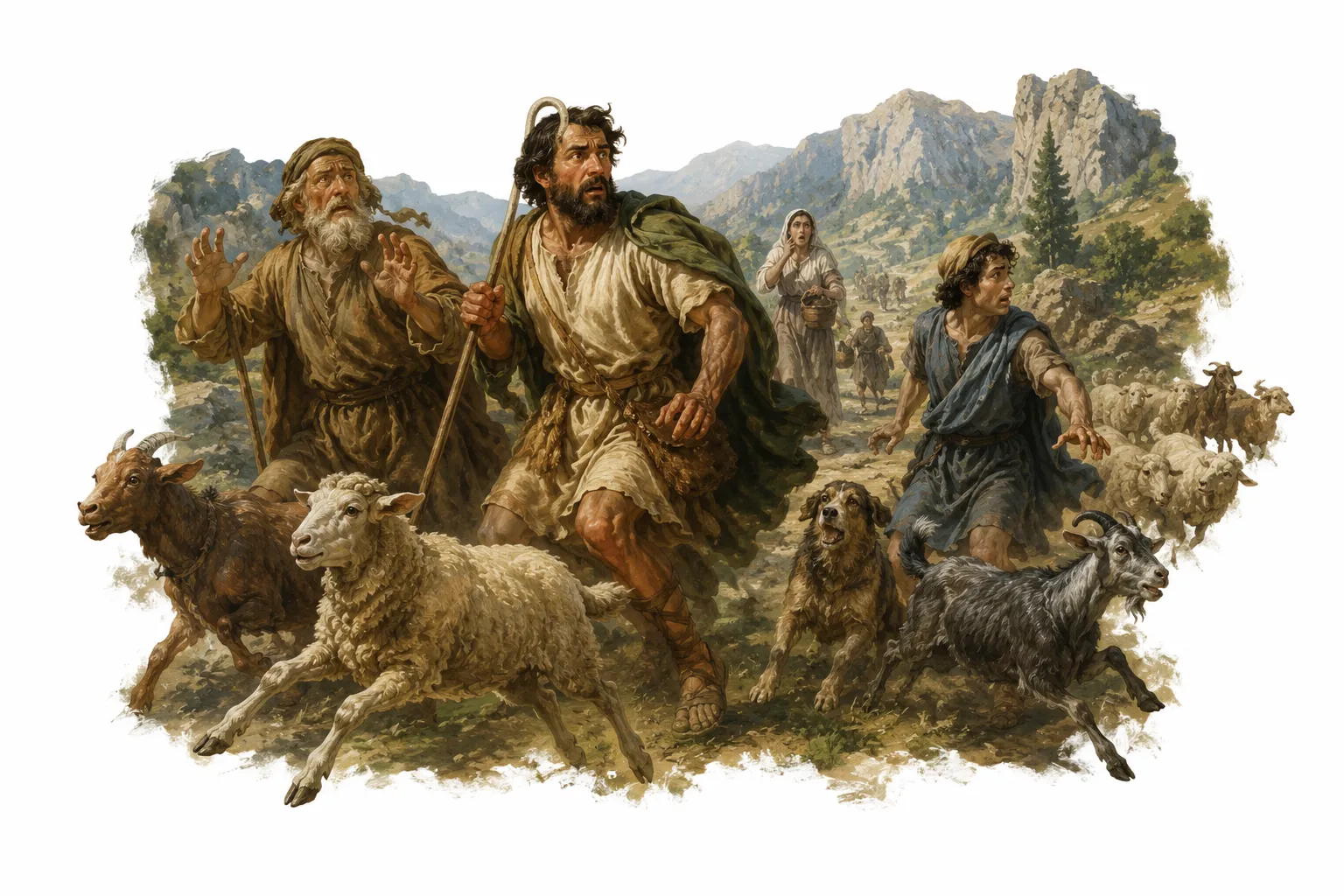
The Greeks believed Pan could inflict a sudden, causeless terror on anyone who intruded on his solitude, especially in the stillness of midday — a fear so specific and irrational it needed its own name, 'panikon deima,' fear caused by Pan, distinct from fear that had an obvious source.

The idea got its most famous historical attachment through the Battle of Marathon. According to the historian Herodotus, the runner Pheidippides, sent to Sparta for military help before the battle, encountered Pan on the road, who complained that Athens neglected him despite his goodwill toward the city and promised to aid them anyway. The Athenians won a stunning victory against a much larger Persian force, and Pan was widely credited with helping cause disorder and terror in the enemy ranks.

02

From a Minor Woodland God to a Clinical Term

Pan himself was never one of the major, widely worshipped Olympian gods, which makes it a little unusual that his name is the one that survived into everyday modern vocabulary so thoroughly, while far more prominent gods left comparatively few common English words behind.

The word's staying power owes a lot to how precisely it named something real and universal — sudden, disproportionate, contagious fear — that needed a label regardless of whether anyone still believed a goat-legged god was causing it. By the time psychology needed a clinical term for exactly that experience, 'panic' was already sitting right there, ready-made.

Illustration contrasting calm fear with sudden causeless terror at a forest edge
An illustration contrasting a figure calmly walking a clear, sunlit path with a figure recoiling in sudden fear at the edge of a dark, undefined tree line, with no visible threat shown.

Where this idea shows up outside the textbook.

In clinical psychology

Panic attacks and panic disorder, characterized by sudden, intense fear without a clear immediate trigger.

In economics

Financial 'panics' — sudden, self-reinforcing waves of fear driving market crashes or bank runs.

In crowd behavior

Mass panic, where fear spreads through a group faster than any single cause could justify.

In everyday speech

Casually describing any sudden burst of stress, as in 'don't panic.'

CONCEPT MAP

Every idea has neighbors. This is where the current concept sits in the TinyThat knowledge graph.

Current concept

Why Is It Called Panic

'Panic' comes from Pan, the Greek god of the wild, shepherds, and flocks, who was believed to cause sudden, irrational terror in travelers who disturbed him in remote or wild places — a fear the Greeks called 'panikon deima,' or 'panic fear.' The word later became linked to the Athenian victory at the Battle of Marathon in 490 BCE, where Pan was credited with striking terror into the Persian army.

What people often get wrong about this idea.

Pan was a major, widely worshipped Olympian god.

He was a comparatively minor, rural deity associated with wild places, not one of the twelve central Olympian gods.

'Panic' always implies mass, crowd-level fear.

The original Greek concept applied just as much to a single lone traveler in the wilderness as to any group.

Three simple ways to apply the idea without turning it into a slogan.

1

Reserve 'panic' for fear that's sudden and disproportionate to its trigger, or that spreads faster than the actual threat justifies — that's the distinction the word was built to capture, separate from ordinary, proportionate fear or anxiety

Reserve 'panic' for fear that's sudden and disproportionate to its trigger, or that spreads faster than the actual threat justifies — that's the distinction the word was built to capture, separate from ordinary, proportionate fear or anxiety.

Quick answers to common questions.

Is 'panic' actually named after the god Pan?

Yes — the Greek phrase 'panikon deima' ('panic fear') explicitly attributes sudden, unexplained terror to Pan, and the English word derives directly from that.

What is the connection between panic and the Battle of Marathon?

According to Herodotus, Pan pledged support to Athens before the battle and was later credited with helping cause disorder and terror among the Persian forces, reinforcing his association with sudden, overwhelming fear.

Is 'pandemonium' related to 'panic'?

No, despite the similar sound — 'pandemonium' was coined by John Milton from Greek roots meaning 'all demons,' unrelated to the god Pan.