Word Origins

Why Is It Called a Mentor?

The original Mentor gave surprisingly little of the advice credited to him. Most of it came from a goddess wearing his face.

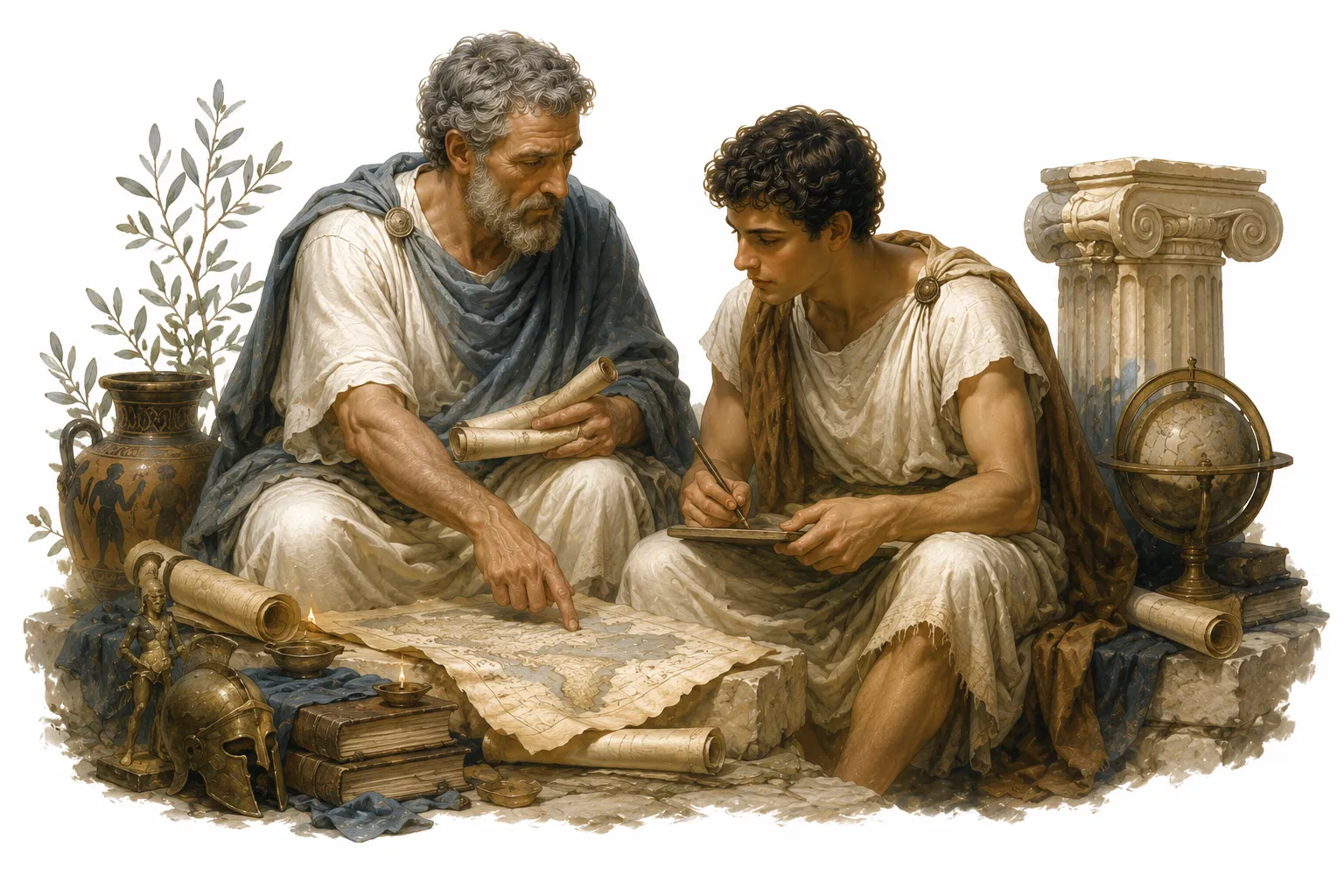
An ancient Greek pottery illustration of an older man advising a young traveler
Source Homer's Odyssey (c. 8th century BCE)Original role Guardian of Telemachus, Odysseus's sonTwist Athena disguises herself as Mentor to advise Telemachus directlyModern meaning popularized by Fénelon's 'Les Aventures de Télémaque' (1699)

QUICK ANSWER

Here is the idea in plain English.

'Mentor' comes from a character in Homer's Odyssey, an old friend Odysseus leaves in charge of his household and son, Telemachus, while away at war. The goddess Athena repeatedly disguises herself as Mentor to guide Telemachus directly — meaning the wisest advice in the story technically comes from her, not him.

If you remember only a few things, remember these.

The basic move

Strip away the mythology, and the Odyssey's version of mentorship is actually a fairly sharp observation: sometimes the most valuable advice arrives wearing a familiar, trusted face, precisely because a young person is more likely to listen to someone they already know and respect than to a stranger, however wise.

Why it matters

That's arguably a more interesting founding idea for the word than a simple 'wise old man gives good advice' story — the myth is really about trust as the delivery mechanism for wisdom, not wisdom on its own.

Use it deliberately

A mentor relationship implies more than giving advice — it implies an ongoing, trusted relationship the guidance travels through. That's the part of the original story worth keeping: it's less about being the smartest voice in the room and more about being the trusted one.

CORE IDEA

The concept in its simplest useful form.

Guidance Doesn't Require the Guide to Be Who They Seem

Strip away the mythology, and the Odyssey's version of mentorship is actually a fairly sharp observation: sometimes the most valuable advice arrives wearing a familiar, trusted face, precisely because a young person is more likely to listen to someone they already know and respect than to a stranger, however wise.

That's arguably a more interesting founding idea for the word than a simple 'wise old man gives good advice' story — the myth is really about trust as the delivery mechanism for wisdom, not wisdom on its own.

The small mechanism underneath the big idea.

01

The Advisor Who Was Usually a Goddess in Disguise

In Homer's Odyssey, Mentor is an aging friend Odysseus trusts to look after his household and his son Telemachus while he's away fighting, and later lost, on his long journey home. On paper, that's the whole role: a loyal steward left in charge.

But the actual guidance Telemachus receives in the story comes largely from Athena, goddess of wisdom, who repeatedly takes on Mentor's exact appearance to counsel Telemachus directly — urging him to search for news of his father, sail out into the world, and grow into the kind of man capable of reclaiming his home. The real Mentor, as written, is mostly a name Athena borrows.

It's a strange origin for the word, when you notice it: the concept of a 'mentor' as a source of wise guidance is technically named after a character whose main function in the text is being impersonated by someone wiser.

02

A French Sequel Did More Than Homer Did

Mentor existed in Homer's text for centuries as a fairly minor character before the word gained its modern, general meaning. The real turning point came from a very different book: François Fénelon's 1699 French novel 'Les Aventures de Télémaque,' a continuation of Telemachus's story written explicitly as a moral and political education for the young grandson of King Louis XIV.

Fénelon's version puts the character Mentor front and center as a constant guiding presence throughout the narrative, and the book became enormously popular and influential across Europe as an educational text in its own right — widely read, translated, and imitated for over a century. That popularity is largely what pushed 'mentor' from a minor Homeric name into the general English noun for a wise guide or trusted advisor.

Silhouette of an older man with a subtle owl symbol suggesting Athena's disguise
An illustration showing an older man's silhouette with a faint owl symbol (representing Athena) subtly overlaid within it, suggesting the disguise.

Where this idea shows up outside the textbook.

In education

Formal school and university mentorship programs pairing students with experienced advisors.

In the workplace

Senior employees informally or formally guiding newer colleagues through career development.

In fiction

The 'mentor' archetype in storytelling — an older guide who trains and advises the protagonist, a pattern scholars trace partly back to this exact myth.

In sports

Veteran athletes or coaches taking younger players under their guidance.

CONCEPT MAP

Every idea has neighbors. This is where the current concept sits in the TinyThat knowledge graph.

Current concept

Why Is It Called a Mentor

'Mentor' comes from a character in Homer's Odyssey, an old friend Odysseus leaves in charge of his household and son, Telemachus, while away at war. The goddess Athena repeatedly disguises herself as Mentor to guide Telemachus directly — meaning the wisest advice in the story technically comes from her, not him.

What people often get wrong about this idea.

Mentor was the primary source of wisdom in the Odyssey.

Most of the meaningful guidance to Telemachus in the text actually comes from Athena, who repeatedly disguises herself as Mentor to deliver it.

The modern meaning of 'mentor' comes straight from Homer.

The general English sense owes much more to Fénelon's hugely popular 1699 French continuation of the story than to the original Odyssey text.

Three simple ways to apply the idea without turning it into a slogan.

1

A mentor relationship implies more than giving advice — it implies an ongoing, trusted relationship the guidance travels through

A mentor relationship implies more than giving advice — it implies an ongoing, trusted relationship the guidance travels through. That's the part of the original story worth keeping: it's less about being the smartest voice in the room and more about being the trusted one.

Quick answers to common questions.

Was Mentor in the Odyssey a real wise man, or a disguise?

Mentor is a named character in the Odyssey, but much of the guidance credited to him is actually delivered by the goddess Athena disguised in his form.

Where does the modern meaning of 'mentor' come from?

It's largely traced to François Fénelon's 1699 French novel 'Les Aventures de Télémaque,' which put the Mentor character at the center of a widely read moral education story and helped popularize the general use of the word.

Is a mentor the same as a teacher?

Not quite — mentoring typically implies a more personal, ongoing relationship built on trust, rather than the more formal, structured relationship implied by 'teacher.'