Word Origins

Was Ned Ludd a Real Person?

Call someone a Luddite today and you mean they're scared of their phone. The actual Luddites were expert machinists who understood the technology better than most of the men who owned it.

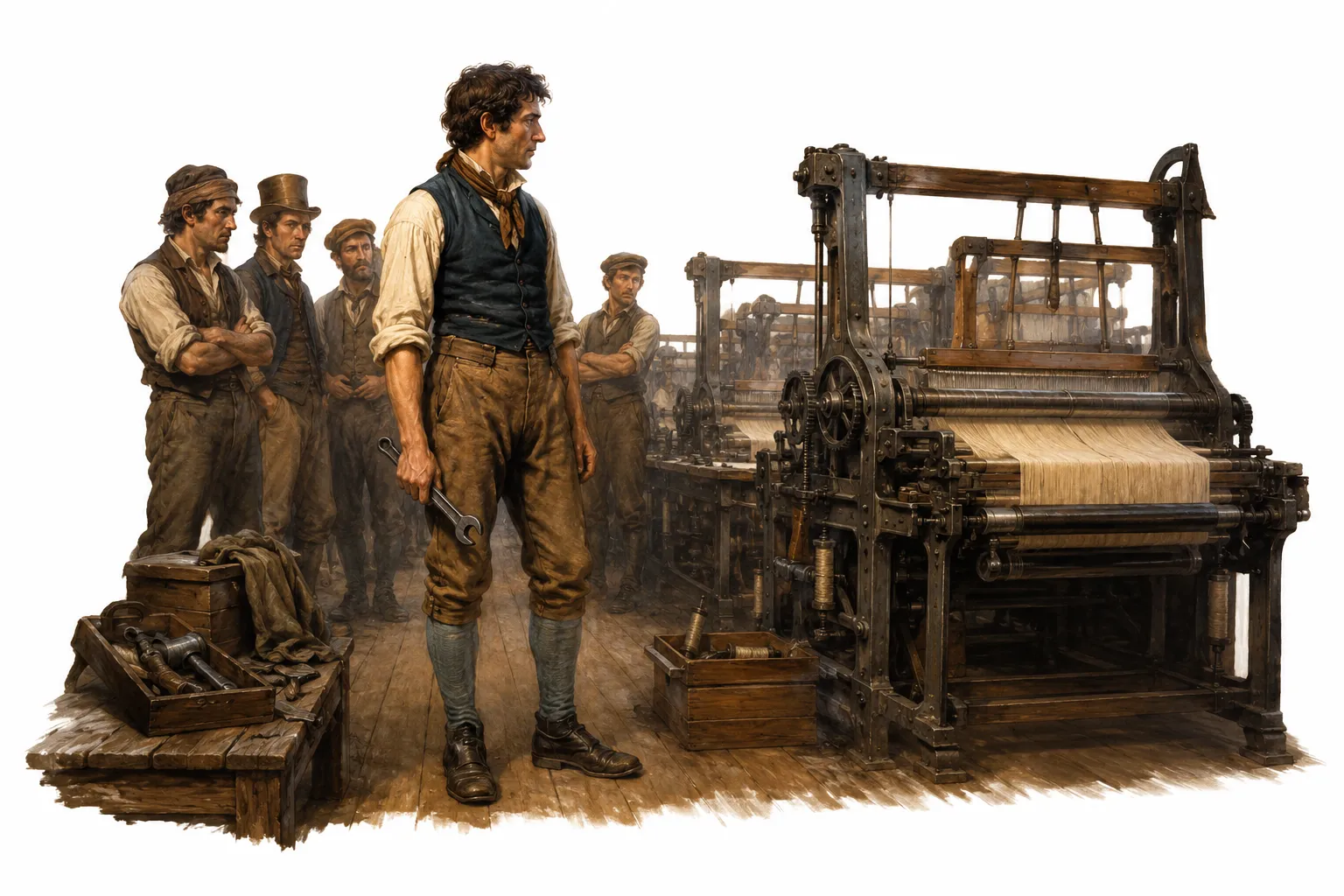
A dim 19th-century textile mill interior with rows of mechanical knitting frames
Movement active 1811–1816, EnglandNamed after 'Ned Ludd,' likely apocryphalPunishment introduced Death penalty for frame-breaking, 1812Actual grievance Wages and deskilling, not machines

QUICK ANSWER

Here is the idea in plain English.

Luddites were English textile workers who, between 1811 and 1816, smashed factory machinery to protest wage cuts and the use of unskilled labor — not the machines themselves. They were named after Ned Ludd, a probably-fictional apprentice supposedly said to have smashed two knitting frames in 1779 in a fit of temper.

If you remember only a few things, remember these.

The basic move

The popular version says Luddites hated technology and wanted to go back to hand-weaving. The actual complaint was narrower and, honestly, more reasonable: mill owners were using new frames to churn out cheap, shoddy goods, made by unapprenticed workers paid a fraction of a skilled weaver's wage — while calling the product the same thing a trained craftsman used to make.

Why it matters

The Luddites weren't smashing every machine in sight. Raiders often left alone the frames of owners who paid fair wages and used trained workers, and targeted specifically the ones being used to undercut both. This wasn't blind rage at technology. It was a targeted labor dispute that happened to involve hammers instead of picket signs.

Use it deliberately

If you want the accurate jab, aim it at people opposing a specific economic effect of technology — job loss, deskilling, wage suppression — not at someone who simply prefers a landline. Calling every skeptic a Luddite erases the one thing that made the original Luddites interesting: they had a specific, arguable point.

CORE IDEA

The concept in its simplest useful form.

They Weren't Against the Machines. They Were Against the Trick.

The popular version says Luddites hated technology and wanted to go back to hand-weaving. The actual complaint was narrower and, honestly, more reasonable: mill owners were using new frames to churn out cheap, shoddy goods, made by unapprenticed workers paid a fraction of a skilled weaver's wage — while calling the product the same thing a trained craftsman used to make.

The Luddites weren't smashing every machine in sight. Raiders often left alone the frames of owners who paid fair wages and used trained workers, and targeted specifically the ones being used to undercut both. This wasn't blind rage at technology. It was a targeted labor dispute that happened to involve hammers instead of picket signs.

The small mechanism underneath the big idea.

01

The Man Who Probably Didn't Exist

Every Luddite raid supposedly traced back to one act: in 1779, in a Leicestershire village, an apprentice named Ned Ludd allegedly took a hammer to two stocking frames in a rage — either because he'd been whipped for idleness, or because he'd been ordered to work too fast, depending on who's telling it.

Nobody has ever found a birth record, a court record, or a contemporary who claims to have actually met him. Historians now generally treat Ned Ludd the way you'd treat a bar legend — a story that keeps getting told because it's a good story, not because anyone checked it.

What's certain is what came after. Starting in Nottinghamshire in 1811, groups of textile workers began raiding mills at night, smashing specific machines, and signing their threatening letters from 'General Ludd' or 'King Ludd' — a folk hero invented on the spot to give a leaderless movement a leader.

02

From Hanging Offense to Internet Insult

The British government took the raids seriously enough to make machine-breaking a capital crime in 1812 and to deploy more soldiers domestically against the Luddites than Wellington had fighting Napoleon in Spain that same year. Dozens were hanged or transported to Australia before the movement collapsed by 1816.

The word went quiet for over a century, then got resurrected in the 20th century as shorthand for anyone reluctant to adopt new technology — a meaning almost the opposite of the original movement's actual, narrow economic grievance. By the time computers arrived, 'Luddite' had become an all-purpose jab at your uncle who won't use email.

Illustration comparing a skilled hand weaver to an unskilled power-loom operator
A split illustration: on the left, a trained weaver at a hand loom producing fine cloth; on the right, an unskilled worker feeding a power loom producing thin, uneven cloth at speed — with a wage figure stamped beneath each showing the pay gap.

Where this idea shows up outside the textbook.

In tech criticism

Dismissively used against anyone questioning AI, automation, or social media, regardless of whether the objection resembles the original wage-and-quality complaint at all.

In labor history

Historians now use 'neo-Luddite' more precisely, for movements that specifically protest technology's effect on labor conditions, closer to the 1811 original.

In everyday speech

Self-deprecating shorthand — 'I'm such a Luddite' — for someone who still prefers a paper calendar.

In academic history

A whole subfield studies Luddism as an early, sophisticated labor movement rather than a reactionary one.

CONCEPT MAP

Every idea has neighbors. This is where the current concept sits in the TinyThat knowledge graph.

Current concept

Was Ned Ludd a Real Person

Luddites were English textile workers who, between 1811 and 1816, smashed factory machinery to protest wage cuts and the use of unskilled labor — not the machines themselves. They were named after Ned Ludd, a probably-fictional apprentice supposedly said to have smashed two knitting frames in 1779 in a fit of temper.

What people often get wrong about this idea.

Luddites were anti-technology.

They objected to specific uses of machinery — cheap goods and unskilled labor undercutting trained workers — not machinery in general.

Ned Ludd led the movement.

He's almost certainly a legend invented to give anonymous raiders a symbolic leader; no solid historical record of him exists.

The Luddites lost badly and quietly.

The government's response was disproportionately severe — more troops than were fighting Napoleon in Spain — which tells you how seriously authorities took the threat.

Three simple ways to apply the idea without turning it into a slogan.

1

If you want the accurate jab, aim it at people opposing a specific economic effect of technology — job loss, deskilling, wage suppression — not at someone who simply prefers a landline

If you want the accurate jab, aim it at people opposing a specific economic effect of technology — job loss, deskilling, wage suppression — not at someone who simply prefers a landline. Calling every skeptic a Luddite erases the one thing that made the original Luddites interesting: they had a specific, arguable point.

Quick answers to common questions.

Did the Luddites actually destroy all machines?

No — raids often targeted specific frames owned by employers paying low wages to unskilled workers, while sparing machinery used by employers who kept fair labor practices.

Was Ned Ludd a real person?

There's no verified historical record of him; most historians treat him as a folk legend the movement adopted as a symbolic figurehead.

Why did machine-breaking become a capital offense?

Parliament passed the Frame-Breaking Act in 1812 specifically in response to the raids, making destruction of textile machinery punishable by death.

Is 'Luddite' still an insult today?

Yes, though it's used loosely — usually for anyone reluctant to adopt new technology, regardless of whether their reasoning resembles the original movement's.