Word Origins

Why Is It Called a Gerrymander?

The practice is as old as elections themselves. The word is much younger, and it's named after a man who reportedly hated the whole idea.

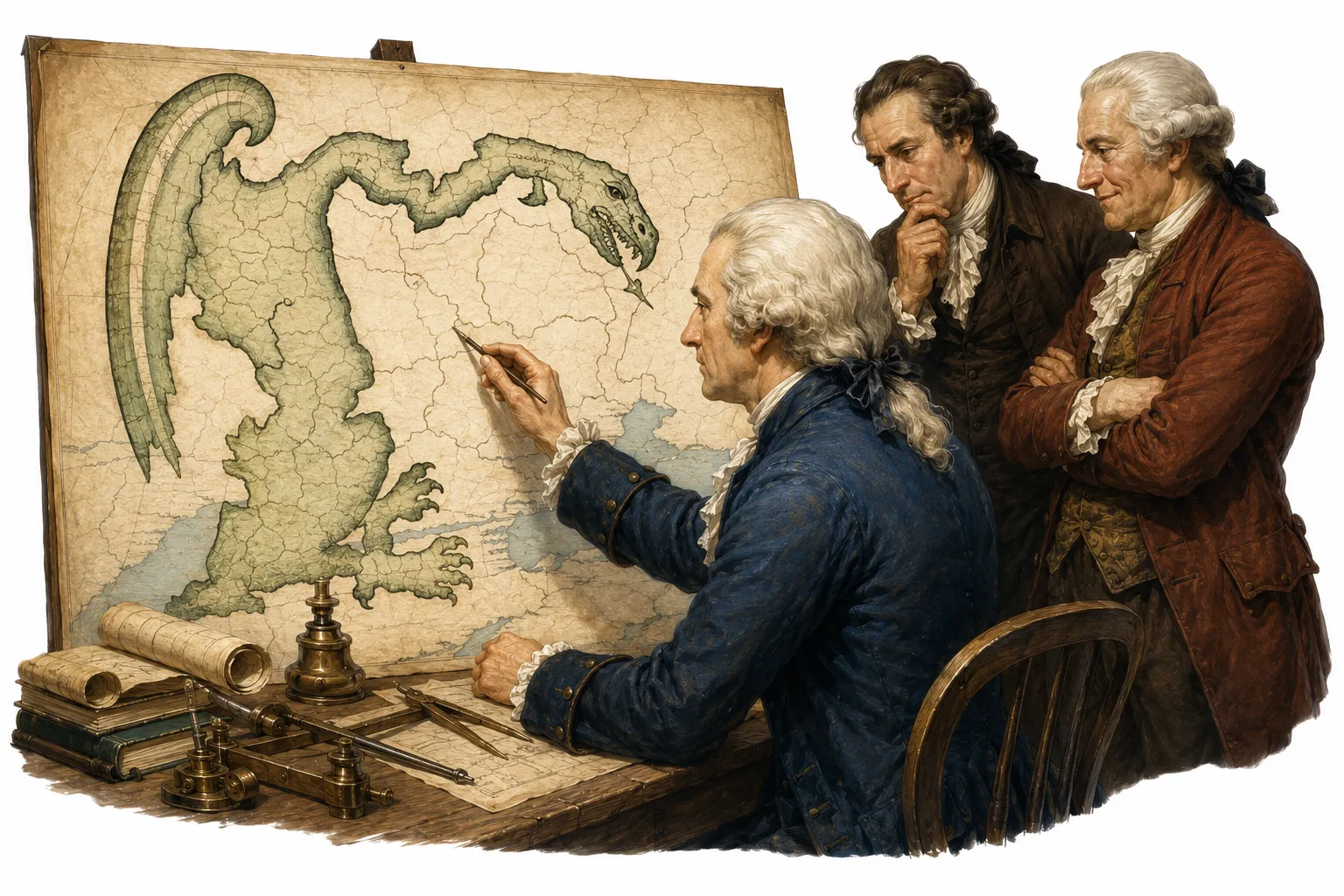
A vintage political cartoon of a winged, clawed salamander-shaped map district
Coined March 26, 1812, Boston GazetteNamed after Governor Elbridge GerryCartoonist Elkanah TisdaleOdd detail 'Gerry' is pronounced like 'Gary'; the word isn't

QUICK ANSWER

Here is the idea in plain English.

'Gerrymander' comes from Massachusetts Governor Elbridge Gerry, who in February 1812 signed a redistricting law that heavily favored his party. A Boston Gazette cartoon that March, drawn by Elkanah Tisdale, depicted one of the oddly shaped new districts as a salamander-like monster and dubbed it 'The Gerry-Mander' — a blend of Gerry's name and 'salamander.'

If you remember only a few things, remember these.

The basic move

Gerrymandering works by manipulating the *shape* of voting districts rather than the votes themselves — concentrating your opponents' supporters into a small number of districts they win overwhelmingly (a strategy called 'packing'), while spreading them thin across many districts where they always lose by a small margin ('cracking'). No individual vote is touched. The map does all the work.

Why it matters

That's what made the original Essex County district so visually strange — its odd, snaking shape wasn't an accident of geography, it was the geometry of a specific vote-counting strategy, made visible enough that a cartoonist could draw a monster out of it.

Use it deliberately

'Gerrymander' specifically describes manipulating district boundaries for political advantage — it's not a generic synonym for any political unfairness, and it applies to the shape of the map, not to vote counting, campaign spending, or other separate forms of electoral manipulation.

CORE IDEA

The concept in its simplest useful form.

A Shape Is a Strategy

Gerrymandering works by manipulating the *shape* of voting districts rather than the votes themselves — concentrating your opponents' supporters into a small number of districts they win overwhelmingly (a strategy called 'packing'), while spreading them thin across many districts where they always lose by a small margin ('cracking'). No individual vote is touched. The map does all the work.

That's what made the original Essex County district so visually strange — its odd, snaking shape wasn't an accident of geography, it was the geometry of a specific vote-counting strategy, made visible enough that a cartoonist could draw a monster out of it.

The small mechanism underneath the big idea.

01

A Governor Who Reportedly Didn't Even Like the Plan

On February 11, 1812, Massachusetts Governor Elbridge Gerry — a signer of the Declaration of Independence and later U.S. vice president — signed a bill redrawing state senate districts to consolidate his Democratic-Republican party's voting strength, at the direct expense of the rival Federalists. Contemporary accounts suggest Gerry personally found the plan distasteful, but he signed it anyway.

One of the resulting districts, wrapping oddly through Essex County to capture the right voters, looked strange enough on a map that it caught an illustrator's eye. Artist Elkanah Tisdale added a head, wings, and claws to the district's outline, turning it into a dragon-like creature, and the Boston Gazette ran it on March 26, 1812, under the title 'The Gerry-Mander' — a play on Gerry's name and 'salamander.'

The exact origin of the actual pun is disputed — a later historical account credits it to a joke made at a private Boston dinner party among Federalist newspapermen, with poet Richard Alsop supposedly coining the word on the spot when someone said the district looked like a salamander. Either way, the word and the image spread together, fast.

02

A 19th-Century Word for a Still-Current Fight

What kept 'gerrymander' alive for over two centuries, rather than fading as a dated 1812 reference, is that the practice it names never went away — redistricting fights over district shape remain a live, actively litigated issue in American politics today, which means the word gets fresh use in news coverage every redistricting cycle.

There's a small irony baked into the word's survival: Elbridge Gerry's name is pronounced like 'Gary,' but almost everyone now pronounces 'gerrymander' with a soft 'J' — 'Jerry-mander' — meaning most people using the word aren't even saying his name correctly.

Two district maps of identical population data showing proportional versus gerrymandered outcomes
Two side-by-side district maps of the same population of colored dots: one divided into neat squares producing a proportional result, one divided into oddly snaking shapes producing a lopsided result from the identical population.

Where this idea shows up outside the textbook.

In U.S. politics

Ongoing legal battles over congressional district maps drawn after each decennial census.

In legal terminology

'Racial gerrymandering,' specifically challenged under the Voting Rights Act.

In data journalism

Compactness scores and algorithms now used to flag unusually shaped districts.

In general usage

Loosely applied to any rule or system rigged through its structure rather than its content.

CONCEPT MAP

Every idea has neighbors. This is where the current concept sits in the TinyThat knowledge graph.

Current concept

Why Is It Called a Gerrymander

'Gerrymander' comes from Massachusetts Governor Elbridge Gerry, who in February 1812 signed a redistricting law that heavily favored his party. A Boston Gazette cartoon that March, drawn by Elkanah Tisdale, depicted one of the oddly shaped new districts as a salamander-like monster and dubbed it 'The Gerry-Mander' — a blend of Gerry's name and 'salamander.'

What people often get wrong about this idea.

Elbridge Gerry invented the practice of rigging district maps.

The practice predates him considerably; he simply signed the specific 1812 law that produced the district a cartoonist turned into 'The Gerry-Mander.'

Gerry actively championed the redistricting plan.

Historical accounts suggest Gerry found the plan personally disagreeable, though he signed it as governor; he also lost his own next election shortly after.

The word is pronounced the same as Gerry's name.

'Gerry' is pronounced like 'Gary,' but 'gerrymander' is almost universally pronounced with a soft 'J' sound today.

Three simple ways to apply the idea without turning it into a slogan.

1

'Gerrymander' specifically describes manipulating district boundaries for political advantage — it's not a generic synonym for any political unfairness, and it applies to the shape of the map, not to vote counting, campaign spending, or other separate forms of electoral manipulation

'Gerrymander' specifically describes manipulating district boundaries for political advantage — it's not a generic synonym for any political unfairness, and it applies to the shape of the map, not to vote counting, campaign spending, or other separate forms of electoral manipulation.

Quick answers to common questions.

Who coined the word 'gerrymander'?

The exact coiner is disputed and was never definitively identified, though the word and its accompanying cartoon first appeared in the Boston Gazette on March 26, 1812, illustrated by Elkanah Tisdale.

Did Elbridge Gerry support the redistricting plan?

Accounts suggest he personally found it distasteful but signed it into law as governor in February 1812; he lost his own reelection bid later that year.

How do you pronounce gerrymander?

Most people today pronounce it with a soft 'J' sound ('Jerry-mander'), even though Elbridge Gerry's own name was pronounced like 'Gary.'

Is gerrymandering illegal in the United States?

It depends on the type — racial gerrymandering can violate the Voting Rights Act and has been struck down by courts, while partisan gerrymandering has faced a more mixed and evolving legal record.