Word Origins

Why Is It Called a Diesel Engine?

It sounds like a fuel first, an inventor second. It's actually the other way around, and the inventor's ending is stranger than anything in the engine itself.

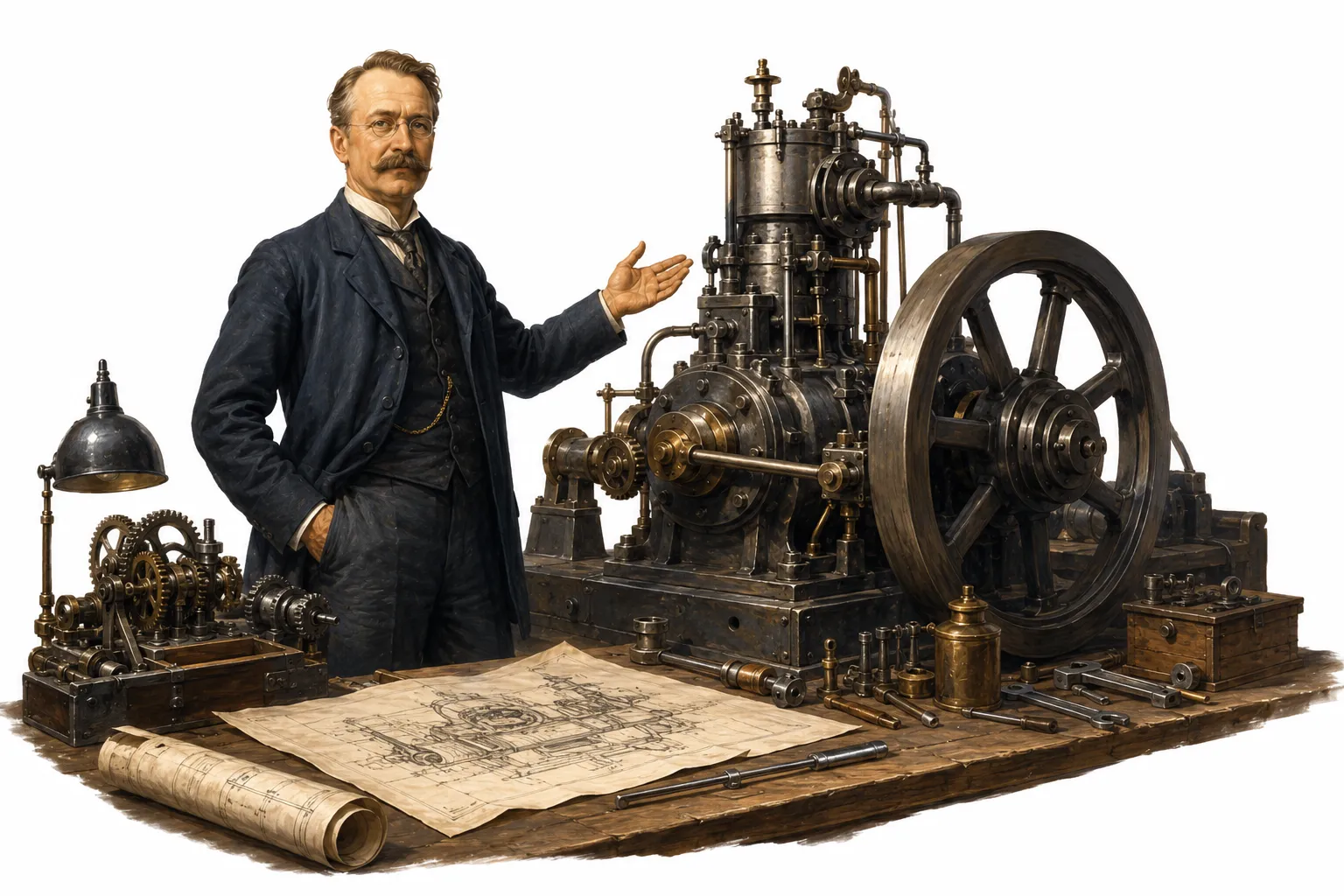
A cutaway technical illustration of an early compression-ignition engine
Patented 1892–1893, Rudolf DieselOriginally designed to run on Peanut oil / vegetable oilDemonstrated at 1900 Paris ExpositionDiesel's death Disappeared at sea, 1913

QUICK ANSWER

Here is the idea in plain English.

The diesel engine is named after Rudolf Diesel, a German engineer who patented a compression-ignition engine design in the early 1890s. He designed it to be dramatically more fuel-efficient than the steam engine and initially intended it to run on vegetable oils, not petroleum.

If you remember only a few things, remember these.

The basic move

A gasoline engine ignites its fuel-air mixture with a spark plug. A diesel engine skips the spark entirely: it compresses air so hard and so fast that it simply gets hot enough to ignite the injected fuel on its own. Less wasted energy, more of the fuel's potential converted directly into motion.

Why it matters

That single design choice is the whole reason diesel engines get better mileage and more torque than equivalent gasoline engines, and it's exactly the efficiency gain Diesel set out to invent in the first place.

Use it deliberately

'Diesel' correctly refers to the compression-ignition mechanism itself, not just the fuel — a diesel engine can, in principle, run on various oils, which is exactly what modern biodiesel takes advantage of.

CORE IDEA

The concept in its simplest useful form.

Compression Instead of a Spark

A gasoline engine ignites its fuel-air mixture with a spark plug. A diesel engine skips the spark entirely: it compresses air so hard and so fast that it simply gets hot enough to ignite the injected fuel on its own. Less wasted energy, more of the fuel's potential converted directly into motion.

That single design choice is the whole reason diesel engines get better mileage and more torque than equivalent gasoline engines, and it's exactly the efficiency gain Diesel set out to invent in the first place.

The small mechanism underneath the big idea.

01

An Engine Built to Help the Little Guy

Rudolf Diesel wasn't chasing horsepower for its own sake. He was frustrated by how wasteful the steam engines of his era were — most of the energy from the fuel disappeared as heat rather than doing useful work — and set out to design something closer to thermodynamically ideal.

His solution, patented in the early 1890s, used compression alone to ignite fuel, without spark plugs, and it worked — dramatically more efficient than steam. But Diesel had a second ambition that gets left out of most short versions of the story: he wanted his engine to run on vegetable oil, specifically so that small farmers and workshops in developing regions could run machinery on locally grown fuel instead of depending on imported coal or petroleum.

At the 1900 Paris Exposition, Diesel's engine ran on peanut oil, exactly as he'd hoped — proof, to him, that industrial power didn't have to be tied to a handful of fuel-exporting nations.

02

The Mystery That Made Him More Famous Than the Engine

In September 1913, Diesel boarded a mail steamer crossing the English Channel from Antwerp to Harwich, heading to a meeting in England. He was seen going to his cabin that night and was never seen alive again. Ten days later, a body — identified from personal items — was recovered from the sea by the crew of another ship.

The disappearance happened on the eve of World War I, with Diesel's engine technology of clear military interest to multiple governments, which fed decades of speculation — accident, suicide amid financial troubles, even sabotage — none of it ever conclusively resolved.

The mystery kept his name in circulation long after the technical details of his patent had become industry standard, and 'diesel' stopped being a person's name and became, permanently, a category of fuel and engine.

Side-by-side diagram comparing spark ignition and compression ignition
A side-by-side cutaway diagram: one cylinder with a spark plug firing (gasoline), one cylinder compressing air to the point of self-ignition with fuel injected directly (diesel).

Where this idea shows up outside the textbook.

In transportation

Trucks, trains, and ships overwhelmingly run diesel engines because of their torque and fuel efficiency at heavy loads.

In fuel terminology

'Diesel' as a fuel type sold at gas stations, chemically distinct from gasoline.

In slang

'Diesel' used informally to describe something powerfully built or muscular.

In renewable energy

Modern biodiesel, made from vegetable oils, is essentially a direct return to Diesel's original 1900 vision.

CONCEPT MAP

Every idea has neighbors. This is where the current concept sits in the TinyThat knowledge graph.

Current concept

Why Is It Called a Diesel Engine

The diesel engine is named after Rudolf Diesel, a German engineer who patented a compression-ignition engine design in the early 1890s. He designed it to be dramatically more fuel-efficient than the steam engine and initially intended it to run on vegetable oils, not petroleum.

What people often get wrong about this idea.

Diesel engines were designed to run specifically on petroleum diesel fuel.

Rudolf Diesel originally designed and demonstrated his engine running on peanut oil; petroleum-based diesel fuel became standard later, largely for cost reasons.

Diesel's death was definitively ruled a murder.

The cause of his disappearance and death has never been conclusively established — accident and suicide remain the leading theories among historians, alongside persistent but unproven foul-play speculation.

Three simple ways to apply the idea without turning it into a slogan.

1

'Diesel' correctly refers to the compression-ignition mechanism itself, not just the fuel — a diesel engine can, in principle, run on various oils, which is exactly what modern biodiesel takes advantage of

'Diesel' correctly refers to the compression-ignition mechanism itself, not just the fuel — a diesel engine can, in principle, run on various oils, which is exactly what modern biodiesel takes advantage of.

Quick answers to common questions.

Did Rudolf Diesel intend his engine to run on peanut oil?

Yes — he demonstrated it running on peanut oil at the 1900 Paris Exposition, explicitly hoping to make industrial power accessible to farmers using locally grown fuel.

How did Rudolf Diesel die?

He disappeared from a Channel steamer in September 1913 and a body believed to be his was recovered from the sea about ten days later; the exact circumstances were never conclusively determined.

What's the main difference between a diesel and gasoline engine?

Diesel engines ignite fuel through high compression alone, without a spark plug, which generally makes them more fuel-efficient and higher-torque than gasoline engines.