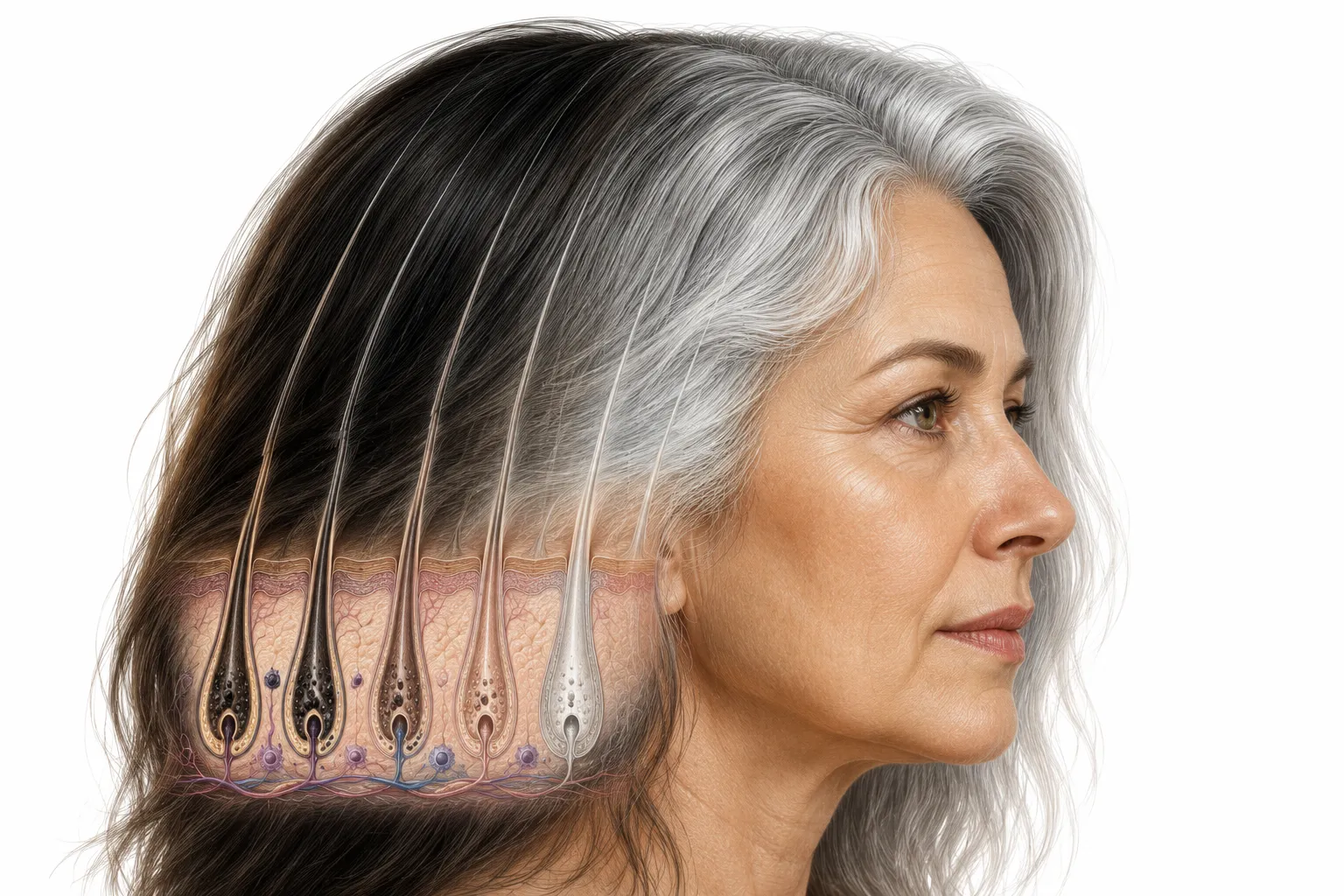
A strand of 'gray' hair is not actually gray in pigment; it's colorless and appears gray or silver because of how light scatters off its structure.
Body & Brain
Why does hair turn gray as we age?
Why Does Hair Turn Gray?
Somewhere around midlife, a strand of hair grows in looking different from every strand that came before it, not dyed or faded, just colorless.
On this page
The short answer
Hair turns gray because the melanocyte stem cells that supply pigment to each hair follicle gradually deplete with age, so new hair grows in without the melanin that used to color it, appearing gray, silver, or white depending on how much pigment remains.
Hair color comes from melanin, a pigment produced by cells called melanocytes that live at the base of each hair follicle and deposit color into the growing hair shaft. These melanocytes are replenished by a reservoir of melanocyte stem cells. As a person ages, this stem cell reservoir gradually depletes, a process driven by cellular aging, oxidative stress, and DNA damage accumulating in the follicle over decades. Once a follicle's melanocyte stem cells are exhausted, that follicle can no longer supply pigment to new hair, and the strand grows in without color. Because hair is actually translucent rather than white, the visual effect of no pigment combined with light scattering off the strand's keratin structure is what reads to the eye as gray, silver, or white. Different follicles exhaust their pigment supply at different rates, which is why graying typically appears gradually and unevenly rather than all at once.
At a glance
Hair color is added during growth, not applied afterward.
Plucking a single gray hair causes more gray hairs to grow back in its place.
Every hair follicle houses its own small population of pigment-producing cells, and those cells have a limited lifespan, they eventually stop dividing and vanish, strand by strand.
Picture a paint factory with a fixed number of workers on the color-mixing line; as workers retire one by one and nobody replaces them, more and more cans roll off the line completely clear.
Diagram
Why Does Hair Turn Gray: the idea in one diagram
Melanocyte stem cells supply pigment to each hair follicle, and as this reservoir depletes with age, new hair grows in without melanin, producing the visual effect of gray or white hair.
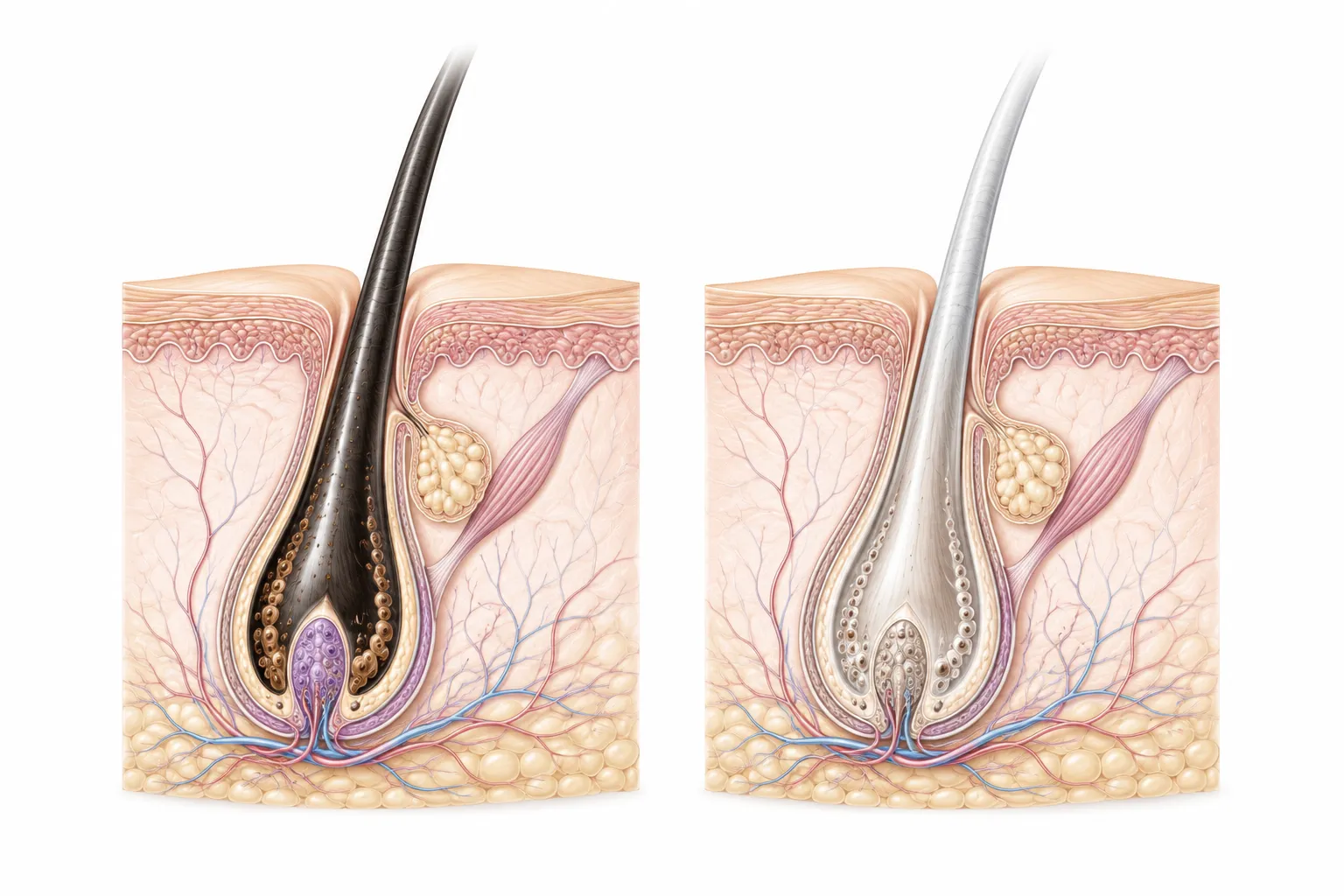
- 1Melanocytes pigment the growing hair shaft
Hair color is added during growth, not applied afterward.
- 2A stem cell reserve keeps melanocytes replenished
Continuous hair color depends on a renewable, but not infinite, supply of pigment cells.
- 3The stem cell reserve gradually depletes with age
Graying reflects a gradual resource depletion rather than a sudden malfunction.
- 4New hair grows in without pigment
Gray hair is colorless hair, not discolored hair.
How it works
The mechanism
Melanocyte stem cells supply pigment to each hair follicle, and as this reservoir depletes with age, new hair grows in without melanin, producing the visual effect of gray or white hair.
- Step 01
Melanocytes pigment the growing hair shaft
Cells called melanocytes sit near the base of each active hair follicle and deposit melanin into the keratin as the hair shaft forms and grows outward.
Like a dye injector adding color to thread as it's spun and pulled through a machine.
Hair color is added during growth, not applied afterward.
- Step 02
A stem cell reserve keeps melanocytes replenished
Melanocytes themselves have a limited working lifespan and are periodically replaced by melanocyte stem cells stored in a reservoir within the follicle.
Like a factory keeping a back room of trained replacement workers ready to step onto the line.
Continuous hair color depends on a renewable, but not infinite, supply of pigment cells.
- Step 03
The stem cell reserve gradually depletes with age
Over years and decades, accumulated cellular stress reduces the reservoir's ability to keep producing new melanocytes, and the supply eventually runs out for a given follicle.
Like a factory's replacement worker pool shrinking year after year until nobody is left to fill an empty position.
Graying reflects a gradual resource depletion rather than a sudden malfunction.
- Step 04
New hair grows in without pigment
Once a follicle's melanocyte supply is exhausted, hair growing from that follicle contains no melanin and appears gray, silver, or white due to light scattering off the unpigmented, translucent strand.
Like a printer producing blank pages once it finally runs out of ink.
Gray hair is colorless hair, not discolored hair.
Surprises
Facts worth sitting with
A strand of 'gray' hair is not actually gray in pigment; it's colorless and appears gray or silver because of how light scatters off its structure.
Surprising facts
What seems backwards
Worth comparing
In everyday life
Easy to get wrong
Pressure points
Where the simple answer gets interesting
Why do melanocyte stem cells deplete with age in the first place?
Accumulated oxidative stress and DNA damage over decades gradually impair the ability of melanocyte stem cells to self-renew and differentiate, eventually exhausting the pool available to supply pigment to the follicle.
The same kind of cellular wear and tear implicated in broader aging processes shows up visibly in something as simple as hair color.
Why does graying usually start at the temples?
Researchers believe follicles across the scalp age and deplete their melanocyte reserves at somewhat different rates, and temple-area follicles are commonly among the earliest affected, though the precise reason for this pattern isn't fully settled.
Even within a single scalp, individual follicles seem to run on their own independent aging clocks.
Can gray hair ever regain its color?
Small-scale research has documented individual hair strands that grew in gray and later grew back pigmented, suggesting that in some cases the melanocyte stem cell supply can become temporarily dormant rather than permanently destroyed.
Graying may be less like flipping an irreversible switch and more like a light dimming that can, occasionally, flicker back on.
Behind the science
The story behind it
Research linking acute stress to localized graying
Studies on stress hormones and hair follicles have found that intense physiological stress can accelerate the depletion of melanocyte stem cells in affected follicles.
This research gave a biological mechanism to the long-standing folk belief that severe stress could turn hair gray.
Old anecdotal beliefs sometimes turn out to have a genuine, if more nuanced, biological basis.
Tracking individual hair strands for pigment loss and regrowth
Researchers analyzed individual hair strands along their length to correlate pigment patterns with life events and stress periods.
Some strands showed patterns consistent with temporary pigment loss followed by a return of color, suggesting graying isn't always permanent at the individual strand level.
Clarify
Myth and reality
Myth
Plucking a single gray hair causes more gray hairs to grow back in its place.
Reality
Each hair follicle operates independently, so removing one gray hair has no effect on the pigment status of neighboring follicles.
Evidence
Follicles are anatomically separate units with their own individual melanocyte supply, unconnected to adjacent follicles.
Looking closer
The deeper pattern
Gray hair is not decay, it's the visible record of a finite resource being spent down over an entire lifetime.
One way to think about it
Systems that appear to run flawlessly for years are often quietly drawing down a limited reserve the whole time, and the first visible sign of that depletion can look sudden even though the underlying process was gradual.
Visible change is frequently just the final, noticeable stage of a process that had been running invisibly for a very long time.
Limits
Where the explanation bends
People experiencing premature graying in their teens or twenties.
Premature graying is often linked to genetics, though it has also been associated in some cases with certain vitamin deficiencies, thyroid conditions, or autoimmune conditions affecting the hair follicle.
The same underlying process that normally takes decades can, in some people, be triggered or accelerated much earlier in life.
In daily life
What this helps you notice
Understanding graying as a gradual, follicle-by-follicle process helps explain why hair color often changes unevenly rather than turning gray all at once.
Many people notice gray strands appearing first at the temples or hairline years before the rest of the head follows.
Remember
Key takeaways
- 1
Hair color comes from melanin deposited by melanocyte cells at the base of each hair follicle.
- 2
A reservoir of melanocyte stem cells continuously replenishes these pigment-producing cells over a lifetime.
- 3
Aging gradually depletes this stem cell reservoir, eventually leaving some follicles without pigment supply.
- 4
New hair grown from a depleted follicle contains no melanin and appears gray, silver, or white.
- 5
Graying happens unevenly because individual follicles deplete their pigment supply at different rates.
A single gray hair isn't a sign that something broke, it's a quiet announcement that one tiny, tireless cellular factory finally reached the end of its very long shift.
Every strand of gray hair on your head is proof of a pigment factory that ran, uninterrupted, for years or decades before finally closing its doors.
Read around the idea
More questions with the same curious pull
Nearby doors from the TinyThat archive, chosen by topic, intent, and reader curiosity.
Body & Brain
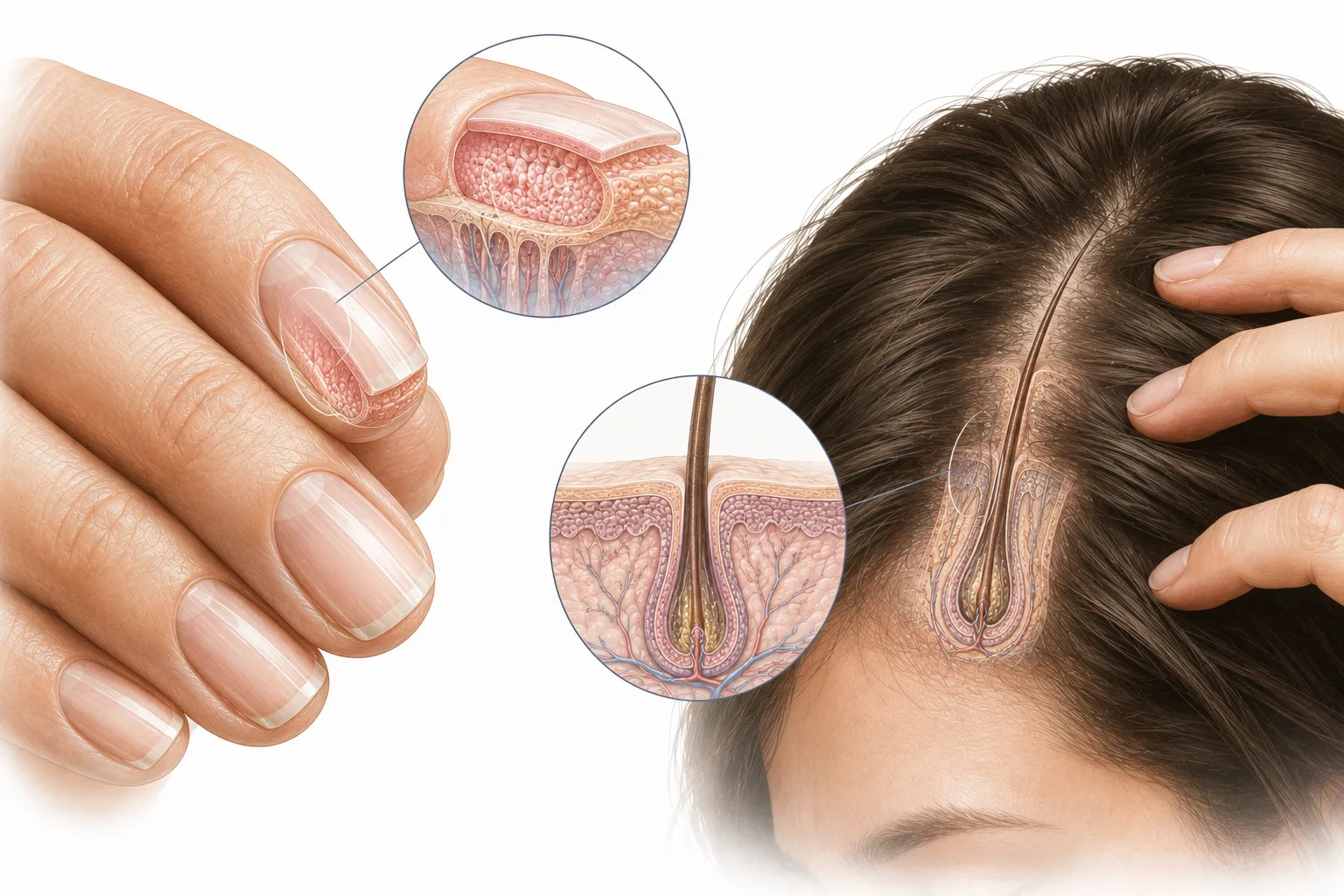
Why Do Nails Grow Faster Than Hair?
Nail cells and hair follicle cells divide at different inherent rates, driven by differences in their underlying grow...
Body & Brain
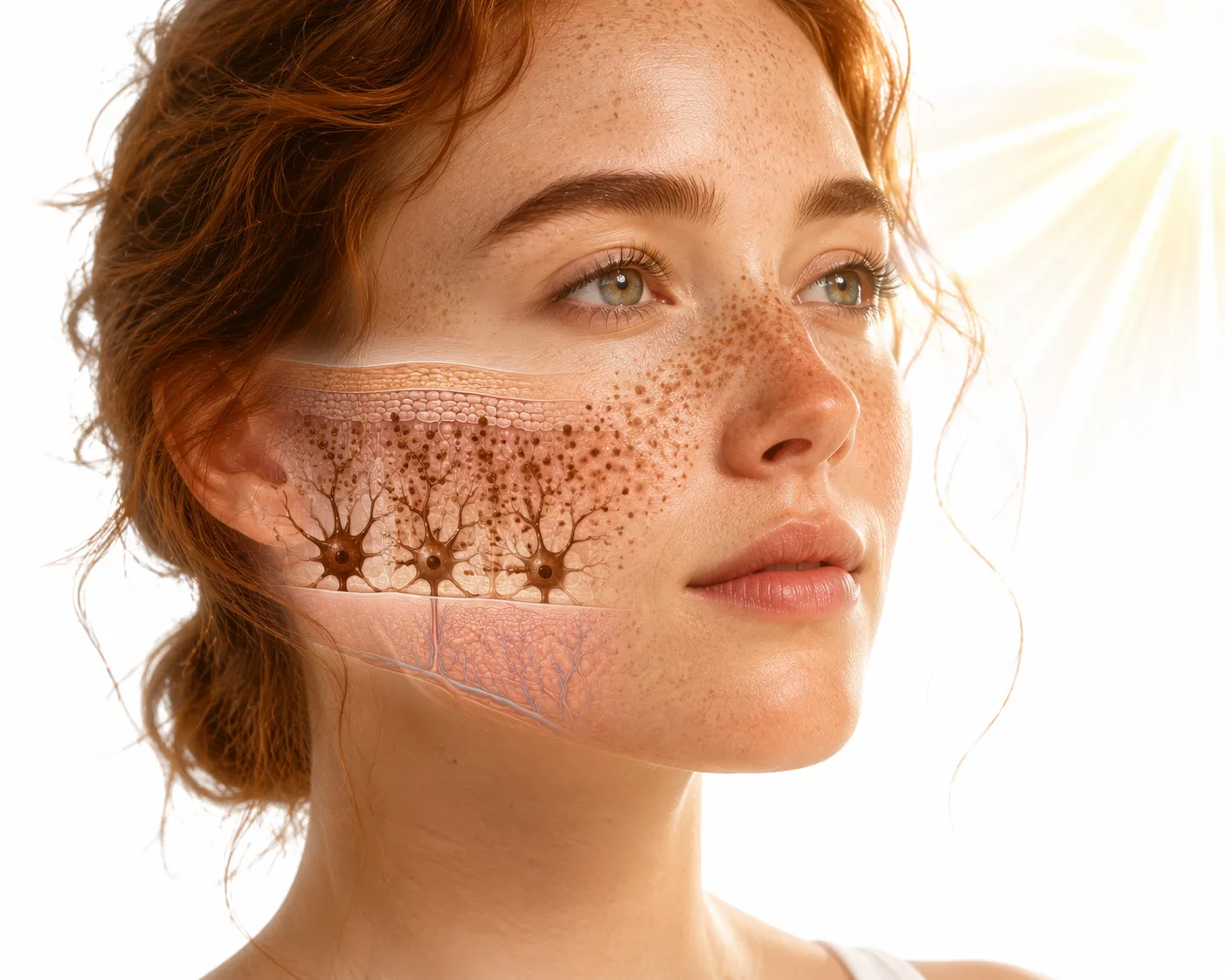
Why Do We Have Freckles?
Freckles form when melanocytes in the skin produce pigment unevenly, often triggered or intensified by sun exposure.
Body & Brain
Can the Brain Feel Pain?
The brain controls all pain in your body, yet it cannot feel pain itself. Discover why, and what this strange fact re...