Fingernails grow roughly three to four times faster than toenails on average, largely due to differences in blood flow and exposure to everyday physical stimulation.
Body & Brain
Why do fingernails grow faster than hair?
Why Do Nails Grow Faster Than Hair?
Fingernails need a trim every couple of weeks, while hair can go a month or more before it demands the same attention, even though both are built from the exact same material.
On this page
The short answer
Nails grow faster than hair mainly because the nail matrix, the growth tissue at the base of each nail, has a much richer and more direct blood supply and a simpler, continuous production process than the deeper, cyclically active hair follicle.
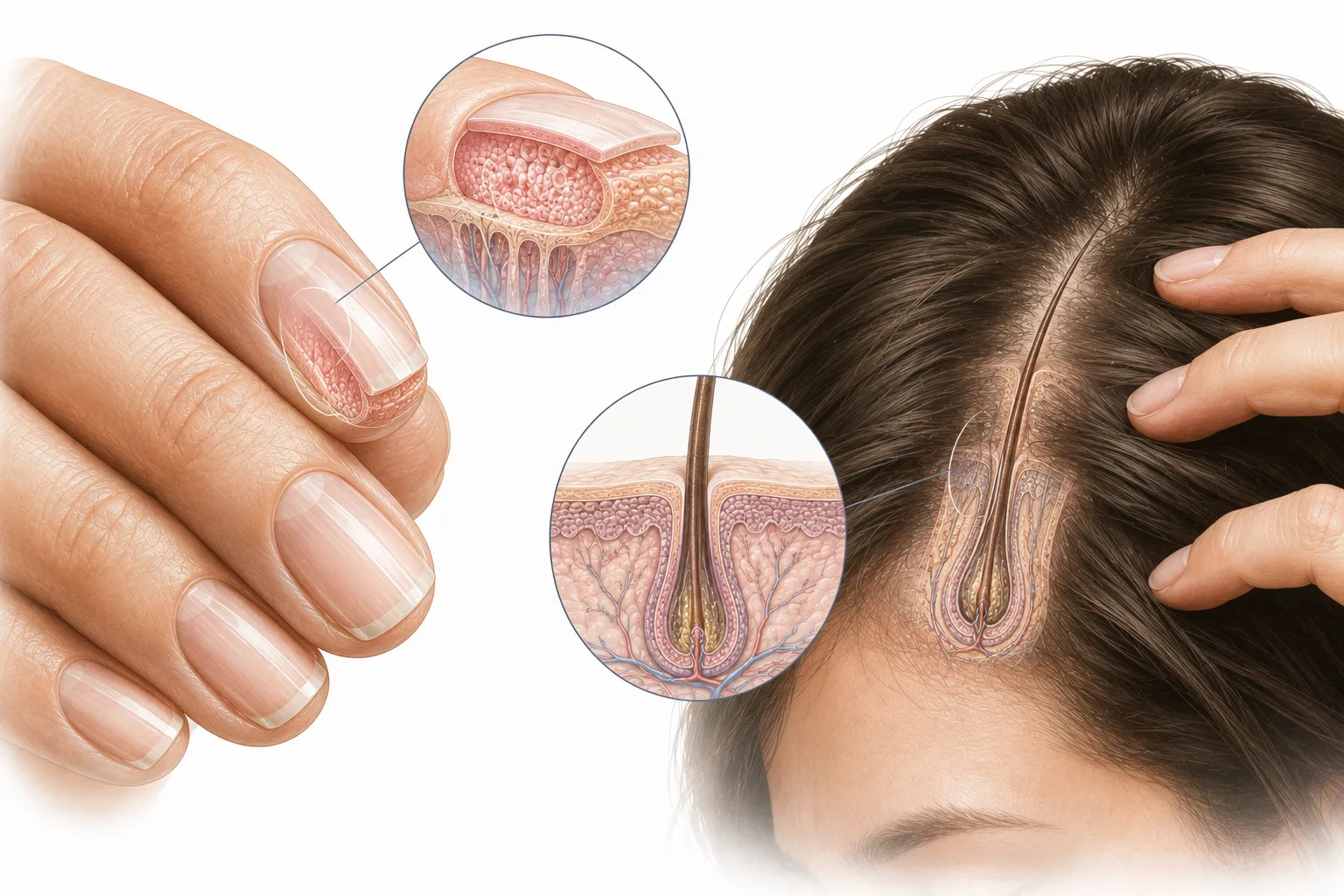
Both nails and hair are made primarily of keratin, a tough structural protein, but they're produced by very different tissues. Nails grow from the nail matrix, a small area of actively dividing cells just under the base of the nail, close to the skin surface and well supplied with blood vessels that deliver oxygen and nutrients efficiently. This matrix produces new nail cells continuously and relatively steadily. Hair, by contrast, grows from a follicle set deeper in the skin, and each follicle cycles through distinct phases, an active growth phase, a transitional phase, and a resting phase, during which no growth occurs at all. Because a portion of hair follicles are always in a non-growing phase at any given time, and because the follicle's growth tissue is positioned deeper with a less direct supply route than the nail matrix, hair's average growth rate ends up slower than the nail's steadier, more continuously fed production process. Fingernails also tend to grow faster than toenails, largely due to greater blood flow and more frequent minor trauma stimulating growth in the fingers.
At a glance
Nail growth is a steady, uninterrupted process.
Nails and hair keep growing for some time after a person dies.
The nail matrix, the tissue that produces new nail, sits directly beneath skin that is far more richly supplied with blood vessels than the deeper follicle that produces hair.
Picture two factories making the exact same product, one with a wide, fast-flowing supply road delivering raw materials constantly, the other tucked down a narrower, slower route.
Diagram
Why Do Nails Grow Faster Than Hair: the idea in one diagram
Nails grow from a continuously active, well-blood-supplied matrix near the skin surface, while hair grows from a deeper follicle that cycles through active and resting phases, resulting in nails growing consistently faster.
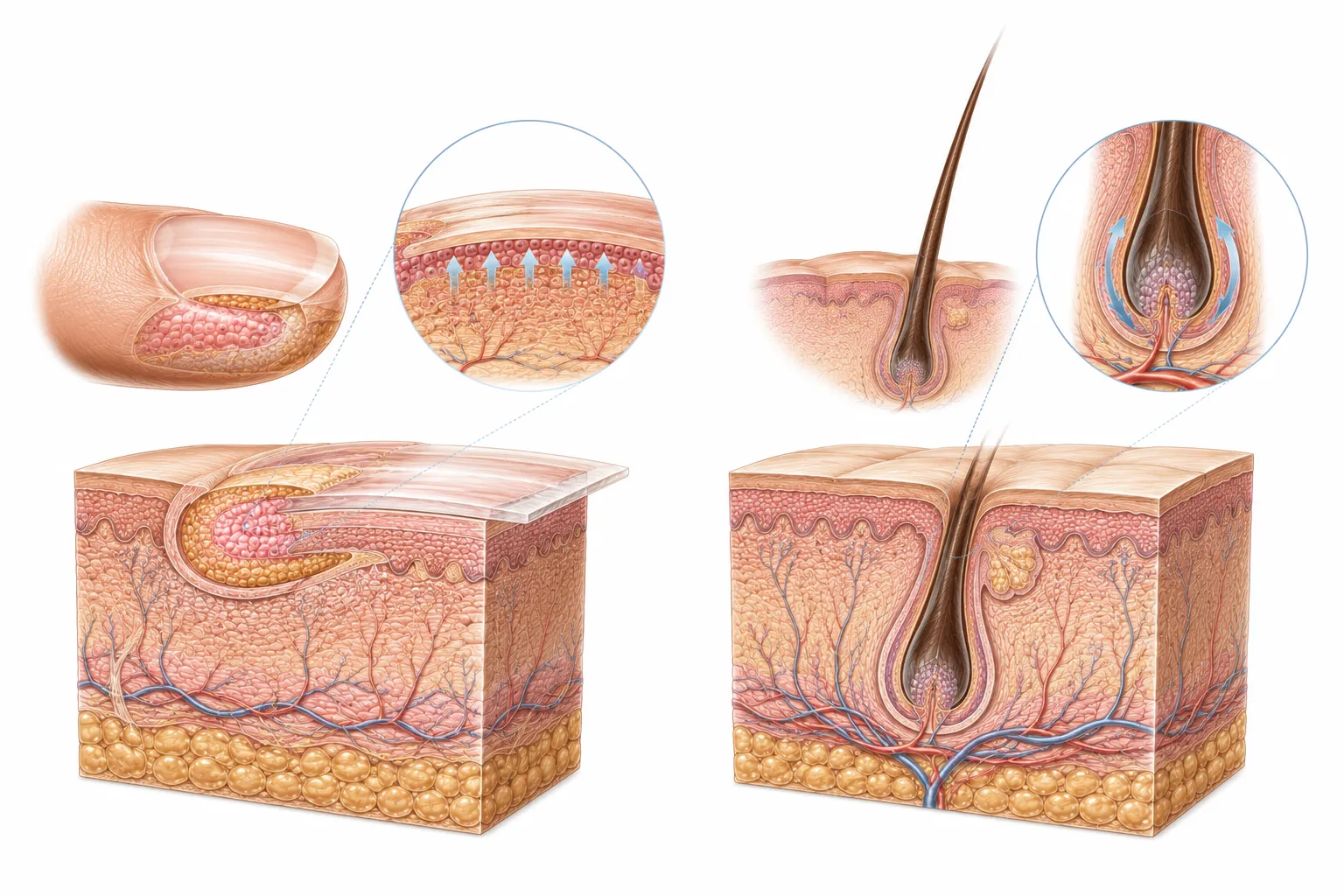
- 1The nail matrix produces cells continuously
Nail growth is a steady, uninterrupted process.
- 2The nail matrix has a rich, direct blood supply
Efficient nutrient delivery supports faster, more consistent nail growth.
- 3Hair follicles cycle through growth and rest phases
A portion of hair follicles are always inactive, lowering the average overall growth rate.
- 4Hair follicles sit deeper with a less direct supply route
Structural positioning within the skin itself plays a real role in the speed difference.
How it works
The mechanism
Nails grow from a continuously active, well-blood-supplied matrix near the skin surface, while hair grows from a deeper follicle that cycles through active and resting phases, resulting in nails growing consistently faster.
- Step 01
The nail matrix produces cells continuously
A small area of actively dividing cells beneath the base of the nail, called the matrix, continuously produces new keratin-rich cells that push older nail forward.
Like a factory assembly line running nonstop, pushing finished product steadily out the door.
Nail growth is a steady, uninterrupted process.
- Step 02
The nail matrix has a rich, direct blood supply
Because the nail matrix sits close to the skin's surface, it benefits from dense, easily accessible blood vessels that efficiently deliver the oxygen and nutrients needed for rapid cell division.
Like a construction site located right next to a major supply highway, materials arrive quickly and reliably.
Efficient nutrient delivery supports faster, more consistent nail growth.
- Step 03
Hair follicles cycle through growth and rest phases
Each hair follicle moves through an active growth phase, a short transitional phase, and an extended resting phase during which no new hair is produced at all.
Like a factory that periodically shuts its line down for maintenance before restarting production.
A portion of hair follicles are always inactive, lowering the average overall growth rate.
- Step 04
Hair follicles sit deeper with a less direct supply route
Positioned deeper within the skin than the nail matrix, hair follicles rely on a comparatively less direct blood supply route, contributing further to their slower average growth speed.
Like a facility located farther from the main supply road, receiving materials on a slightly slower, less direct schedule.
Structural positioning within the skin itself plays a real role in the speed difference.
Surprises
Facts worth sitting with
Fingernails grow roughly three to four times faster than toenails on average, largely due to differences in blood flow and exposure to everyday physical stimulation.
Surprising facts
What seems backwards
Worth comparing
In everyday life
Easy to get wrong
Pressure points
Where the simple answer gets interesting
Why does the hair growth cycle include a resting phase but the nail growth process doesn't?
Hair follicles evolved to cycle through growth and rest phases partly tied to shedding and renewal processes, while nails serve a continuously protective, structural function that favors steady, uninterrupted growth.
Two tissues made of the same material ended up with fundamentally different growth strategies suited to their different jobs.
Why do fingernails grow faster than toenails specifically?
Fingers receive significantly more blood flow and more frequent minor mechanical stimulation from everyday use than toes, both factors associated with faster nail matrix activity.
Something as simple as how often a body part is used and exposed to blood flow can noticeably change its growth rate.
Does nail growth rate change with age?
Nail growth generally slows gradually with age, consistent with broader reductions in cell turnover and circulation that occur throughout the body over time.
A visible, easily measured trait like nail growth can serve as a small window into broader aging processes happening throughout the body.
Behind the science
The story behind it
Forensic and medical research using nail growth rates
Nail growth measurements have been used in medical and forensic research to estimate timelines of nutritional deficiencies, illnesses, or exposure to certain substances based on growth patterns and ridges.
This research demonstrated that nail growth rate isn't just a curiosity but a measurable biological signal with practical diagnostic applications.
Everyday biological processes can carry meaningful, measurable information when examined closely.
Comparative growth rate studies of fingernails versus toenails
Researchers tracked nail growth across different digits and body regions over extended periods to compare growth speeds.
The studies confirmed fingernails consistently outpace toenails by a significant, measurable margin, tied closely to differences in local blood flow.
Clarify
Myth and reality
Myth
Nails and hair keep growing for some time after a person dies.
Reality
Nails and hair do not continue growing after death; the surrounding skin dehydrates and retracts, creating the illusion of continued growth.
Evidence
Cell division, which drives all growth, requires active biological processes that stop entirely at death.
Looking closer
The deeper pattern
Growth speed isn't just about what something is made of, it's about how well-supplied and how continuously active the system producing it happens to be.
One way to think about it
Two systems built from identical raw materials can produce dramatically different results depending entirely on their supporting infrastructure and operating rhythm.
Output differences often trace back to differences in support and consistency, not differences in the raw material itself.
Limits
Where the explanation bends
People recovering from a nail injury or undergoing chemotherapy.
Nail growth can temporarily speed up during recovery from injury due to increased local blood flow, while it often slows or produces visible ridges during chemotherapy due to disrupted cell division.
Nail growth patterns can serve as a visible timeline of significant events affecting the body's cell division processes.
In daily life
What this helps you notice
Understanding why nails grow faster than hair explains the mismatch in how often each requires trimming or maintenance.
Most people trim their fingernails roughly twice as often as they get a haircut, a direct reflection of their differing growth rates.
Remember
Key takeaways
- 1
Nails and hair are both made primarily of keratin but grow from structurally different tissues.
- 2
The nail matrix sits close to the skin surface and has a rich, direct blood supply.
- 3
Hair follicles sit deeper and cycle through active growth and resting phases.
- 4
A portion of hair follicles are always resting, which lowers the average hair growth rate.
- 5
Fingernails also grow faster than toenails due to greater blood flow and more frequent stimulation.
Nails and hair are built from the same basic material, but one is produced by a factory that never takes a break, and the other regularly shuts its line down.
The next time a nail trim comes around faster than a haircut, it's a small, everyday reminder of two very different production schedules running just beneath the skin.
Read around the idea
More questions with the same curious pull
Nearby doors from the TinyThat archive, chosen by topic, intent, and reader curiosity.
Body & Brain
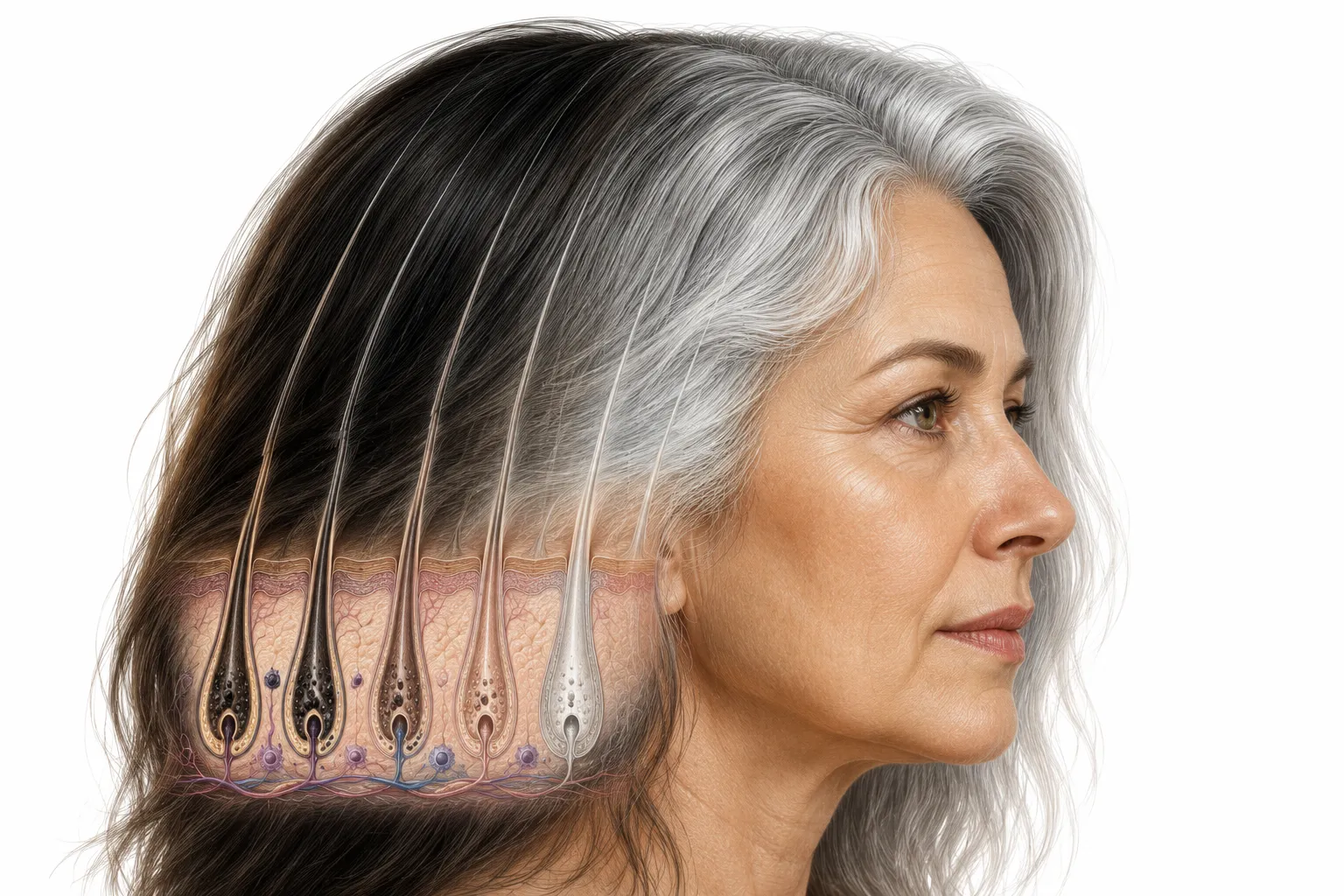
Why Does Hair Turn Gray?
Hair turns gray when the pigment-producing melanocyte stem cells supplying a hair follicle gradually deplete with age.
Body & Brain
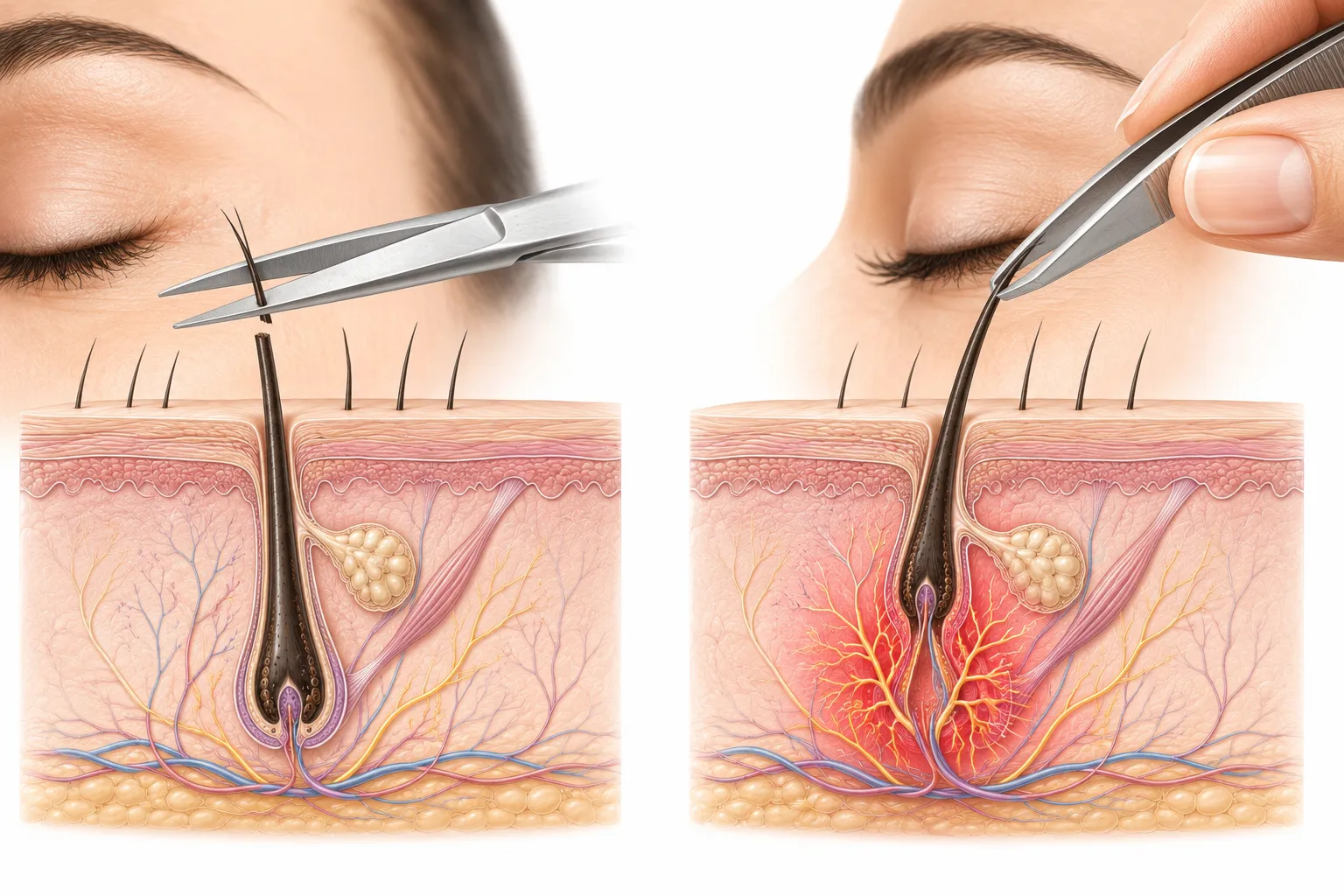
Why Does Plucking Hair Hurt But Cutting It Doesn't?
Plucking disturbs nerve-rich tissue at the follicle's base, while the hair shaft itself contains no nerves and feels...
Body & Brain
Can the Brain Feel Pain?
The brain controls all pain in your body, yet it cannot feel pain itself. Discover why, and what this strange fact re...