Freckles are technically classified as ephelides, distinct from the larger, more stable pigmented spots called lentigines, which don't fade seasonally the way true freckles typically do.
Body & Brain
Why do some people have freckles?
Why Do We Have Freckles?
Some people step into summer sunshine and watch a scattering of small brown spots appear across their nose and cheeks within days.
On this page
The short answer
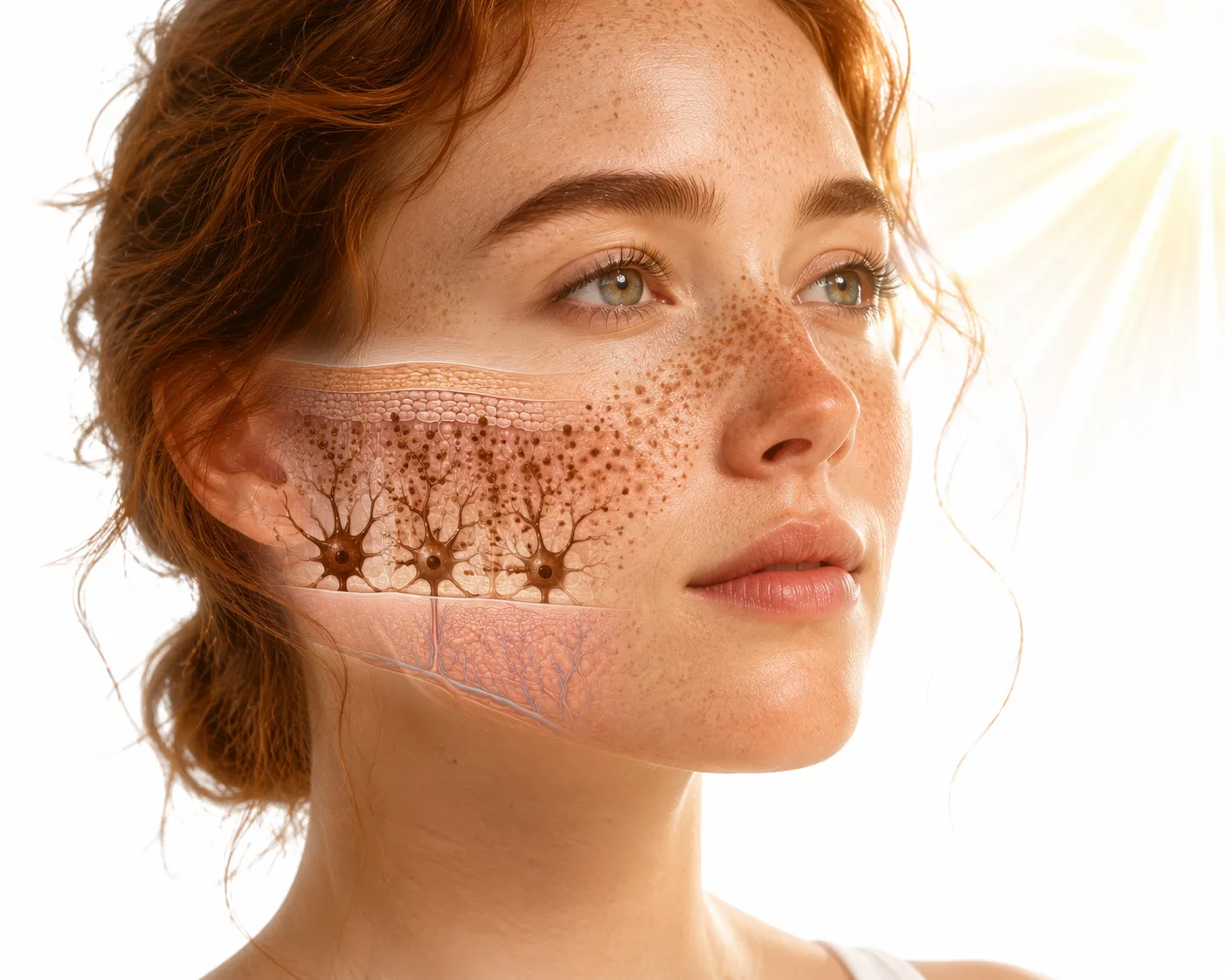
Freckles form when melanocytes, the pigment-producing cells in skin, distribute melanin unevenly rather than uniformly, creating small, concentrated clusters of pigment that darken with sun exposure, a pattern strongly influenced by genetics and most common in people with fair skin.
Melanin, the pigment responsible for skin, hair, and eye color, is produced by cells called melanocytes distributed throughout the skin. In most people, melanin production and distribution is relatively even, but in people genetically predisposed to freckling, melanocytes in certain areas produce and deposit melanin in a clustered, uneven pattern rather than spreading it uniformly. Ultraviolet light from the sun stimulates melanocytes to produce more melanin as a protective response against UV damage, which is why freckles typically become darker and more numerous with sun exposure and can fade somewhat during darker winter months when UV exposure decreases. Genetics plays a major role in determining freckle likelihood, and variants of a gene called MC1R, which also strongly influences red hair and fair skin, are closely associated with a higher likelihood of freckling. This is why freckles are especially common among people with lighter skin tones and red or light-colored hair, though people of many different skin tones can develop freckles depending on their specific genetic makeup.
At a glance
Melanin production is a normal, universal function of skin cells in everyone.
Freckles are simply a mild form of sun damage similar to sunburn.
Freckles form when melanocytes, the same pigment-producing cells responsible for tanning, cluster their pigment output unevenly rather than spreading it smoothly across the skin.
Picture a sprinkler system that, instead of spraying water evenly across an entire lawn, releases it in small, concentrated bursts scattered unevenly across the grass.
Diagram
Why Do We Have Freckles: the idea in one diagram
Genetic variants, particularly in the MC1R gene, cause melanocytes to distribute melanin unevenly in some people, and UV exposure from sunlight stimulates these clustered pigment cells to darken further, producing visible freckles.
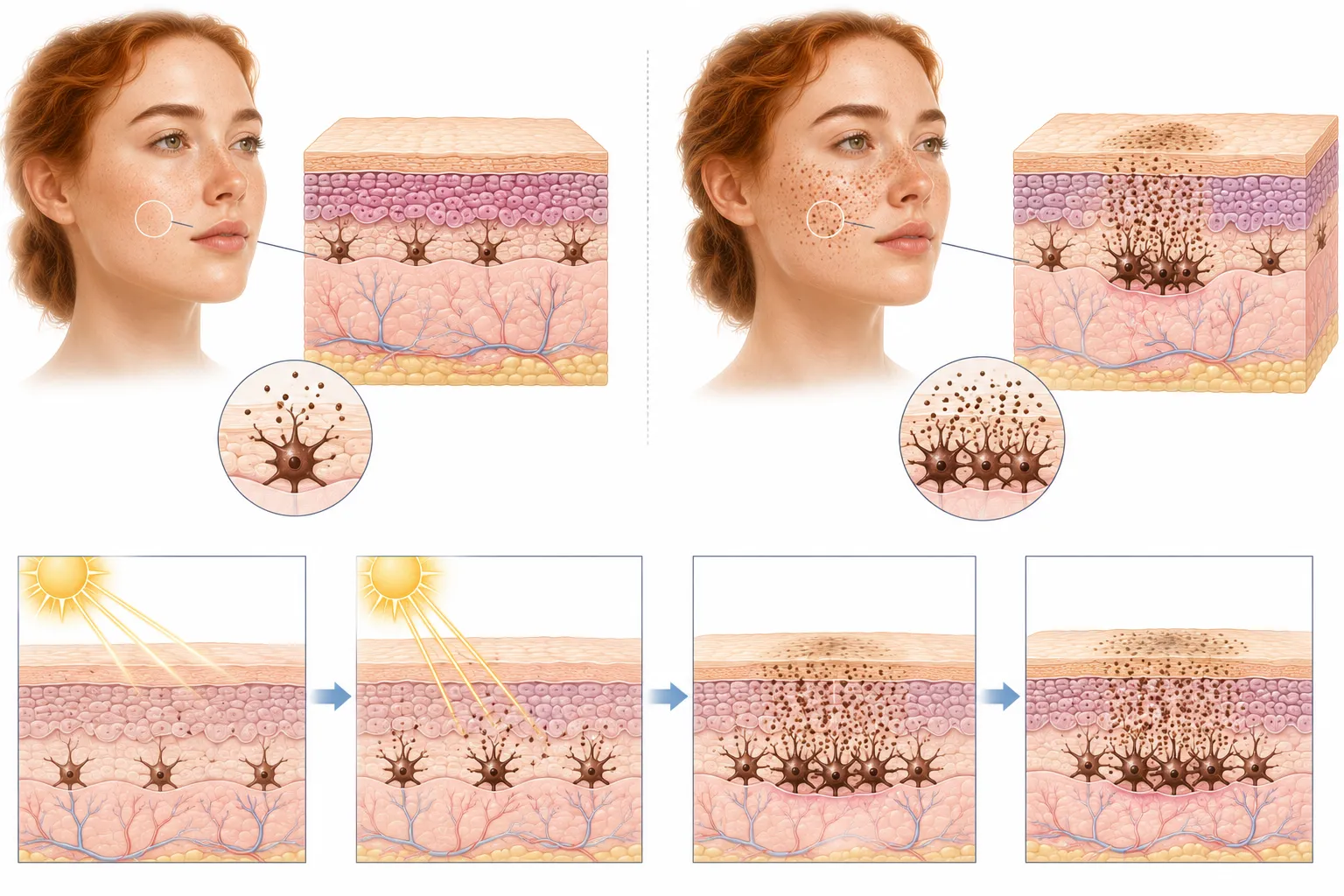
- 1Melanocytes produce melanin throughout the skin
Melanin production is a normal, universal function of skin cells in everyone.
- 2Genetic variants cause uneven melanin distribution
This clustering is the specific genetic root of the freckle pattern.
- 3UV exposure stimulates melanin production
This is why freckles darken and become more numerous with increased sun exposure.
- 4Freckles fade as UV stimulation decreases
This seasonal fading distinguishes true freckles from more permanent forms of skin pigmentation.
How it works
The mechanism
Genetic variants, particularly in the MC1R gene, cause melanocytes to distribute melanin unevenly in some people, and UV exposure from sunlight stimulates these clustered pigment cells to darken further, producing visible freckles.
- Step 01
Melanocytes produce melanin throughout the skin
Cells called melanocytes, distributed across the skin, produce melanin, the pigment responsible for skin color and protection against UV radiation.
Like a widespread network of small paint stations distributed evenly across a surface.
Melanin production is a normal, universal function of skin cells in everyone.
- Step 02
Genetic variants cause uneven melanin distribution
In genetically predisposed individuals, particularly those with certain MC1R gene variants, melanocytes cluster their pigment output unevenly rather than distributing it smoothly.
Like a sprinkler system malfunctioning just enough to release water in small, uneven bursts rather than an even mist.
This clustering is the specific genetic root of the freckle pattern.
- Step 03
UV exposure stimulates melanin production
Ultraviolet light from the sun triggers melanocytes to increase melanin production as a protective response against UV damage.
Like a factory ramping up output specifically in response to increased demand or a specific triggering signal.
This is why freckles darken and become more numerous with increased sun exposure.
- Step 04
Freckles fade as UV stimulation decreases
When sun exposure decreases, such as during winter months, the stimulus for increased melanin production drops, and existing freckles often become lighter and less visible.
Like a dimmer switch gradually turning down as the original triggering signal fades away.
This seasonal fading distinguishes true freckles from more permanent forms of skin pigmentation.
Surprises
Facts worth sitting with
Freckles are technically classified as ephelides, distinct from the larger, more stable pigmented spots called lentigines, which don't fade seasonally the way true freckles typically do.
Surprising facts
What seems backwards
Worth comparing
In everyday life
Easy to get wrong
Pressure points
Where the simple answer gets interesting
Why do freckles cluster in small spots rather than spreading evenly across the skin?
In genetically predisposed individuals, melanocytes distribute melanin unevenly at a localized level rather than spreading pigment production smoothly and uniformly, producing the classic small, scattered freckle pattern.
The same pigment system responsible for an even tan produces a completely different visual pattern depending on subtle genetic differences in how it's distributed.
Why are freckles more common in people with red hair and fair skin?
Variants of the MC1R gene strongly associated with red hair and fair skin also independently increase the likelihood of uneven melanin clustering, linking these traits together at a genetic level.
A single gene variant quietly influences several visible traits that might otherwise seem entirely unrelated to each other.
Why do freckles fade in winter but sun spots and moles typically don't?
True freckles are directly driven by UV-stimulated melanin production in existing pigment cells, so reduced sun exposure lowers that stimulus and allows them to fade, while sun spots and moles involve more permanent changes to pigment cells that don't reverse seasonally.
Two visually similar skin markings can have completely different underlying biological permanence.
Behind the science
The story behind it
Genetic research linking MC1R variants to freckling and hair color
Genetic studies identified specific MC1R gene variants strongly associated with both red hair and an increased likelihood of freckling across diverse populations.
This research clarified the shared genetic basis behind multiple visible traits previously understood only as loosely, informally related.
Careful genetic research can reveal precise, testable connections behind traits that were previously only loosely associated by casual observation.
Genome-wide association studies of pigmentation traits
Large-scale genetic studies analyzed DNA from thousands of individuals to identify gene variants associated with freckling, hair color, and skin tone.
MC1R variants emerged as strongly and consistently linked to freckle likelihood across multiple independent studies and populations.
Clarify
Myth and reality
Myth
Freckles are simply a mild form of sun damage similar to sunburn.
Reality
Freckling is primarily a genetically determined trait; sun exposure triggers and intensifies existing genetic predisposition rather than independently causing freckles in everyone.
Evidence
Twin and family studies show freckle likelihood is strongly heritable, with sun exposure acting as a triggering rather than a root causal factor.
Looking closer
The deeper pattern
Freckles reveal that even distribution isn't the default outcome of a biological process, unevenness and clustering are just as natural a result depending on the underlying genetic instructions.
One way to think about it
Genetic variation doesn't just change whether a process happens, it can change the fundamental pattern of how that process plays out across an entire system.
A small instruction embedded deep within a system's genetic code can completely reshape the visible pattern that system ultimately produces.
Limits
Where the explanation bends
People with darker skin tones who still develop visible freckles.
While freckling is most common and visually prominent in fair-skinned individuals, people across a range of skin tones can develop freckles depending on their specific genetic makeup and melanocyte distribution patterns.
A trait strongly associated with one particular appearance can still appear, sometimes more subtly, across a much broader range of people.
In daily life
What this helps you notice
Understanding freckles as a genetically influenced, sun-triggered trait helps clarify why sun protection habits vary in importance based on individual freckling tendency and skin type.
People who freckle easily are often advised to pay particular attention to sun protection given their genetically fairer, more UV-sensitive skin.
Remember
Key takeaways
- 1
Freckles form when melanocytes distribute melanin unevenly rather than uniformly across the skin.
- 2
Genetic variants, particularly in the MC1R gene, strongly influence freckle likelihood.
- 3
UV exposure from sunlight stimulates melanin production, darkening existing freckles and creating new ones.
- 4
Freckles often fade during winter months when UV exposure decreases.
- 5
Freckling is genetically linked to traits like red hair and fair skin through shared gene variants.
A face full of freckles is really a small, visible map of a single gene quietly deciding to distribute pigment unevenly rather than spreading it smoothly across the skin.
Every freckle that darkens in the summer sun is a tiny, genetically scripted response playing out exactly the way it has for that person's entire life.
Read around the idea
More questions with the same curious pull
Nearby doors from the TinyThat archive, chosen by topic, intent, and reader curiosity.
Body & Brain
Why Do We Have Different Blood Types?
Genetic variation in antigen markers on red blood cells creates different blood types, likely persisting due to varyi...
Body & Brain
Why Does Hair Turn Gray?
Hair turns gray when the pigment-producing melanocyte stem cells supplying a hair follicle gradually deplete with age.
Body & Brain
Can the Brain Feel Pain?
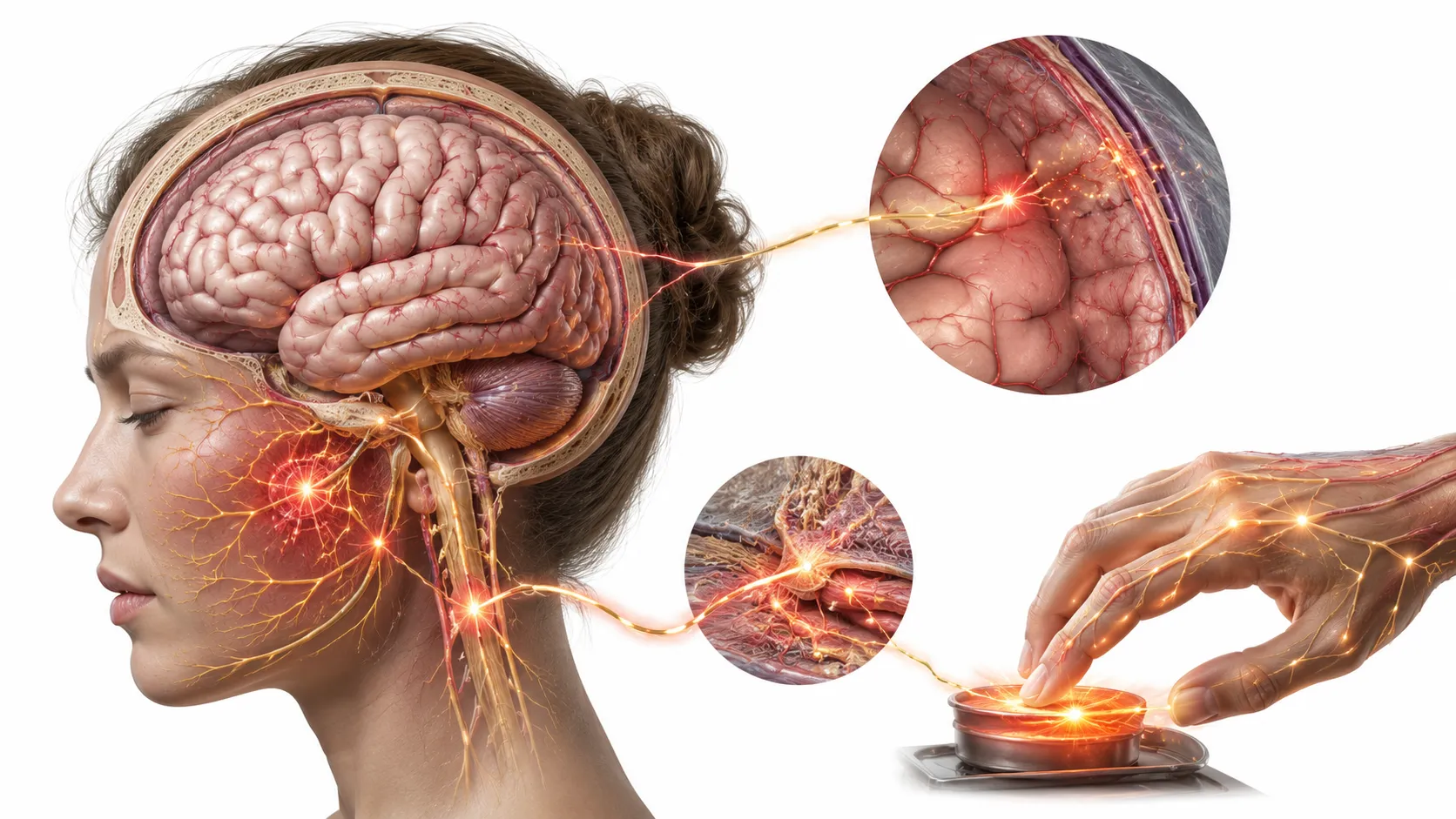
The brain controls all pain in your body, yet it cannot feel pain itself. Discover why, and what this strange fact re...