Basal tears, the ones constantly keeping the eyes lubricated, are chemically different in composition from emotional tears, which contain additional stress hormones and proteins not found in ordinary basal tear fluid.
Body & Brain
Why does yawning sometimes make your eyes water?
Why Do We Produce Tears When We Yawn?
A deep, satisfying yawn sometimes leaves the eyes visibly watery, even though nothing sad, irritating, or emotional has actually happened.
On this page
The short answer
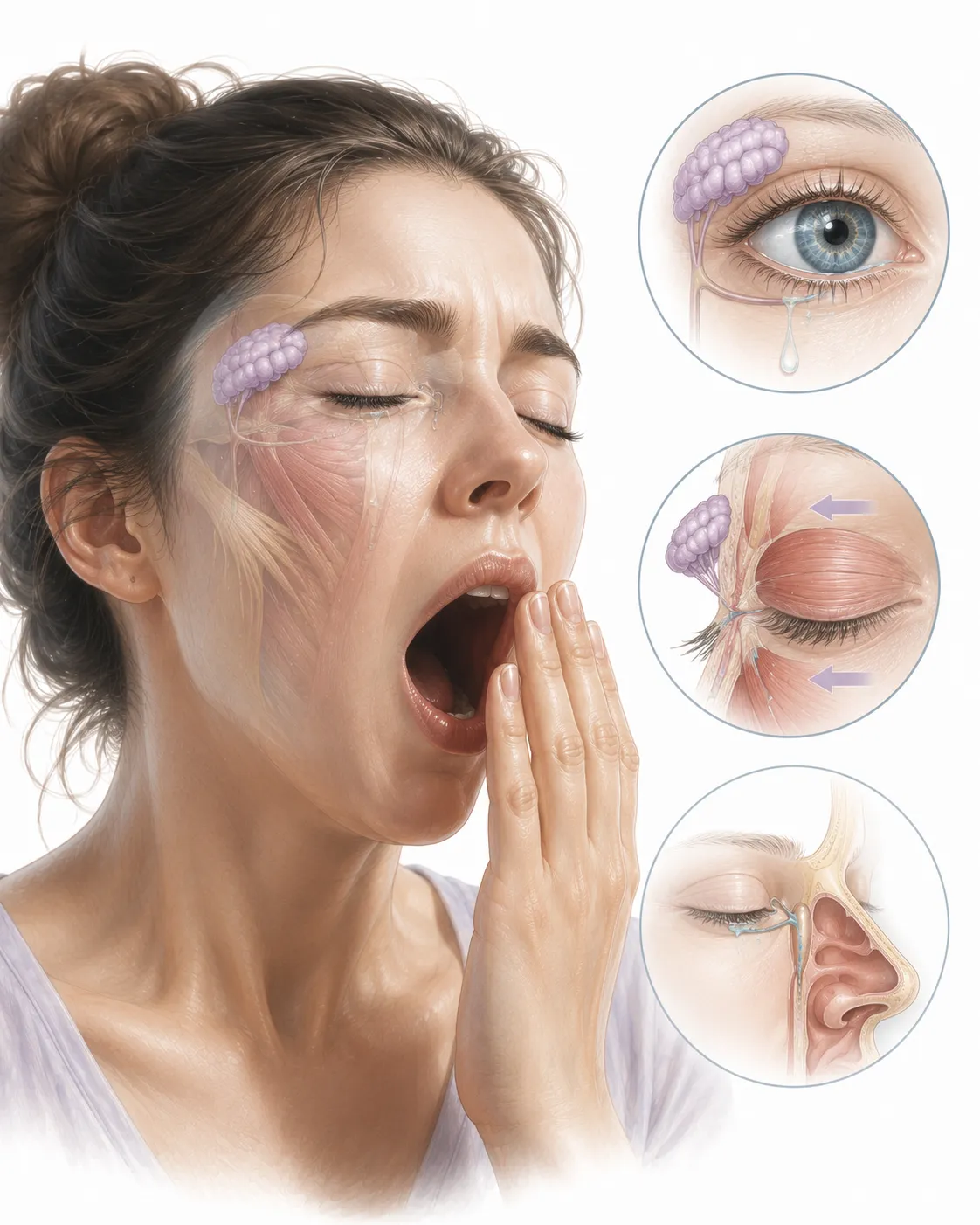
Yawning can make the eyes water because the intense muscle contraction involved in a full yawn physically squeezes the tear glands and temporarily narrows the small ducts that normally drain tears away, causing excess tear fluid to build up and spill over rather than draining normally.
A complete yawn involves far more than just an open mouth, it triggers a wide, coordinated contraction of muscles across the face, jaw, and around the eyes. The lacrimal glands, located above each eye, continuously produce a small, steady amount of tear fluid to keep the eyes lubricated, and this fluid normally drains away through tiny channels called tear ducts into the nasal cavity. During a yawn, the strong contraction of facial muscles physically compresses the area around the eyes, including the tear glands themselves, which can cause a temporary increase in tear production or release. At the same time, this same muscular tightening can partially and briefly constrict the tear ducts responsible for draining fluid away. With more tear fluid being expressed and its normal drainage pathway partly and briefly restricted, tears can pool and spill over the edge of the eyelid, producing the watery-eyed appearance many people notice during or right after a big yawn. This is a purely mechanical effect and entirely unrelated to genuine emotional tears, which are triggered by a completely different neurological and hormonal pathway.
At a glance
This widespread contraction is what brings the eye area into the reflex at all.
Watery eyes during a yawn mean you're actually a little emotional, even if you don't consciously feel it.
A full yawn tightly contracts muscles all around the eyes, jaw, and face at once, and that contraction physically presses on the tear glands while also temporarily narrowing the tiny ducts that normally drain tears away.
Picture squeezing a wet sponge with your whole hand; even without adding new water, the physical pressure alone is enough to push existing moisture out.
Diagram
Why Do We Produce Tears When We Yawn: the idea in one diagram
A full yawn triggers strong, widespread facial muscle contraction that physically compresses the tear glands and temporarily narrows the tear ducts, causing tear fluid to build up and spill over as a purely mechanical side effect.
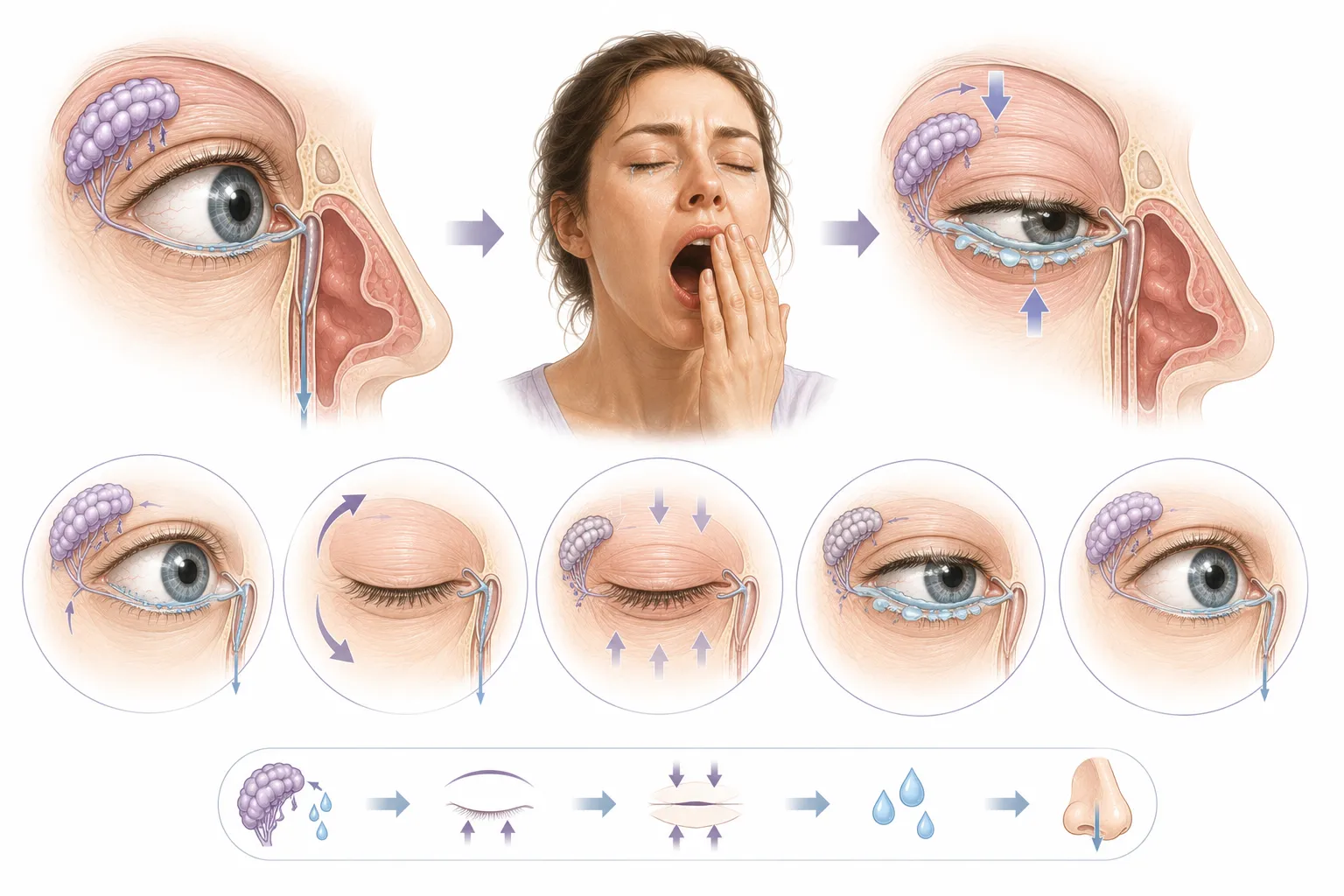
- 1A yawn triggers widespread facial muscle contraction
This widespread contraction is what brings the eye area into the reflex at all.
- 2This contraction compresses the tear glands
This compression is the first mechanical trigger behind yawning-related tears.
- 3Tear ducts are briefly and partially narrowed
This drainage disruption compounds the effect of the tear gland compression.
- 4Excess tear fluid pools and spills over
This overflow is exactly what produces the visibly watery eyes associated with a big yawn.
How it works
The mechanism
A full yawn triggers strong, widespread facial muscle contraction that physically compresses the tear glands and temporarily narrows the tear ducts, causing tear fluid to build up and spill over as a purely mechanical side effect.
- Step 01
A yawn triggers widespread facial muscle contraction
A complete yawn involves a strong, coordinated contraction of muscles across the jaw, face, and area surrounding the eyes, not just the muscles controlling the mouth.
Like a full-body stretch that engages far more muscle groups than the single joint that first prompted it.
This widespread contraction is what brings the eye area into the reflex at all.
- Step 02
This contraction compresses the tear glands
The lacrimal glands positioned above each eye are physically compressed by the surrounding facial muscle contraction, which can cause a temporary increase in tear fluid release.
Like squeezing a sponge, applying direct pressure is often enough to push out fluid that was already there.
This compression is the first mechanical trigger behind yawning-related tears.
- Step 03
Tear ducts are briefly and partially narrowed
The same muscular tightening can also briefly and partially constrict the small tear ducts responsible for normally draining tear fluid away from the eyes.
Like a garden hose being briefly pinched partway, slowing the normal outflow of water.
This drainage disruption compounds the effect of the tear gland compression.
- Step 04
Excess tear fluid pools and spills over
With increased tear release and reduced drainage happening simultaneously, tear fluid builds up faster than it can escape through its normal pathway, causing it to pool and spill over the eyelid.
Like a sink filling faster than its drain can keep up, eventually overflowing at the edge.
This overflow is exactly what produces the visibly watery eyes associated with a big yawn.
Surprises
Facts worth sitting with
Basal tears, the ones constantly keeping the eyes lubricated, are chemically different in composition from emotional tears, which contain additional stress hormones and proteins not found in ordinary basal tear fluid.
Surprising facts
What seems backwards
Worth comparing
In everyday life
Easy to get wrong
Pressure points
Where the simple answer gets interesting
Why does a yawn involve muscles around the eyes at all?
A full yawn triggers a wide, coordinated stretch and contraction across many facial muscles simultaneously, not just the jaw, as part of the broader physiological reflex, and the muscles around the eyes are closely connected to this same shared facial muscle network.
A reflex most people associate purely with the mouth actually recruits a surprisingly large portion of the entire face.
Why are basal tears and emotional tears chemically different?
Basal tears exist primarily to lubricate and protect the eye's surface, while emotional tears are triggered by a distinct neurological pathway linked to the brain's emotional centers and contain additional stress-related hormones and proteins not present in ordinary tear fluid.
The body maintains at least two entirely separate tear-production systems serving completely different biological purposes.
Why do some yawns produce watery eyes and others don't?
The intensity and duration of facial muscle contraction varies between individual yawns, and a deeper, more forceful yawn is more likely to sufficiently compress the tear glands and ducts to produce noticeable watering.
Even a completely automatic, involuntary reflex like a yawn isn't perfectly uniform every single time it happens.
Behind the science
The story behind it
Ophthalmology research on tear gland and duct anatomy
Ophthalmologists studying the anatomy of the lacrimal glands and tear drainage system have documented how surrounding facial muscle activity, including yawning, can mechanically influence tear flow.
This research clarified the purely mechanical basis behind an everyday, widely experienced but often unexplained phenomenon.
Careful anatomical study can explain small, everyday physical quirks that most people simply accept without ever questioning.
Comparative chemical analysis of basal, reflex, and emotional tears
Researchers analyzed the chemical composition of tears produced under different conditions, including baseline lubrication, irritant exposure, and emotional distress.
Emotional tears were found to contain distinct proteins and stress hormones absent from basal tears, confirming that tears from a yawn are chemically unrelated to true emotional crying.
Clarify
Myth and reality
Myth
Watery eyes during a yawn mean you're actually a little emotional, even if you don't consciously feel it.
Reality
Tears produced during a yawn are the result of a purely mechanical process involving muscle contraction around the tear glands and ducts, entirely unrelated to emotional state.
Evidence
Chemical analysis shows tears produced during yawning match basal tear composition, not the distinct composition found in genuine emotional tears.
Looking closer
The deeper pattern
Not every visible physical response has an emotional or deliberate cause, sometimes a strong reaction is simply a mechanical byproduct of an entirely unrelated process happening nearby.
One way to think about it
Tightly interconnected systems, like the muscles of the face, will inevitably produce spillover effects in nearby structures whenever one part of the system activates strongly enough.
Not every visible effect points to its most obvious or emotionally intuitive cause, sometimes proximity alone is the entire explanation.
Limits
Where the explanation bends
People who yawn frequently due to certain medications or medical conditions.
Excessive yawning associated with certain medications or neurological conditions can also lead to more frequent mechanical tearing, purely as a side effect of the increased yawning itself rather than any change in emotional state.
A harmless mechanical side effect can become noticeably more frequent simply because its underlying trigger, yawning, is happening more often.
In daily life
What this helps you notice
Understanding the mechanical cause of yawning-related tears can reassure people that watery eyes during a yawn are a normal, harmless physical reflex rather than a sign of hidden emotion or eye irritation.
Many people casually wipe their eyes after a big yawn without a second thought, a small, routine reflection of this purely mechanical process.
Remember
Key takeaways
- 1
A full yawn triggers widespread contraction of muscles across the face, jaw, and eye area.
- 2
This contraction physically compresses the tear glands, which can increase tear fluid release.
- 3
The same muscle contraction can briefly and partially narrow the tear ducts responsible for drainage.
- 4
Reduced drainage combined with increased tear release causes fluid to pool and spill over the eyelid.
- 5
Tears produced during a yawn are chemically identical to basal tears and unrelated to emotional crying.
That watery-eyed look after a big yawn has nothing to do with feeling anything at all, it's simply your own facial muscles briefly squeezing moisture out of a completely unrelated gland nearby.
The next time a yawn leaves your eyes glistening, it's not emotion sneaking through, it's just a small, harmless mechanical ripple from one of the body's most contagious reflexes.
Read around the idea
More questions with the same curious pull
Nearby doors from the TinyThat archive, chosen by topic, intent, and reader curiosity.
Body & Brain
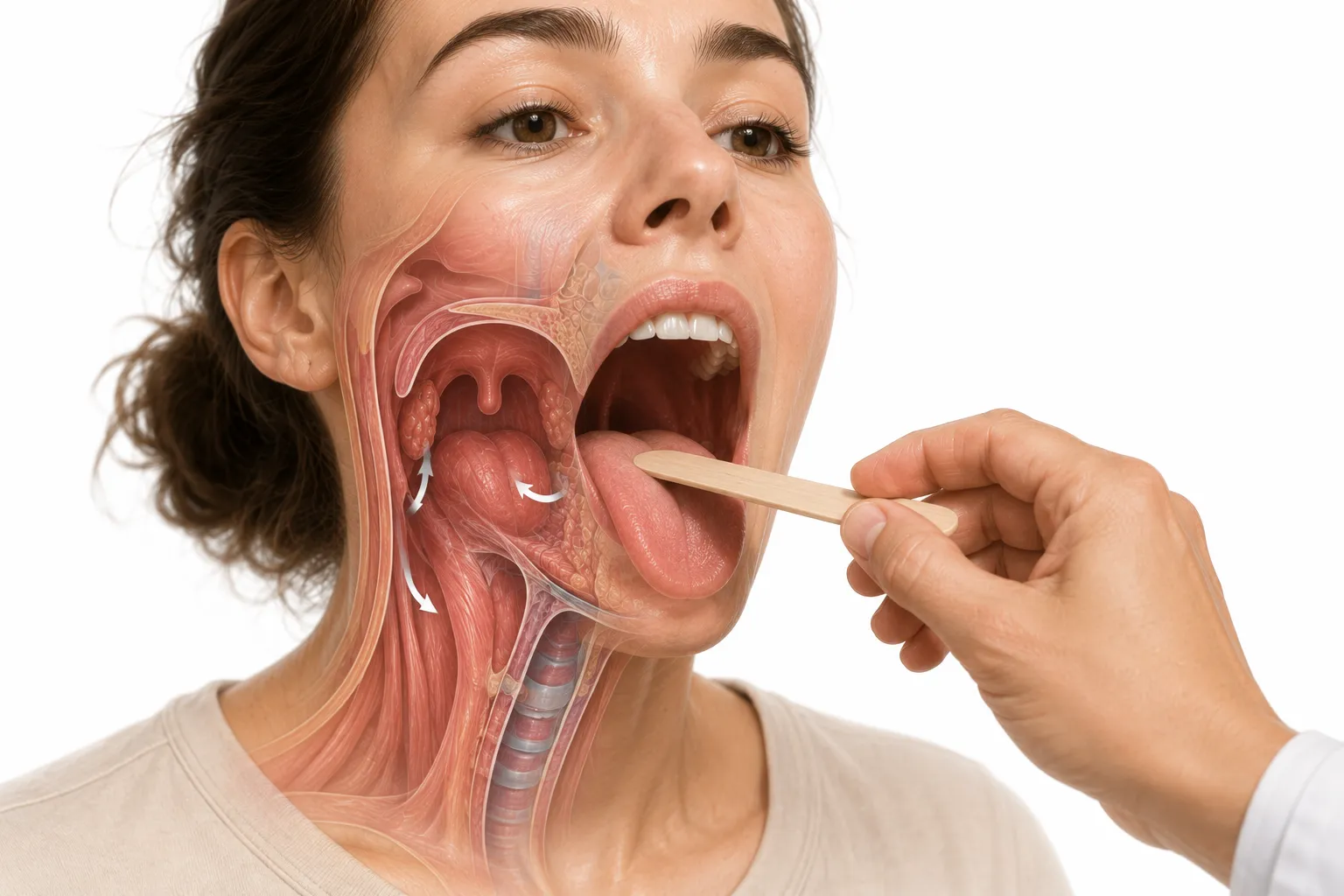
Why Do We Have a Gag Reflex?
The gag reflex protects the airway by triggering a strong muscular response when something touches sensitive areas at...
Body & Brain
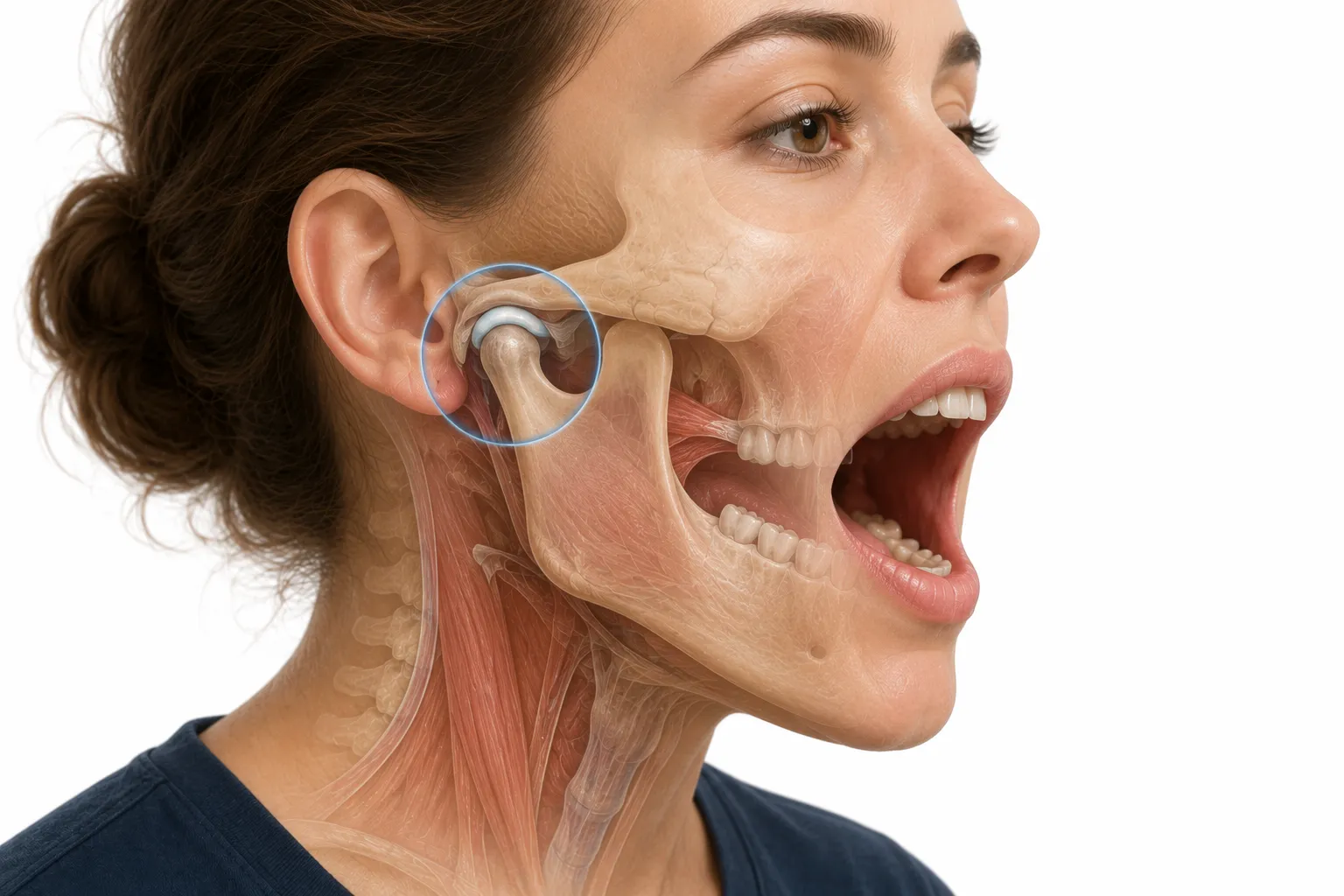
Why Does Your Jaw Click?
Jaw clicking often results from small shifts in the position of the cartilage disc within the jaw joint during movement.
Body & Brain
Can the Brain Feel Pain?
The brain controls all pain in your body, yet it cannot feel pain itself. Discover why, and what this strange fact re...