The gag reflex sensitivity varies significantly from person to person, with some people having a naturally very sensitive trigger point and others having a much higher tolerance before the reflex activates.
Body & Brain
Why do we have a gag reflex?
Why Do We Have a Gag Reflex?
A toothbrush reaching slightly too far back in the mouth can trigger an involuntary, unmistakable convulsive reaction almost instantly.
On this page
The short answer
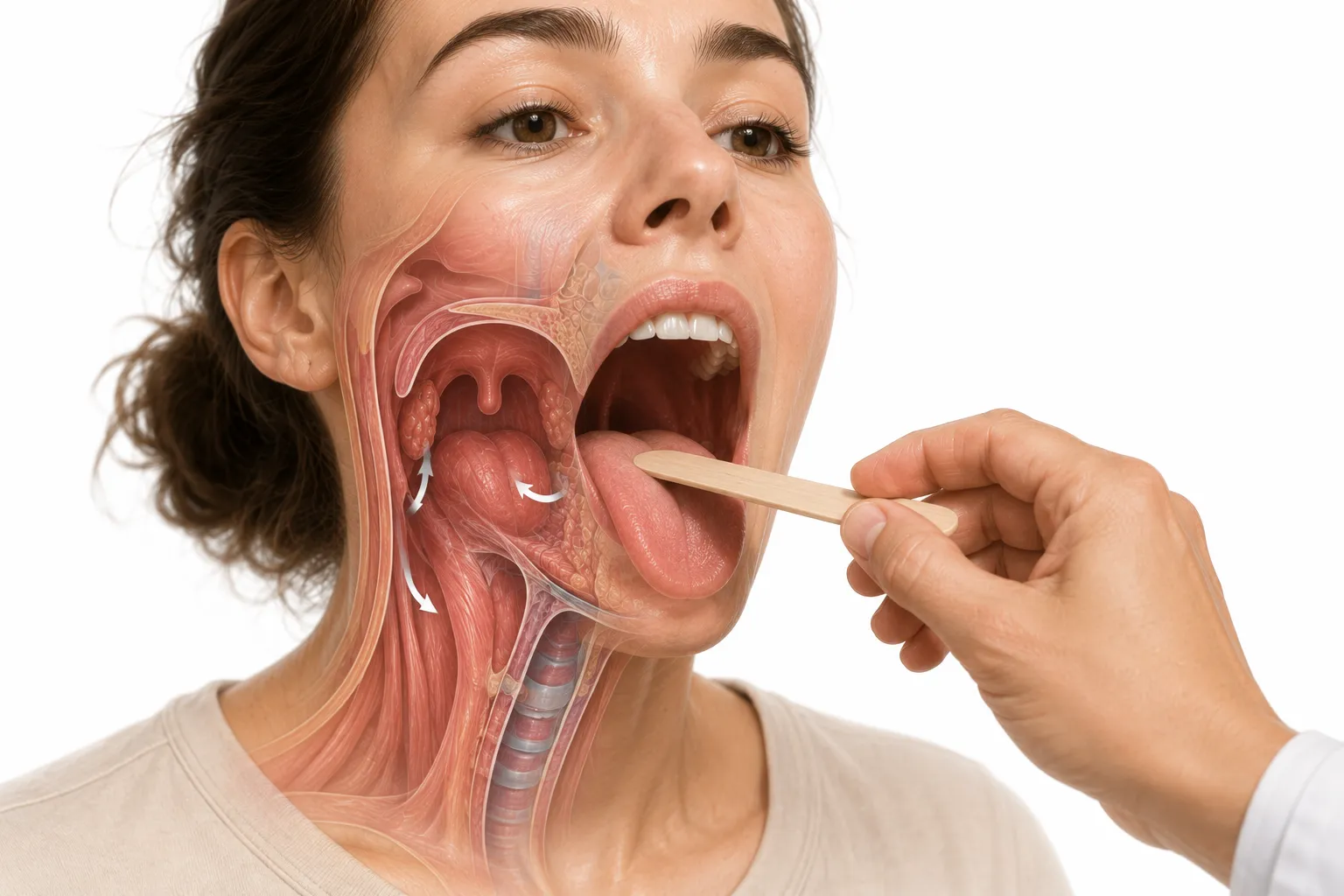
The gag reflex exists as a protective mechanism to prevent foreign objects, excess food, or other material from entering the airway, triggered automatically when sensitive nerve endings at the back of the throat and roof of the mouth are touched, causing a rapid, involuntary contraction of throat muscles.
The back of the throat and the soft palate at the rear of the roof of the mouth are densely packed with sensory nerve endings connected to a specific neurological reflex arc. When something touches these sensitive areas, whether it's a piece of food positioned too far back, a dental instrument, a finger, or a toothbrush reaching too deeply, these nerves immediately send a signal that triggers a rapid, involuntary contraction of the muscles in the throat. This contraction, the gag reflex, serves to push the triggering object forward and away from the airway, reducing the risk that it could be accidentally inhaled into the windpipe and lungs, a genuinely dangerous event called aspiration. Because protecting the airway from foreign objects is critical to survival, this reflex operates automatically and very quickly, bypassing the need for conscious decision-making entirely, similar to how pulling a hand away from a hot surface happens before the brain has fully processed the pain.
At a glance
This is the first, essential step in the body's airway protection system.
Having a strong gag reflex means something is wrong or overly sensitive about a person's body.
Sensitive nerve endings at the back of the throat and roof of the mouth are wired directly to a reflex arc that triggers strong muscular contractions the instant something touches them, no conscious thought required.
Picture a security checkpoint gate that slams shut automatically the moment a sensor is triggered, faster than any human guard could ever react on their own.
Diagram
Why Do We Have a Gag Reflex: the idea in one diagram
Sensitive nerve endings at the back of the throat and soft palate trigger a fast, involuntary reflex arc when touched, causing throat muscles to contract and push a foreign object forward, away from the airway.
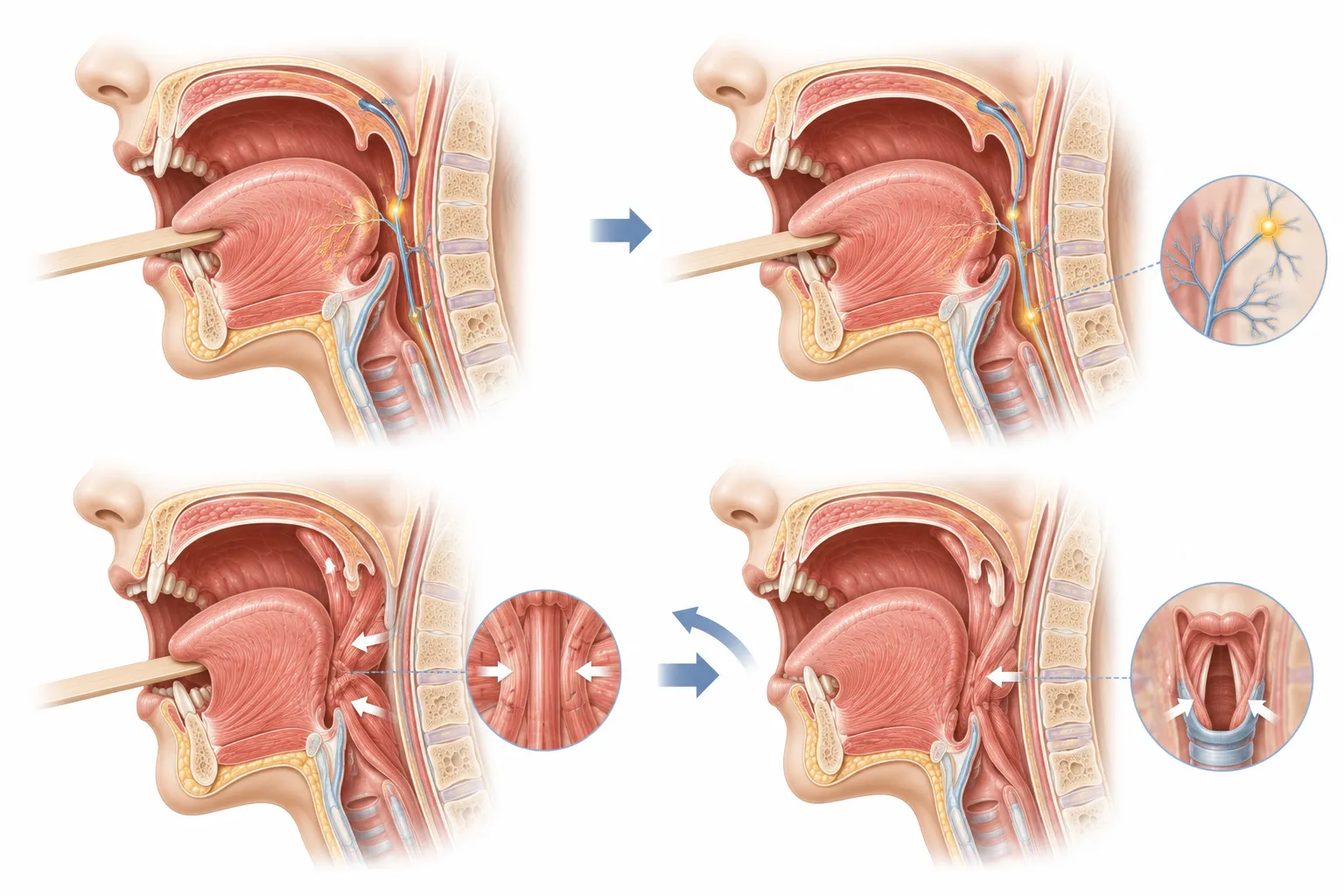
- 1Sensory nerves detect contact at the back of the throat
This is the first, essential step in the body's airway protection system.
- 2A signal travels through a dedicated reflex arc
This dedicated pathway is what allows the reflex to happen almost instantaneously.
- 3Throat muscles contract involuntarily
This muscular response happens without any need for conscious control or decision-making.
- 4The reflex pushes objects away from the airway
The end result of the entire reflex is direct, immediate protection of the airway.
How it works
The mechanism
Sensitive nerve endings at the back of the throat and soft palate trigger a fast, involuntary reflex arc when touched, causing throat muscles to contract and push a foreign object forward, away from the airway.
- Step 01
Sensory nerves detect contact at the back of the throat
Dense clusters of sensory nerve endings line the back of the throat and soft palate, specifically positioned to detect anything touching this critical area near the airway.
Like a sensitive pressure sensor placed exactly at the entrance to a restricted, high-security area.
This is the first, essential step in the body's airway protection system.
- Step 02
A signal travels through a dedicated reflex arc
The nerve signal travels through a fast, dedicated reflex pathway involving specific cranial nerves, bypassing the slower, more deliberate processing pathways typically used for conscious decision-making.
Like an emergency alert routed directly through a dedicated priority channel instead of standard, slower communication lines.
This dedicated pathway is what allows the reflex to happen almost instantaneously.
- Step 03
Throat muscles contract involuntarily
Once triggered, muscles in the throat and soft palate rapidly and involuntarily contract, producing the characteristic gagging motion.
Like an automatic door slamming shut the instant its trigger sensor is activated.
This muscular response happens without any need for conscious control or decision-making.
- Step 04
The reflex pushes objects away from the airway
This muscular contraction works to push the triggering object forward and away from the throat, reducing the risk it could be accidentally inhaled into the airway and lungs.
Like a security gate physically forcing an unauthorized object back out the way it came in.
The end result of the entire reflex is direct, immediate protection of the airway.
Surprises
Facts worth sitting with
The gag reflex sensitivity varies significantly from person to person, with some people having a naturally very sensitive trigger point and others having a much higher tolerance before the reflex activates.
Surprising facts
What seems backwards
Worth comparing
In everyday life
Easy to get wrong
Pressure points
Where the simple answer gets interesting
Why does the gag reflex trigger so quickly, without any conscious thought involved?
Because protecting the airway from foreign objects is critical to preventing potentially fatal choking or aspiration, the reflex operates through a fast, automatic neural pathway that bypasses slower conscious decision-making entirely.
The body prioritizes speed over deliberation specifically because, in a true emergency, a split-second delay could be the difference between safety and serious harm.
Why does gag reflex sensitivity vary so much between different people?
Individual differences in nerve density and sensitivity at the back of the throat and soft palate naturally produce a wide range of gag reflex thresholds from one person to the next, without indicating any underlying health problem.
A reflex meant to protect everyone equally still ends up being calibrated quite differently from person to person.
Can the gag reflex be intentionally trained to become less sensitive?
Repeated, gradual, careful exposure to gentle stimulation of the trigger area has been shown to reduce gag reflex sensitivity over time in many people, a technique used by dental patients, medical professionals in training, and performers who need precise oral control.
Even a fast, involuntary protective reflex can be gradually reshaped through consistent, deliberate practice.
Behind the science
The story behind it
Dental and medical techniques for managing patient gag reflexes
Dental professionals have developed a range of specific techniques, from distraction methods to topical numbing agents, to help manage patients with a particularly sensitive gag reflex during procedures.
This practical, widespread challenge in clinical settings has directly driven the development of dedicated management techniques used worldwide.
A normal, healthy protective reflex can still present real, everyday practical challenges that require thoughtful, dedicated solutions.
Clinical studies on gag reflex desensitization techniques
Researchers studied whether gradual, repeated exposure to gentle throat stimulation could reduce gag reflex sensitivity in patients preparing for medical procedures.
Many participants showed a measurable reduction in gag reflex sensitivity after a structured desensitization program, confirming the reflex's threshold can shift with practice.
Clarify
Myth and reality
Myth
Having a strong gag reflex means something is wrong or overly sensitive about a person's body.
Reality
Gag reflex sensitivity varies naturally and significantly between individuals, and a strong reflex simply reflects one end of a completely normal range, not a malfunction.
Evidence
Clinical studies measuring gag reflex thresholds across large groups of healthy individuals consistently show a wide, normal distribution of sensitivity.
Looking closer
The deeper pattern
The gag reflex shows that speed, not comfort, is sometimes the body's highest priority when survival is genuinely on the line.
One way to think about it
Protective systems built for genuine emergencies are often designed to prioritize immediate, automatic action over precision or comfort, accepting some unnecessary false alarms as the acceptable cost of never missing a real one.
A system built to prevent rare but serious harm will often seem oversensitive in everyday situations, and that oversensitivity is frequently the price of genuine reliability when it truly matters.
Limits
Where the explanation bends
People with an unusually weak or absent gag reflex.
A significantly reduced or absent gag reflex can sometimes indicate an underlying neurological condition affecting the relevant cranial nerves, and in such cases it may warrant medical evaluation, though it can also simply reflect normal individual variation.
The presence or absence of a reflex most people take for granted can occasionally serve as a meaningful clinical clue.
In daily life
What this helps you notice
Understanding the gag reflex's protective purpose explains why certain everyday activities, like brushing teeth or visiting the dentist, commonly trigger it without indicating any problem.
Many people learn specific breathing or distraction techniques to help manage gag reflex triggers during routine dental visits.
Remember
Key takeaways
- 1
The gag reflex protects the airway by preventing foreign objects from being accidentally inhaled.
- 2
Sensitive nerve endings at the back of the throat and soft palate trigger the reflex when touched.
- 3
The reflex operates through a fast, involuntary neural pathway that bypasses conscious decision-making.
- 4
Gag reflex sensitivity varies significantly and normally from person to person.
- 5
Repeated, careful exposure can gradually reduce gag reflex sensitivity over time in many people.
That sudden, uncomfortable gag isn't your body malfunctioning, it's a split-second security check working exactly as designed, protecting your airway faster than you could ever consciously react.
Every triggered gag reflex is a small, involuntary reminder of a protective system standing quiet guard at the back of your throat every single day of your life.
Read around the idea
More questions with the same curious pull
Nearby doors from the TinyThat archive, chosen by topic, intent, and reader curiosity.
Body & Brain
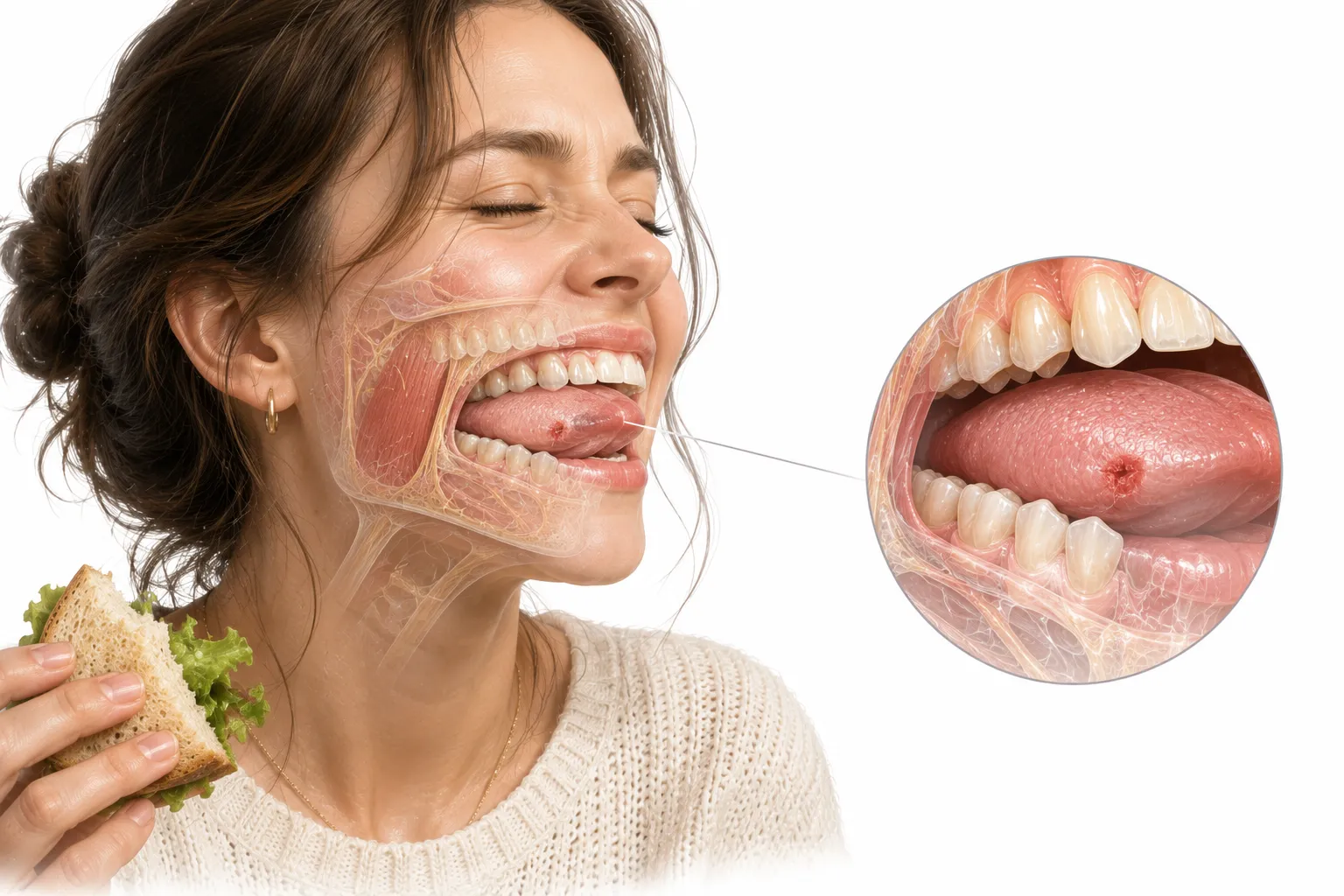
Why Do We Bite Our Tongues?
Chewing is a fast, largely automatic process, and small timing errors occasionally let the tongue get caught between...
Body & Brain
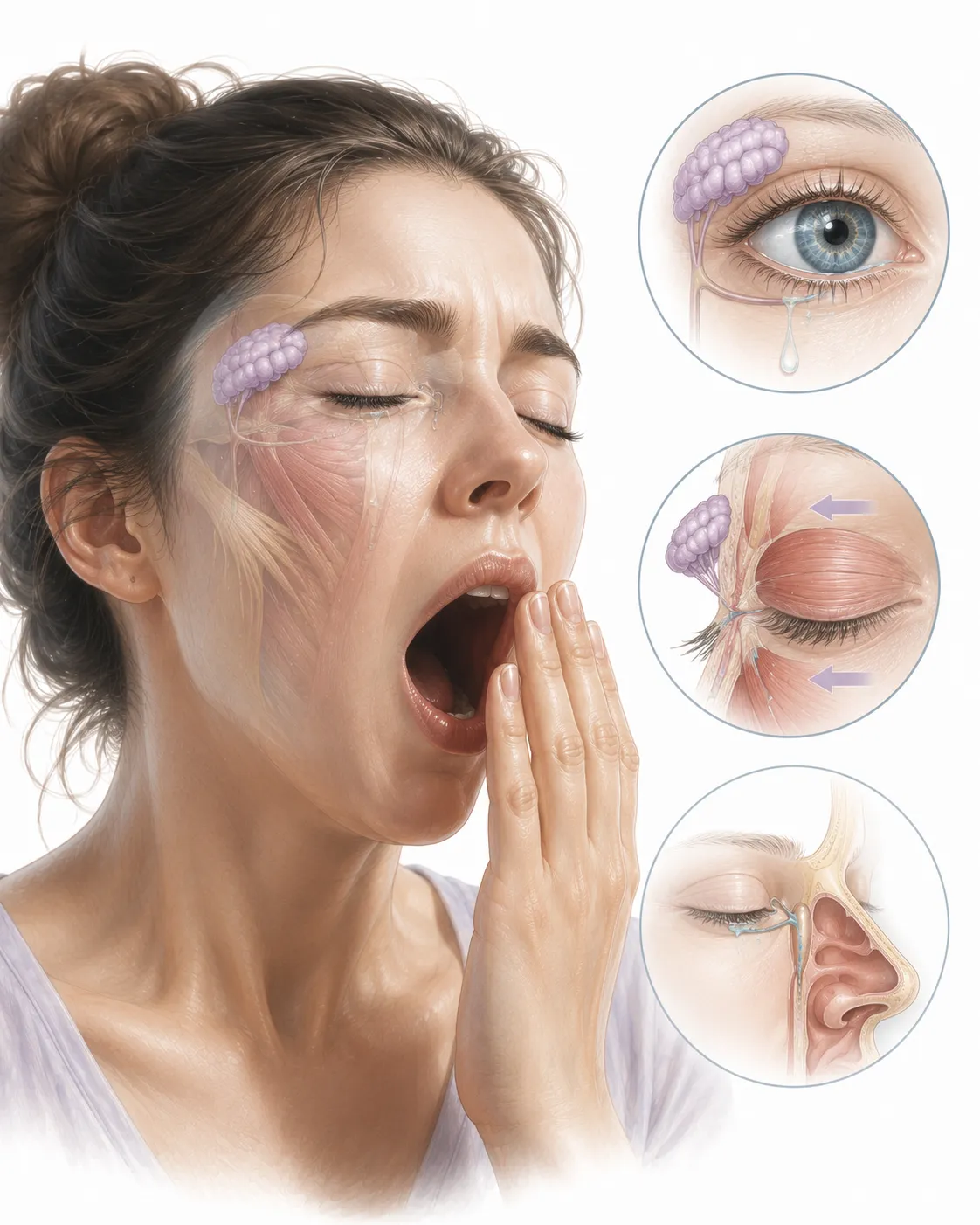
Why Do We Produce Tears When We Yawn?
Yawning changes pressure around the eyes and face, which can trigger the tear glands to release extra fluid.
Body & Brain
Can the Brain Feel Pain?
The brain controls all pain in your body, yet it cannot feel pain itself. Discover why, and what this strange fact re...