Type O blood is often called the universal donor for red blood cell transfusions because it carries neither the A nor B antigen, making it broadly compatible across ABO blood types in emergencies.
Body & Brain
Why do humans have different blood types?
Why Do We Have Different Blood Types?
Two people can share the exact same species, the exact same basic blood function, and still be genuinely incompatible if one tries to donate blood to the other.
On this page
The short answer
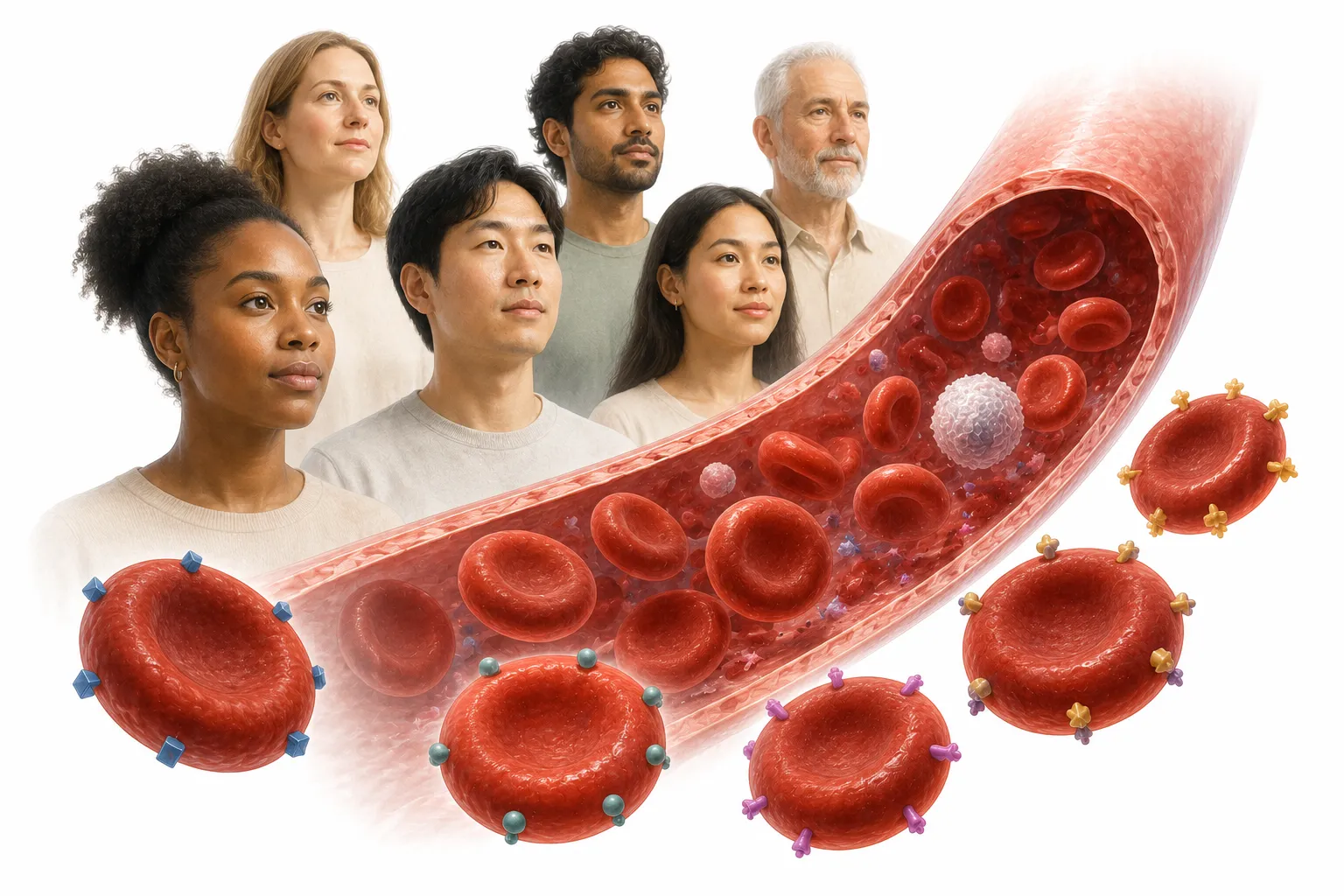
Different blood types exist because of inherited genetic variation in the specific antigens, marker molecules made of sugars and proteins, present on the surface of red blood cells, and this variation appears to have persisted throughout human evolutionary history because different blood type antigens offered varying degrees of resistance to specific infectious diseases.
The most well-known blood type system, the ABO system, is determined by a single gene with multiple variants that control which sugar molecules, called antigens, are attached to the surface of red blood cells. People with type A blood have the A antigen, type B have the B antigen, type AB have both, and type O have neither. A separate gene determines the Rh factor, whether the Rh antigen, commonly called the D antigen, is present, making a person Rh-positive or Rh-negative. These genetic variants aren't random noise, evolutionary biologists believe blood type diversity has persisted in human populations because different antigen types have historically offered varying resistance to specific infections, from certain strains of malaria to cholera and other pathogens, meaning no single blood type has ever offered a decisive survival advantage over all others in every environment. The immune system's job is to recognize the body's own cells and attack unfamiliar ones, so a person's immune system treats blood cells carrying an antigen it doesn't recognize as foreign, which is why receiving an incompatible blood type during a transfusion can trigger a dangerous immune reaction, and why blood type compatibility must always be carefully matched.
At a glance
Blood type is fundamentally a genetically inherited trait passed down from both parents.
Blood type reliably determines aspects of a person's personality or temperament.
Blood type is determined by specific antigens, marker molecules, present or absent on the surface of red blood cells, and the immune system treats unfamiliar antigens as a threat to attack.
Picture millions of tiny identification badges covering the surface of every red blood cell, and an immune system trained to instantly recognize and attack any badge it doesn't personally recognize as belonging.
Diagram
Why Do We Have Different Blood Types: the idea in one diagram
Genetic variation in a single gene controls which sugar antigens appear on red blood cell surfaces, and the immune system's ability to recognize unfamiliar antigens as foreign is what makes blood type compatibility essential for safe transfusions.
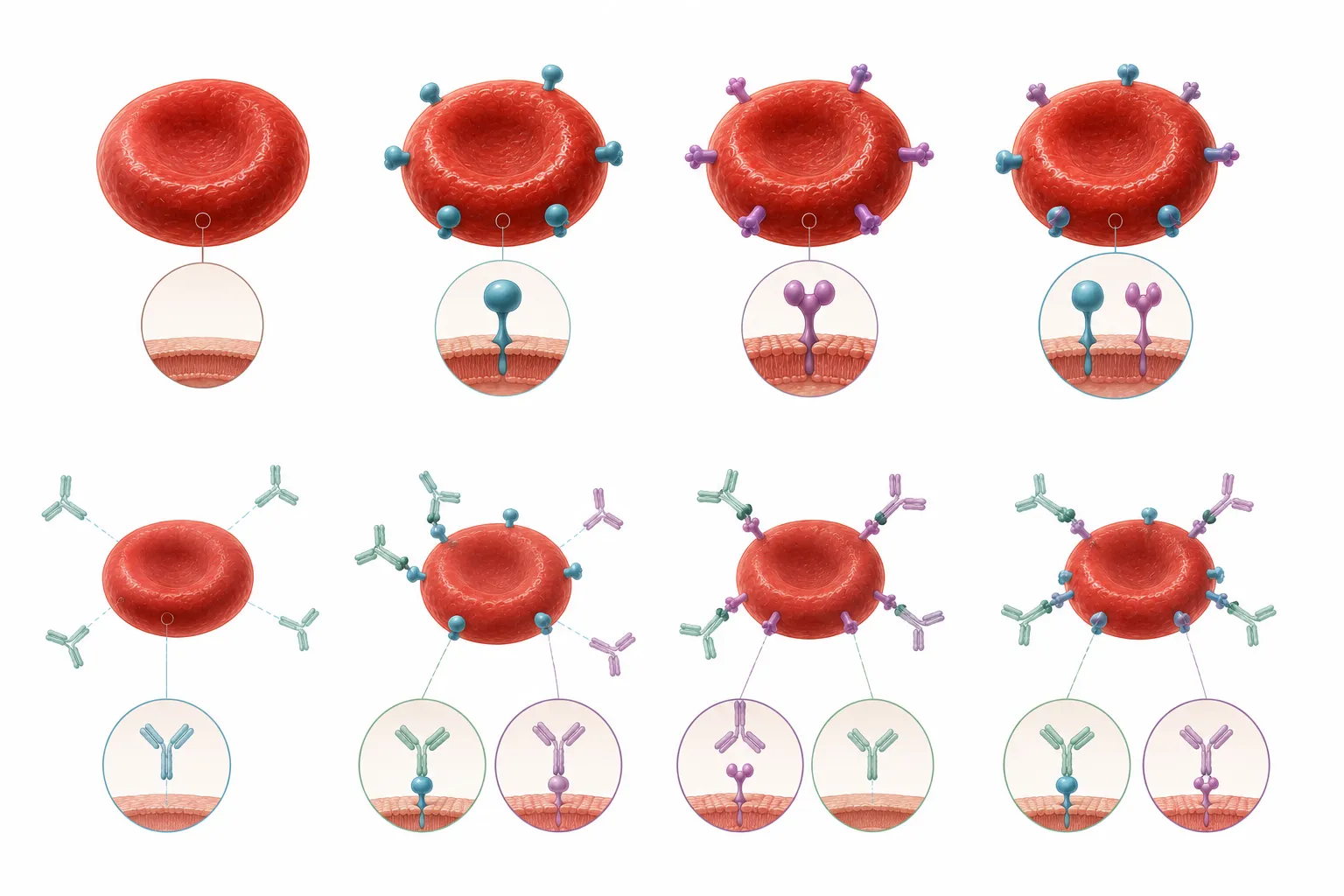
- 1A single gene controls ABO antigen production
Blood type is fundamentally a genetically inherited trait passed down from both parents.
- 2Antigens act as identification markers on red blood cells
This identification system is essential to how the immune system distinguishes self from non-self.
- 3The immune system attacks unfamiliar antigens
This immune response is exactly why blood type matching is critical for safe transfusions.
- 4Different antigen types offered varying disease resistance historically
Blood type diversity likely persisted, in part, as a broader evolutionary hedge against shifting disease threats.
How it works
The mechanism
Genetic variation in a single gene controls which sugar antigens appear on red blood cell surfaces, and the immune system's ability to recognize unfamiliar antigens as foreign is what makes blood type compatibility essential for safe transfusions.
- Step 01
A single gene controls ABO antigen production
The ABO gene has multiple variants that determine whether A antigens, B antigens, both, or neither are attached to the surface of red blood cells.
Like a manufacturing setting that determines which type of ID badge gets printed and attached to every unit coming off the line.
Blood type is fundamentally a genetically inherited trait passed down from both parents.
- Step 02
Antigens act as identification markers on red blood cells
These antigen molecules sit on the outer surface of red blood cells and serve as identification markers that the immune system uses to distinguish the body's own cells from foreign ones.
Like a uniform badge system that lets security instantly identify authorized personnel versus outsiders.
This identification system is essential to how the immune system distinguishes self from non-self.
- Step 03
The immune system attacks unfamiliar antigens
If blood carrying an unfamiliar antigen enters the body, such as during an incompatible transfusion, the immune system recognizes it as foreign and mounts an attack against those cells.
Like a security system triggering an alarm the instant it detects an unrecognized badge attempting entry.
This immune response is exactly why blood type matching is critical for safe transfusions.
- Step 04
Different antigen types offered varying disease resistance historically
Researchers believe certain blood type antigens have historically provided varying degrees of resistance to specific pathogens, helping explain why blood type diversity has persisted rather than converging on a single dominant type.
Like a population maintaining a mix of different lock types so that no single master key, or pathogen, can unlock every single one.
Blood type diversity likely persisted, in part, as a broader evolutionary hedge against shifting disease threats.
Surprises
Facts worth sitting with
Type O blood is often called the universal donor for red blood cell transfusions because it carries neither the A nor B antigen, making it broadly compatible across ABO blood types in emergencies.
Surprising facts
What seems backwards
Worth comparing
In everyday life
Easy to get wrong
Pressure points
Where the simple answer gets interesting
Why hasn't one blood type simply won out through evolution over all the others?
Different blood type antigens have offered varying resistance to different infectious diseases throughout human history, and since disease pressures differ across environments and time periods, no single blood type has ever offered a consistent, decisive survival advantage everywhere.
A trait most people never think twice about turns out to be a living record of humanity's long, complicated relationship with infectious disease.
Why is blood type so important during a transfusion?
The immune system attacks red blood cells carrying antigens it doesn't recognize as its own, so transfusing an incompatible blood type can trigger a dangerous immune reaction, making careful blood type matching essential for patient safety.
A microscopic mismatch invisible to the naked eye can trigger a serious, potentially life-threatening immune response.
Why do blood type frequencies differ so much between global populations?
Genetic drift, founder effects in small migrating populations, and differing historical disease pressures across regions all contributed to blood type frequencies varying significantly from one population to another over generations.
Something as personal as your blood type carries traces of your ancestors' migration history and the diseases they survived.
Behind the science
The story behind it
The discovery of the ABO blood group system
Austrian scientist Karl Landsteiner identified the ABO blood group system in the early twentieth century after observing that mixing blood from different individuals sometimes caused clumping and other times did not.
This discovery made safe blood transfusion possible for the first time and remains foundational to modern transfusion medicine.
A simple, careful observation of an unexplained pattern can lead directly to a discovery that saves countless lives.
Population genetics studies linking blood type to historical disease resistance
Researchers analyzed blood type distribution alongside historical disease prevalence data across different global populations.
Certain blood types were found to correlate with differing susceptibility to diseases such as malaria and cholera, supporting the theory that disease pressure shaped blood type distribution over generations.
Clarify
Myth and reality
Myth
Blood type reliably determines aspects of a person's personality or temperament.
Reality
No rigorous scientific evidence supports a link between blood type and personality traits, despite this belief being culturally popular in some regions.
Evidence
Controlled studies examining blood type against personality measures have consistently failed to find a meaningful, reliable correlation.
Looking closer
The deeper pattern
Genetic diversity in something like blood type isn't a flaw or inefficiency, it's a hedge against an unpredictable, ever-changing landscape of disease threats.
One way to think about it
Populations that maintain diversity in a critical trait are often better protected against unpredictable future threats than populations that converge on a single, seemingly optimal solution.
Diversity within a system can be a genuine survival strategy in itself, not simply an accident or inefficiency waiting to be corrected.
Limits
Where the explanation bends
People with rare blood types not covered by the standard ABO and Rh systems.
Individuals with very rare blood types, sometimes lacking common antigens found in nearly everyone else, can face significant challenges finding compatible blood in an emergency, requiring specialized rare blood registries.
A system built around a handful of common categories still has to account for exceedingly rare individual variation at the extreme edges.
In daily life
What this helps you notice
Understanding blood type compatibility explains why blood donation centers carefully track and label every donation by specific type.
Type O negative blood is often specifically requested in emergency situations because it can typically be given to patients of any blood type when there isn't time for full compatibility testing.
Remember
Key takeaways
- 1
Blood type is determined by specific antigen markers on the surface of red blood cells.
- 2
The ABO gene and the separate Rh factor gene together determine a person's blood type.
- 3
The immune system attacks blood cells carrying unfamiliar antigens, making transfusion compatibility essential.
- 4
Blood type diversity likely persisted throughout human history because different types offered varying resistance to different diseases.
- 5
Blood type distribution varies significantly across global populations due to genetic drift and historical disease pressures.
Your blood type isn't just a label on a medical chart, it's a small genetic inheritance shaped by generations of your ancestors' encounters with disease.
Every blood donation quietly relies on a molecular identification system your body has carried, unnoticed, since long before you were ever aware it existed.
Read around the idea
More questions with the same curious pull
Nearby doors from the TinyThat archive, chosen by topic, intent, and reader curiosity.

Body & Brain
Why Do We Have Freckles?
Freckles form when melanocytes in the skin produce pigment unevenly, often triggered or intensified by sun exposure.
Body & Brain
Can the Brain Feel Pain?
The brain controls all pain in your body, yet it cannot feel pain itself. Discover why, and what this strange fact re...
Body & Brain
Does Your Brain Eat Itself?
Your brain really does consume parts of itself. Learn about autophagy, synaptic pruning, and why self-consumption is...