Chewing is estimated to involve dozens of coordinated jaw movements per minute during a typical meal, each one requiring precise, split-second tongue positioning to avoid injury.
Body & Brain
Why do we accidentally bite our own tongues while eating or talking?
Why Do We Bite Our Tongues?
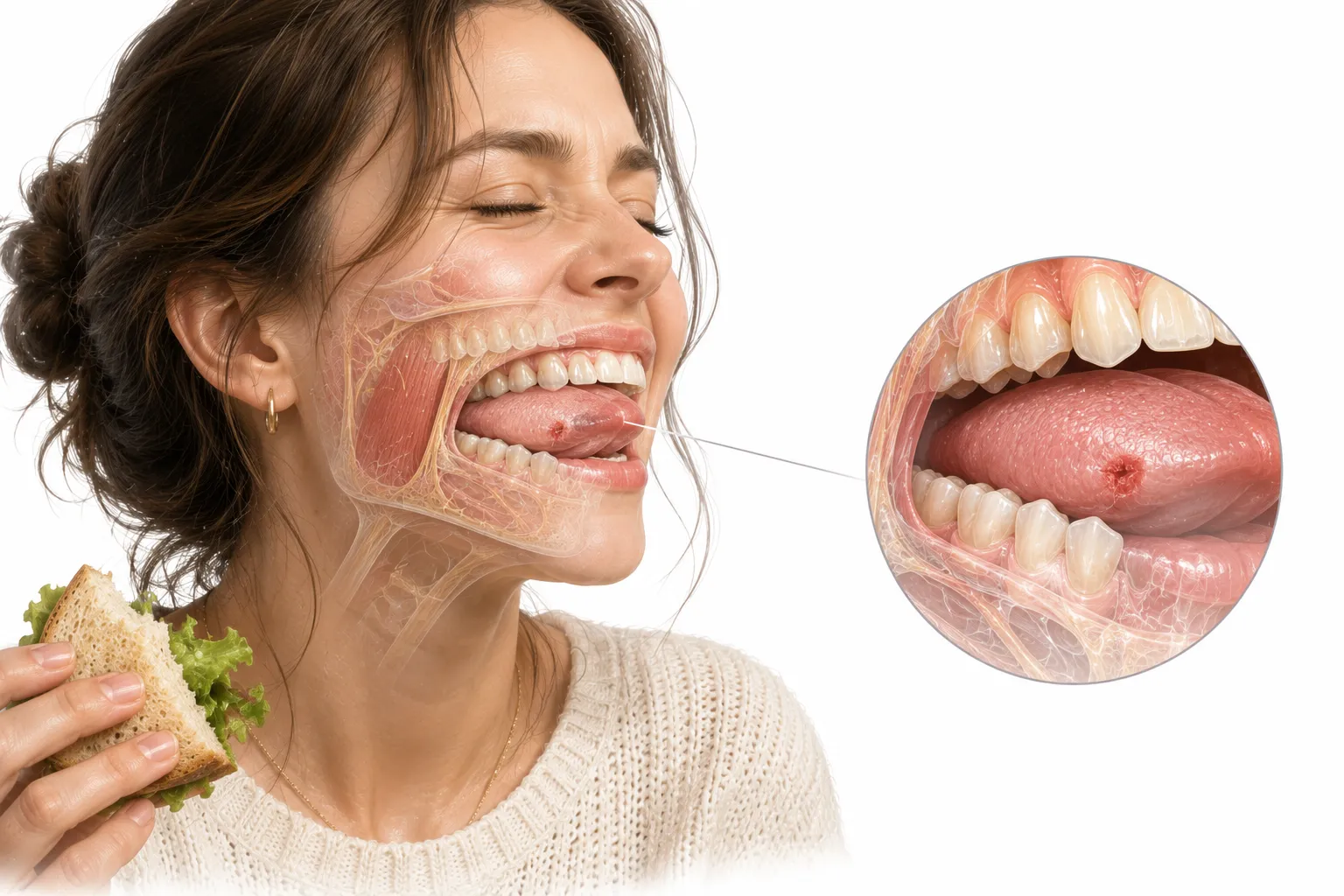
In the middle of a completely ordinary meal, a sudden sharp pain announces that you've just bitten your own tongue.
On this page
The short answer
We bite our tongues because chewing is a fast, largely automatic motor process in which the tongue constantly repositions food in the same space where the jaw is repeatedly closing, and a tiny timing error in this rapid coordination occasionally lets the tongue get caught between the teeth.
Chewing involves a tightly coordinated, repetitive cycle between the jaw muscles and the tongue, which continuously moves food around the mouth to keep it positioned between the teeth for effective grinding. This process happens largely automatically, controlled by motor pathways that don't require conscious, moment-to-moment attention once the pattern is established, similar to how walking becomes automatic after early childhood. Because the tongue is soft, highly mobile, and operating in extremely close proximity to the teeth on every single chewing cycle, its safety depends on very precise timing, retracting just before the jaw closes. Fatigue, distraction, talking while eating, eating quickly, or consuming unusually textured or unpredictable food can all disrupt this fine timing slightly. When that happens, the tongue's position and the jaw's closing motion overlap for just a fraction of a second, resulting in an accidental, often quite painful bite.
At a glance
This automation is what allows people to eat while talking, thinking, or doing other tasks.
Biting your tongue frequently means something is anatomically wrong with your mouth.
The tongue moves food around the mouth continuously during chewing, timed to duck out of the way a split second before the jaw closes, and it only takes a tiny timing error for that system to fail.
Picture a factory worker repositioning parts on a conveyor belt right next to a rhythmically closing stamping press, timed perfectly thousands of times a day, until one small miscalculation puts a hand in the wrong place at the wrong instant.
Diagram
Why Do We Bite Our Tongues: the idea in one diagram
Chewing runs on largely automatic motor coordination between the jaw and tongue, and small timing disruptions from fatigue, distraction, or speech occasionally cause the tongue to be caught between the teeth as the jaw closes.
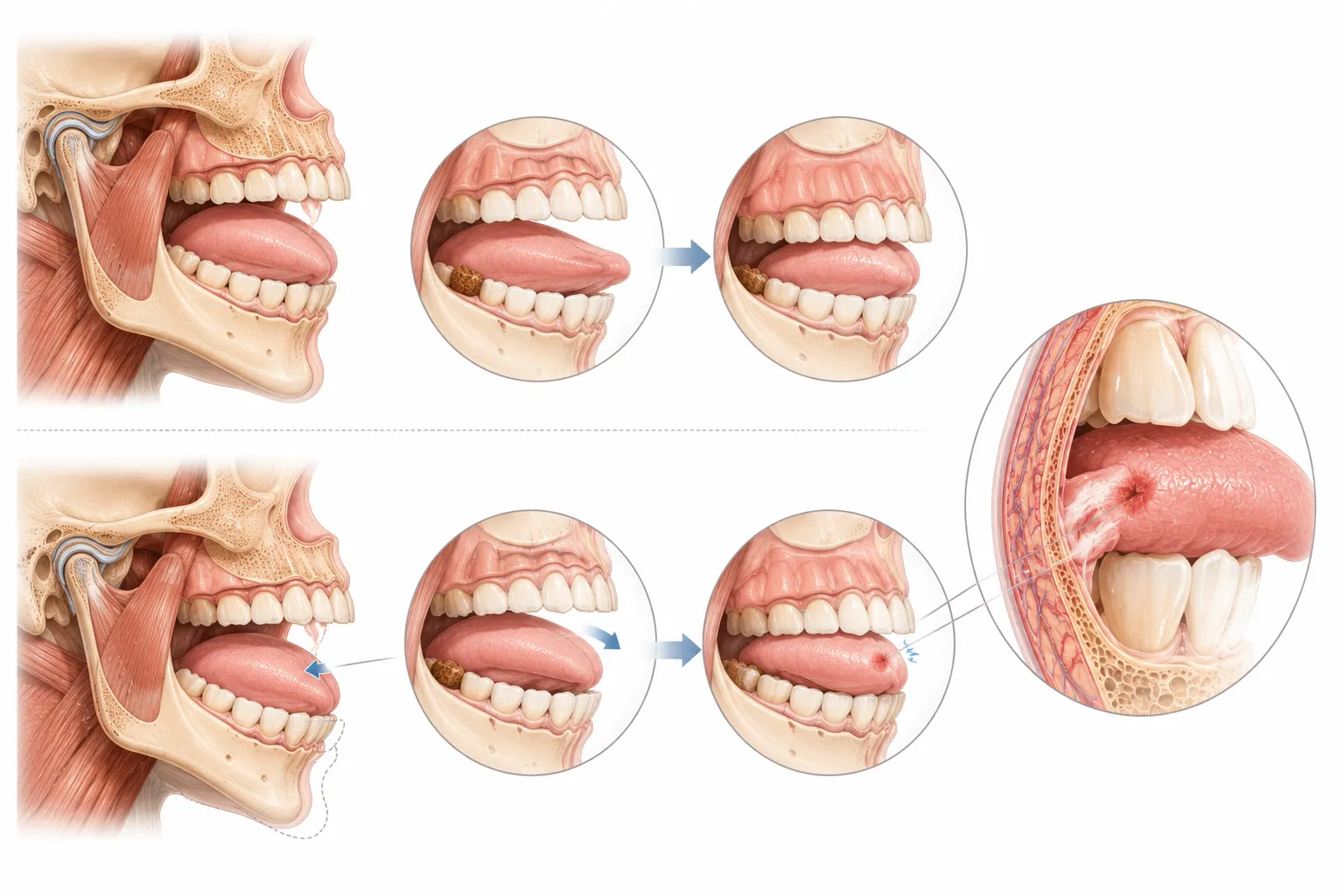
- 1Chewing operates as an automatic motor pattern
This automation is what allows people to eat while talking, thinking, or doing other tasks.
- 2The tongue continuously repositions food near the teeth
The tongue's essential job puts it in inherently close range of potential injury on every single bite.
- 3Precise timing normally keeps the tongue clear
This precise timing usually works flawlessly, meal after meal, for a lifetime.
- 4A small disruption causes a timing failure
Even a highly reliable automatic system will occasionally fail under the right conditions.
How it works
The mechanism
Chewing runs on largely automatic motor coordination between the jaw and tongue, and small timing disruptions from fatigue, distraction, or speech occasionally cause the tongue to be caught between the teeth as the jaw closes.
- Step 01
Chewing operates as an automatic motor pattern
Once learned in early childhood, chewing becomes a largely automatic motor sequence controlled by neural pathways that don't require ongoing conscious attention.
Like riding a bike, a complex coordinated movement that eventually requires little deliberate thought once mastered.
This automation is what allows people to eat while talking, thinking, or doing other tasks.
- Step 02
The tongue continuously repositions food near the teeth
During chewing, the tongue constantly moves food back between the teeth for grinding, requiring it to operate in very close proximity to the jaw's closing motion on every cycle.
Like a worker repeatedly placing material directly under a repeatedly closing press.
The tongue's essential job puts it in inherently close range of potential injury on every single bite.
- Step 03
Precise timing normally keeps the tongue clear
Under normal conditions, the tongue retracts with split-second timing just before the jaw closes, avoiding contact through finely tuned, practiced coordination.
Like a well-rehearsed dance move where each partner reliably clears space at exactly the right moment.
This precise timing usually works flawlessly, meal after meal, for a lifetime.
- Step 04
A small disruption causes a timing failure
Fatigue, distraction, speaking while chewing, or unpredictable food texture can slightly disrupt this fine timing, occasionally allowing the tongue and jaw's closing motion to overlap and result in a bite.
Like a momentary lapse in a well-rehearsed routine causing two performers to briefly collide.
Even a highly reliable automatic system will occasionally fail under the right conditions.
Surprises
Facts worth sitting with
Chewing is estimated to involve dozens of coordinated jaw movements per minute during a typical meal, each one requiring precise, split-second tongue positioning to avoid injury.
Surprising facts
What seems backwards
Worth comparing
In everyday life
Easy to get wrong
Pressure points
Where the simple answer gets interesting
Why does chewing become an automatic, largely unconscious process?
Repetitive motor tasks performed thousands of times over a lifetime become encoded into automatic neural pathways that don't require active conscious control, freeing up mental attention for other tasks while eating.
The same efficiency that lets you eat while having a conversation is exactly what occasionally leaves the tongue vulnerable.
Why does an accidental tongue bite hurt so much compared to other minor injuries?
The tongue contains an extremely high density of sensory nerve endings relative to its size, since fine sensitivity is essential for tasting, speaking, and safely manipulating food, making even minor injuries there disproportionately painful.
A structure built for exceptional sensitivity pays the price of that sensitivity every time it gets caught in the wrong place.
Are certain people more prone to biting their tongue than others?
Factors such as dental alignment issues, jaw disorders, certain neurological conditions, or simply eating quickly and distractedly can all increase the frequency of accidental tongue bites in some individuals.
A seemingly random mishap turns out to have real, identifiable risk factors that vary meaningfully from person to person.
Behind the science
The story behind it
Clinical research on recurrent tongue biting and neurological conditions
Medical researchers have studied recurrent, unusually frequent tongue biting as a potential sign of underlying conditions such as seizure disorders or jaw dysfunction, distinct from the occasional, harmless everyday bite.
This research helped clinicians distinguish ordinary, harmless tongue biting from a potentially significant symptom of an underlying medical condition.
A common, usually trivial mishap can sometimes serve as a useful diagnostic clue when it happens with unusual frequency or severity.
Electromyography studies of jaw and tongue coordination during chewing
Researchers used electromyography to measure the precise timing of jaw muscle activation relative to tongue movement during normal chewing cycles.
The studies confirmed extremely tight timing margins between tongue repositioning and jaw closure, illustrating just how little room for error exists during normal chewing.
Clarify
Myth and reality
Myth
Biting your tongue frequently means something is anatomically wrong with your mouth.
Reality
For most people, occasional tongue biting is simply a normal, harmless timing error in an otherwise highly efficient automatic chewing process, not a sign of an anatomical problem.
Evidence
Studies of chewing coordination show occasional timing lapses occur even in individuals with entirely normal dental and jaw anatomy.
Looking closer
The deeper pattern
Automating a task frees up attention, but it also removes conscious oversight, trading occasional small errors for a massive overall gain in efficiency.
One way to think about it
Systems that run on autopilot are generally far more efficient than ones requiring constant conscious control, but that efficiency comes with an acceptable, built-in margin of occasional error.
Occasional small failures are often simply the accepted cost of an otherwise highly efficient automatic system, not evidence that the system is poorly designed.
Limits
Where the explanation bends
People experiencing frequent, recurrent tongue biting.
Unusually frequent tongue biting can sometimes indicate an underlying dental misalignment, jaw joint disorder, or in rare cases a neurological condition affecting motor coordination, and may warrant a medical evaluation.
A mostly random, occasional mishap can sometimes be a meaningful signal when its frequency significantly increases.
In daily life
What this helps you notice
Understanding why tongue bites happen explains why they tend to increase during distracted eating or fatigue, offering a simple, practical way to reduce their frequency.
Many people notice fewer accidental tongue bites when eating more slowly and without the distraction of talking or screens.
Remember
Key takeaways
- 1
Chewing is a fast, largely automatic motor process requiring precise coordination between the tongue and jaw.
- 2
The tongue continuously repositions food in the same space where the jaw repeatedly closes.
- 3
Precise timing usually keeps the tongue clear of the closing jaw during every chewing cycle.
- 4
Fatigue, distraction, or talking while eating can disrupt this timing and cause an accidental bite.
- 5
The tongue's high nerve density makes even a minor bite feel disproportionately painful.
Every accidental tongue bite is a rare misstep in a coordination routine so fast and so automatic that it succeeds correctly thousands of times before a single, tiny timing error ever gets noticed.
The sharp, familiar sting of biting your tongue is really just a brief reminder of how astonishingly precise an ordinary bite of food actually requires your body to be.
Read around the idea
More questions with the same curious pull
Nearby doors from the TinyThat archive, chosen by topic, intent, and reader curiosity.
Body & Brain
Why Do We Have a Gag Reflex?
The gag reflex protects the airway by triggering a strong muscular response when something touches sensitive areas at...
Body & Brain
Why Does Your Jaw Click?
Jaw clicking often results from small shifts in the position of the cartilage disc within the jaw joint during movement.
Body & Brain
Can the Brain Feel Pain?
The brain controls all pain in your body, yet it cannot feel pain itself. Discover why, and what this strange fact re...