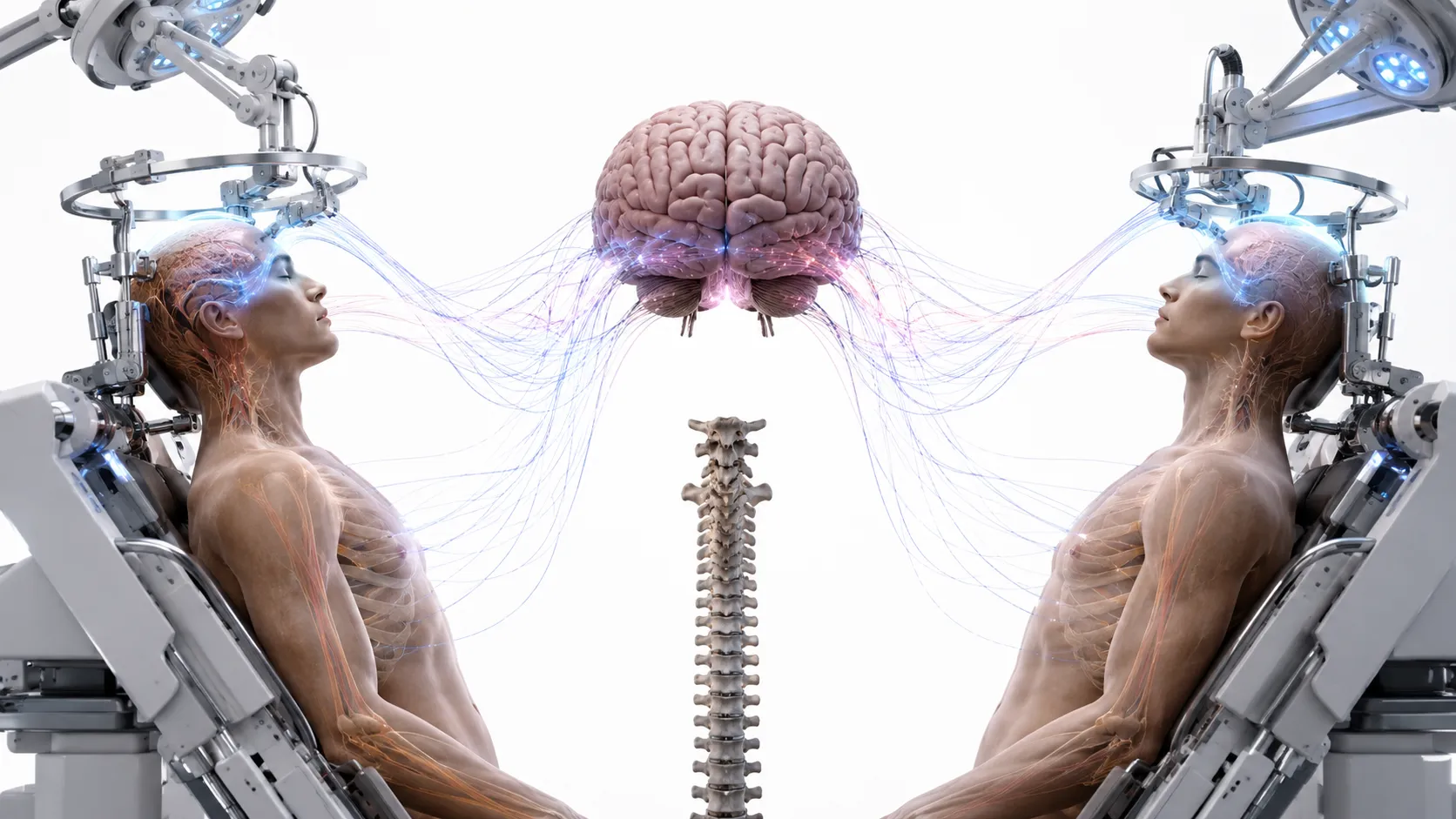
Robert White's 1970 monkey head transplant produced a head that could see, hear, smell, and respond to stimuli for nine days, but could not move the body because the spinal cord was not reconnected.
Body & Brain
Can a human brain be transplanted?
Can the Brain Be Transplanted?
In 1970, a surgeon in Ohio successfully transplanted the head of one monkey onto the body of another. Both remained alive for nine days before dying of immune rejection. The surgeon considered the experiment a partial success.
On this page
The short answer
No. A complete brain transplant is currently impossible because medicine cannot reconnect a severed spinal cord, and without that reconnection, the transplanted brain would be permanently isolated from the body it was placed into.
Removing a brain from one skull and placing it into another requires severing the spinal cord, the brainstem connections, and dozens of cranial nerves. The spinal cord contains millions of nerve fibers, and current medicine has no way to reattach them in a way that restores function. The transplanted brain would be alive but permanently paralyzed, unable to feel the body beneath it or move it. The technical challenge makes heart and kidney transplantation look simple by comparison.
At a glance
Vascular survival is not the core barrier.
Brain transplants are just more complicated versions of organ transplants.
The obstacle to brain transplantation is not removing the brain. It is the spinal cord. The second you sever the spinal cord, you create a problem that no technology in existence can currently solve.
Imagine trying to transplant a city's entire communications network to a new location without interrupting a single phone call. Not the buildings. Not the servers. Every call, every signal, every connection, live and uninterrupted, during the move.
Behind the science
The story behind it
Robert White and the Monkey Head Transplant, 1970
Robert White, a neurosurgeon at Case Western Reserve University, transplanted the head of one rhesus monkey onto the headless body of another. The resulting animal could see, hear, and respond to stimuli for nine days, until immune rejection killed it.
The experiment demonstrated that the severed head could be kept alive with functional sensory systems by connecting its vascular supply to a donor body. It also demonstrated that without spinal cord reconnection, the transplanted head had no relationship with the body below the neck whatsoever.
Nine days of consciousness in a severed and transplanted head proved both the possibility of keeping a brain alive in a foreign body and the total futility of the arrangement without spinal cord reconnection.
Neural organoid transplantation in rodents, 2022 onwards
Researchers grew human neural organoids from stem cells and transplanted them into the brains of newborn rats, where they integrated with host circuitry, formed functional synapses, and influenced behavior.
The organoids survived, formed connections, and became functionally integrated into rat neural circuits, demonstrating that lab-grown human neural tissue can connect with and influence an existing nervous system.
Diagram
Can the Brain Be Transplanted: the idea in one diagram
A brain transplant fails at the point where organ surgery becomes network reconstruction: blood vessels can be reattached, but spinal cord, brainstem and cranial nerve pathways cannot currently be restored.
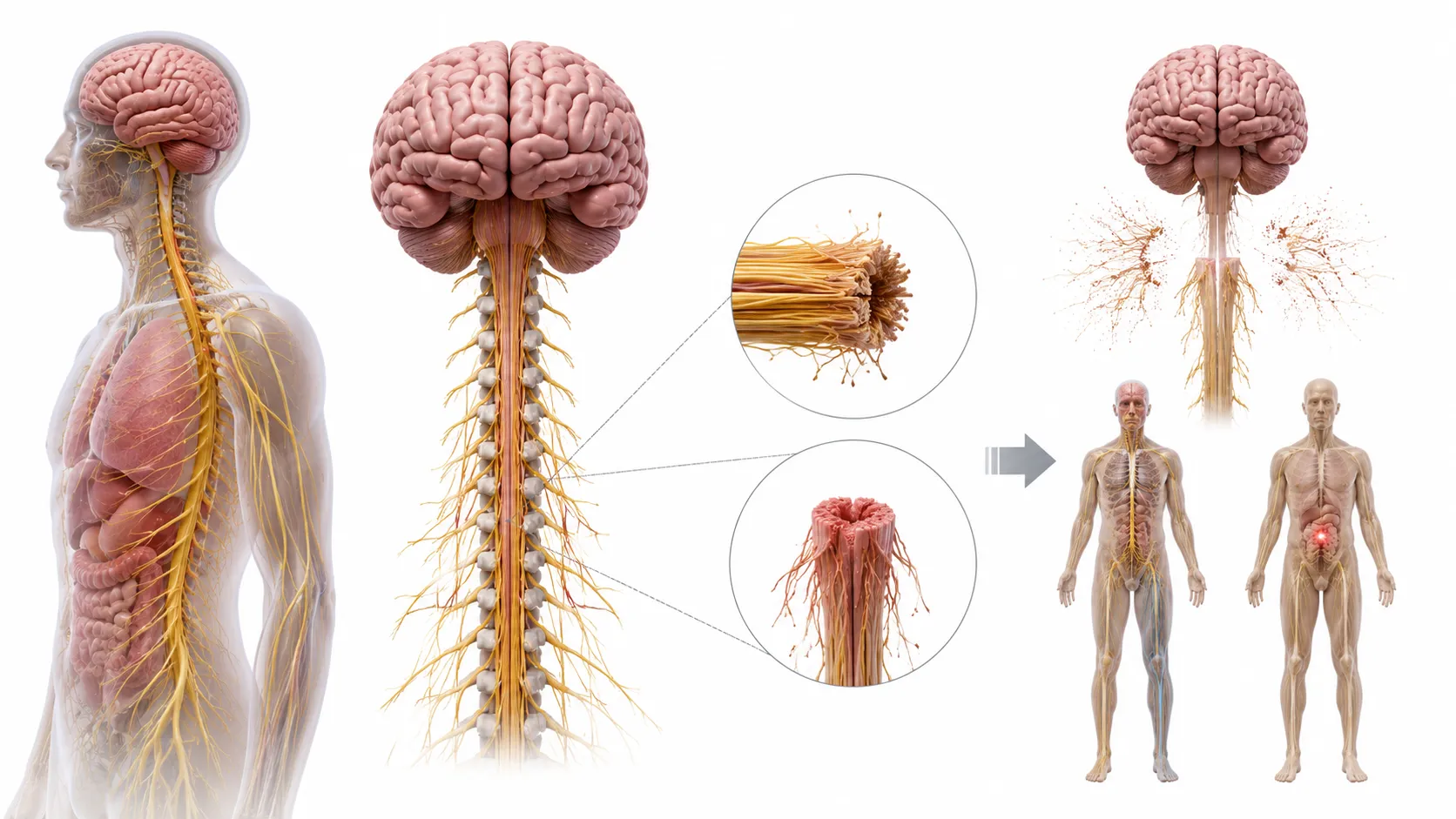
- 1Blood supply can be connected
Vascular survival is not the core barrier.
- 2The spinal cord is severed
A living brain would be isolated from the body.
- 3The network cannot be rebuilt
Connectivity, not anatomy, is the unsolved problem.
How it works
The mechanism
A brain transplant fails at the point where organ surgery becomes network reconstruction: blood vessels can be reattached, but spinal cord, brainstem and cranial nerve pathways cannot currently be restored.
- Step 01
Blood supply can be connected
Surgeons can connect arteries and veins to keep neural tissue alive, as animal head-transplant experiments showed.
Reconnecting the plumbing to a building.
Vascular survival is not the core barrier.
- Step 02
The spinal cord is severed
A transplant would cut millions of nerve fibers carrying movement, sensation and autonomic signals.
Cutting every phone line in a city at once.
A living brain would be isolated from the body.
- Step 03
The network cannot be rebuilt
Current medicine cannot guide severed axons back to their exact targets across the spinal cord and peripheral nervous system.
Splicing millions of individual threads to their original partners.
Connectivity, not anatomy, is the unsolved problem.
Clarify
Myth and reality
Myth
Brain transplants are just more complicated versions of organ transplants.
Reality
Heart, kidney, and liver transplants require vascular reconnection. Brain transplantation would require reconnection of billions of neural fibers in specific configurations.
Evidence
The best current results in spinal cord repair involve partial restoration of limited function in small numbers of fibers, not the wholesale reconnection that transplantation would demand.
Myth
Sergio Canavero's announced human head transplant was performed.
Reality
No verified human head transplant has been performed. A procedure performed on a corpse in 2017 had no clinical or scientific validity as a demonstration of the technique.
Evidence
The medical community rejected the announcement, noting that a procedure on a cadaver demonstrated nothing about functional survival.
Surprises
Facts worth sitting with
Robert White's 1970 monkey head transplant produced a head that could see, hear, smell, and respond to stimuli for nine days, but could not move the body because the spinal cord was not reconnected.
Surprising facts
What seems backwards
Worth comparing
In everyday life
Easy to get wrong
Pressure points
Where the simple answer gets interesting
If a brain transplant succeeded, who would the person be?
Most neuroscientists and philosophers of mind argue the person would be identified with the transplanted brain, carrying their memories, personality, and consciousness into the new body. Legally, this interpretation would mean the recipient of someone else's body is still legally themselves, creating extraordinary questions about identity, inheritance, relationships, and criminal responsibility.
It would be the first surgery in history after which the patient's identity is more ambiguous than their anatomy.
Could organoid or partial brain transplants ever work?
Lab-grown neural organoids have been transplanted into rodent brains, where they have formed connections with host neurons and influenced behavior. These are not full brain transplants but they represent the first successful integration of lab-grown neural tissue with existing neural circuitry.
The future may not involve moving whole brains but integrating additional neural tissue with existing brains, raising entirely different questions about identity.
Has any science produced a functioning brain-body reconnection?
Not in humans, but epidural electrical stimulation of the spinal cord below injury sites has enabled some paralyzed patients to make voluntary movements, suggesting that bypassing damaged connections with electrical interfaces is more achievable than biological reconnection.
The real question is not whether a brain can be reconnected to a body but whether a technological bypass of biological reconnection could achieve the same outcome.
Looking closer
The deeper pattern
The impossibility of brain transplantation is not primarily a surgical problem. It is a connectivity problem. And connectivity is always harder to restore than structure.
One way to think about it
In any sufficiently complex system, the relationships between components are more important than the components themselves. Neuroscience's inability to transplant a brain is the biological expression of this principle at its most extreme.
You can move the hardware. Reconstructing the network it ran is the work that may never be complete.
Limits
Where the explanation bends
Brain-computer interfaces bypassing spinal cord injury.
Devices implanted in motor cortex can read neural signals for intended movement and transmit them via computer to stimulate muscles below a spinal cord injury, bypassing the biological connection.
The detour around the spinal cord via electronics may turn out to be more achievable than any biological repair.
In daily life
What this helps you notice
Research into spinal cord repair has direct implications for millions of people living with spinal cord injuries, making it one of the most consequential frontiers in neuroscience regardless of any hypothetical transplant applications.
Epidural stimulation trials have enabled some complete spinal cord injury patients to make voluntary movements, representing genuine progress toward the connectivity restoration that would be needed for any future brain transplant scenario.
Remember
Key takeaways
- 1
A brain transplant is currently impossible because severed spinal cord fibers cannot be functionally reconnected.
- 2
Head transplants have been performed on animals but produce a conscious head with no body control.
- 3
The philosophical question of who wakes up after a brain transplant remains unresolved.
- 4
Neural organoid transplantation in animals represents the first successful integration of lab-grown brain tissue with existing neural circuits.
- 5
Brain-computer interfaces bypassing the spinal cord represent the nearest practical approximation to brain-body reconnection.
The barrier to brain transplantation is not the surgery. It is the billion threads that must be reconnected in exactly the right order to make a body answer to a mind.
Every organ transplant succeeds by reconnecting pipes. A brain transplant would require reconnecting conversations, billions of them, simultaneously, without missing a single thread. Medicine can move the organ. What it cannot do, not yet, is put it back in touch with the world.
Read around the idea
More questions with the same curious pull
Nearby doors from the TinyThat archive, chosen by topic, intent, and reader curiosity.
Body & Brain
Can the Brain Feel Pain?
The brain controls all pain in your body, yet it cannot feel pain itself. Discover why, and what this strange fact re...
Body & Brain
Does Your Brain Eat Itself?
Your brain really does consume parts of itself. Learn about autophagy, synaptic pruning, and why self-consumption is...
Body & Brain
Why Does Brain Fog Happen?
Brain fog is not imaginary. Learn what actually causes that thick, cloudy feeling in your head and what science says...