STATISTICAL CONCEPT

What Is the Lindy Effect? Why Old Things Last Longer

A book published in 2024 has a short future. A book published in 1924 has a long future. The Lindy Effect explains why old things are more likely to survive.

Editorial illustration of an old book and a new book with their projected life expectancies
Creator Albert Goldman (named after Lindy's Deli)Origin New York CityYear 1964Category Statistics, Technology

QUICK ANSWER

Here is the idea in plain English.

The Lindy Effect is a concept that the future life expectancy of a non-perishable thing is proportional to its current age. For things that do not have a natural expiration date, each additional day of survival implies a longer future life expectancy. The concept was named after Lindy's Deli in New York, where comedians would discuss the longevity of different acts. It has been applied to books, technology, companies, and ideas.

If you remember only a few things, remember these.

The basic move

The Lindy Effect is simple: the future life expectancy of a non-perishable thing is proportional to its current age. If something has survived for a long time, it is likely to survive for a long time in the future.

Why it matters

This applies to books, technologies, companies, and ideas. A book published in 1924 has survived for 100 years. It is likely to survive for another 100 years. A book published in 2024 has not proven its durability. It is less likely to survive.

Use it deliberately

When evaluating an idea, ask: how long has it survived? The longer the survival, the more robust the idea.

CORE IDEA

The concept in its simplest useful form.

What Does the Lindy Effect Mean in Simple Terms?

The Lindy Effect is simple: the future life expectancy of a non-perishable thing is proportional to its current age. If something has survived for a long time, it is likely to survive for a long time in the future.

This applies to books, technologies, companies, and ideas. A book published in 1924 has survived for 100 years. It is likely to survive for another 100 years. A book published in 2024 has not proven its durability. It is less likely to survive.

The logic is that survival is evidence of fitness. Things that are fragile do not survive. Things that are robust do. The longer something has survived, the more robust it is.
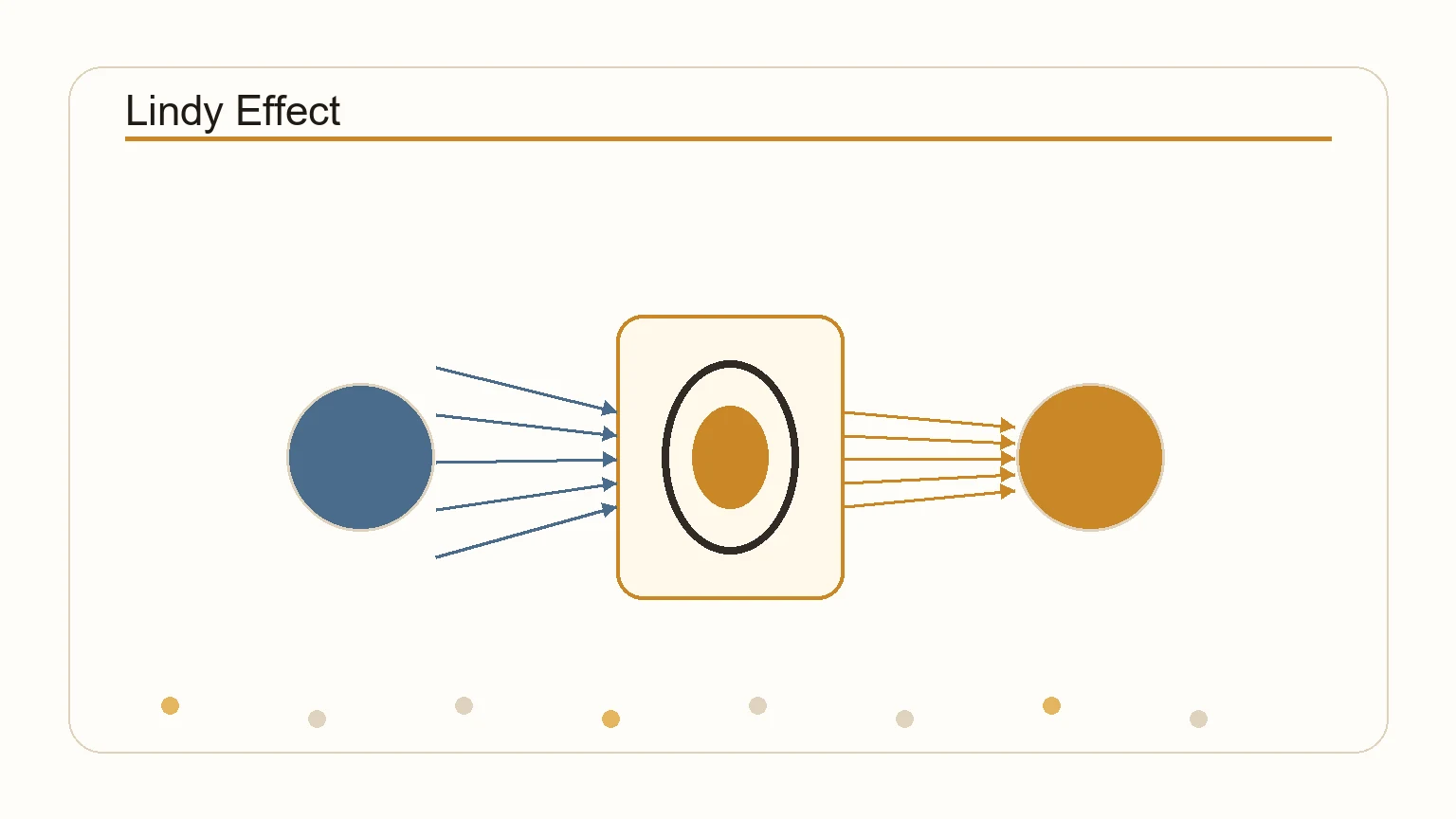

The small mechanism underneath the big idea.

01

The Story Behind the Lindy Effect

In the 1960s, comedians would gather at Lindy's Deli in New York City. They discussed the entertainment industry. They noticed a pattern: comedians who had been performing for a long time were likely to continue performing for a long time. New comedians were likely to disappear quickly.

The pattern was named after the deli. The Lindy Effect became a way to think about longevity. If a comedian had been performing for ten years, they would likely perform for another ten years. If they had been performing for twenty years, they would likely perform for another twenty years.

The concept was popularized by Nassim Nicholas Taleb in his book 'Antifragile.' Taleb applied the Lindy Effect to ideas, technologies, and companies. The logic is simple: survival is evidence of fitness.

02

Why the Lindy Effect Became Famous

The Lindy Effect became famous because of Nassim Nicholas Taleb. In 'Antifragile,' Taleb used the Lindy Effect to argue that old ideas are more reliable than new ones. The logic is counterintuitive and controversial. It became a topic of debate.

The concept has been applied to technology, investing, and decision making. It suggests that you should bet on the old, not the new. The new is unproven. The old is proven.

Today, the Lindy Effect is a popular mental model for evaluating ideas, technologies, and investments. It is a useful heuristic for distinguishing between fads and durable trends.

Diagram showing the Lindy Effect: older things have longer future life expectancies
A diagram showing the relationship between age and future life expectancy. Older things are projected to survive longer.

Where this idea shows up outside the textbook.

History

Shakespeare's plays have survived for 400 years. They will likely survive for another 400 years. The Lindy Effect applies. The endurance is evidence of quality.

Technology

The wheel has survived for 5,000 years. It will likely survive for another 5,000 years. A new technology like blockchain is unproven. The Lindy Effect applies.

Everyday Life

A restaurant that has been open for 50 years will likely be open for another 50 years. A new restaurant is less likely to survive. The Lindy Effect applies.

Internet Culture

A meme that has been around for a year is more likely to survive than a meme that is one day old. The Lindy Effect applies to internet culture too.

CONCEPT MAP

Every idea has neighbors. This is where the current concept sits in the TinyThat knowledge graph.

Current concept

Lindy Effect

The Lindy Effect is a concept that the future life expectancy of a non-perishable thing is proportional to its current age. For things that do not have a natural expiration date, each additional day of survival implies a longer future life expectancy. The concept was named after Lindy's Deli in New York, where comedians would discuss the longevity of different acts. It has been applied to books, technology, companies, and ideas.

What people often get wrong about this idea.

The Lindy Effect means new things are always bad.

No. It means new things are unproven. They have not demonstrated their durability. The Lindy Effect is a heuristic, not a rule.

The Lindy Effect applies to everything.

No. It applies to non-perishable things. Ideas, technologies, and books. It does not apply to perishable things like food or living beings.

The Lindy Effect is a law of nature.

No. It is a statistical pattern. It describes a tendency. It is not inevitable.

Useful ideas become dangerous when they are stretched too far.

Criticisms and Limitations of the Lindy Effect

The Lindy Effect is a useful heuristic, but it has limitations. It assumes that survival is evidence of quality. This is not always true. Some things survive because of inertia, not quality.

The effect does not apply to perishable things. Living beings, food, and other perishable items have a natural expiration date. The Lindy Effect does not apply.

The effect can be misused to justify conservatism. Not all old things are good. Not all new things are bad. The Lindy Effect is a guide, not a judge.

Three simple ways to apply the idea without turning it into a slogan.

1

When evaluating an idea, ask: how long has it survived? The longer the survival, the more robust the idea

When evaluating an idea, ask: how long has it survived? The longer the survival, the more robust the idea.

2

When investing, bet on the old, not the new

When investing, bet on the old, not the new. Old companies have proven their survival. New companies have not.

3

When reading, choose classics over bestsellers

When reading, choose classics over bestsellers. Classics have passed the test of time. Bestsellers have not.

EXPLORE NEXT

The best next ideas to read after this one.

Quick answers to common questions.

What is the Lindy Effect in simple terms?

The longer something has been around, the longer it will stick around. Old books, old technologies, and old ideas are more likely to survive.

What is an example of the Lindy Effect?

Shakespeare's plays have survived for 400 years. They will likely survive for another 400 years. The Lindy Effect explains why.

How do you use the Lindy Effect?

When evaluating ideas, technologies, or investments, favor the old over the new. Old things have proven their durability.

Why is the Lindy Effect a problem?

It can lead to conservatism. Not all old things are good. Not all new things are bad. The Lindy Effect is a guide, not a judge.