Visual answer
Snake Jacobson's Organ and Tongue
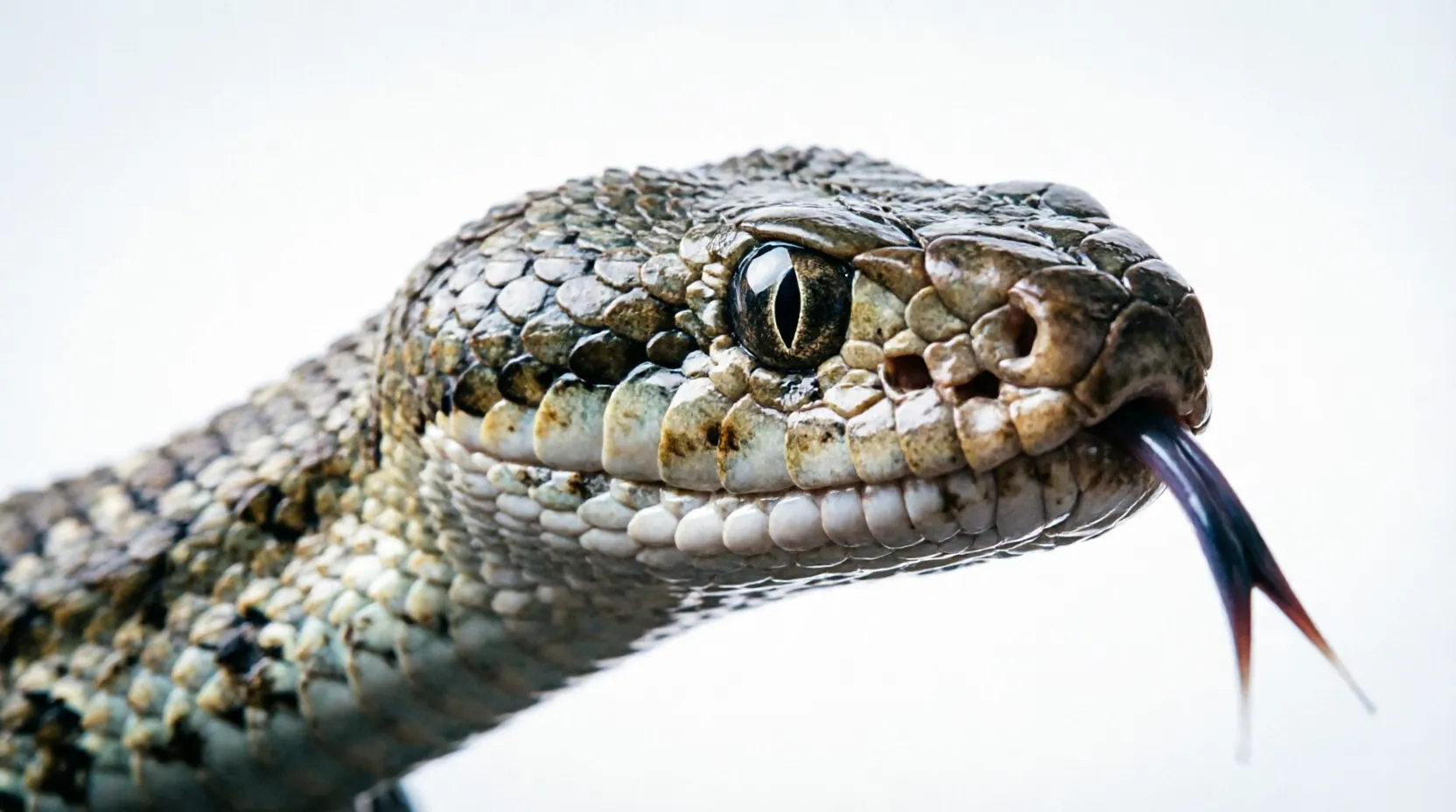
The forked tongue collects chemicals and transfers them to the VNO for analysis.
Forked tongue
Each tip collects chemicals from a slightly different spatial location.
Tongue retraction
Tongue pulls back into mouth, tips enter VNO openings.
Jacobson's organ (VNO)
Two chemoreceptor pits; each receives from one fork tip exclusively.
Accessory olfactory bulb
Brain region that processes the two independent signals for directional information.
Why forked?
The Mystery: Why Is the Tongue Forked?
For a long time, the forked tongue was assumed to be for tasting - but experiments show its primary function is directional smelling. Each tip samples a slightly different location in space. If a prey animal walked nearby, the scent molecules will be more concentrated on the fork tip that is closer to the trail. The brain compares the two signals - just as two ears compare sound arrival times for directional hearing - and extracts precise directional information from every single tongue flick.
Two-part system
The Two-Part Smelling System
The snake's chemical sense relies on a coordinated system: the tongue as data collector and the Jacobson's organ as molecular analyzer, together producing a directional 3D scent map.
Key components: Forked Tongue (chemical collector with directional sensing - the forked tips maximize the baseline between left and right sampling points). Tongue Flicking Behavior (oscillation creates air vortices that condense molecules onto the tongue's moist surface). Jacobson's Organ (VNO) (two pits lined with chemoreceptors; each pit receives molecules from one fork tip exclusively). Conventional Nostrils (long-range airborne chemical detection - triggers tongue-flicking when scent is interesting). Accessory Olfactory Bulb (dedicated brain region processing the two independent chemical signals).
Tracking prey
How a Snake Tracks Prey
1. Initial airborne detection - The snake's conventional nostrils detect trace airborne scents of a potential prey animal. This triggers increased tongue-flicking.
2. Tongue deployed - The forked tongue extends and oscillates, collecting chemical molecules from air and surfaces onto the moist surface of each tip.
3. Tongue retracted to Jacobson's organ - Each fork tip inserts into its dedicated VNO pit, transferring the collected molecules to chemoreceptors.
4. Directional comparison - The brain compares the molecular concentration and identity from left and right VNO pits. A stronger signal on one side indicates the prey's scent trail leads in that direction.
5. Trail following - The snake adjusts its heading toward the stronger signal, flicking its tongue every few seconds to continuously update the directional information.
Evolutionary purpose
Why Did Snakes Evolve This Sensing System?
Snakes descended from burrowing ancestors who navigated underground tunnels where vision is useless. Chemical sensing through the VNO was essential for tracking prey, avoiding predators, and finding mates in dark, confined spaces. The tongue-based delivery system evolved because it dramatically increases sensitivity and adds directional capability unavailable to nasal-only smelling.
Benefits include: Prey tracking (follow scent trails of animals that have long since moved on), Predator detection (chemical cues trigger defensive behavior before visual contact), and Mate location (follow pheromone trails over long distances).
Snake vs mammal
Snake Smell vs. Mammal Smell
Primary organ
Snake: Jacobson's organ (VNO) + nostrils / Mammal: Olfactory epithelium in nasal cavity
Chemical delivery
Snake: Forked tongue / Mammal: Airflow through nostrils
Directional ability
Snake: Stereo (each fork tip compares) / Mammal: Limited (nostril separation provides some direction)
Sensitivity to pheromones
Snake: Extremely high (can detect months-old trails) / Mammal: High but less directional
Examples
Snake Smelling in Action
Rattlesnake Post-Strike Tracking: After striking envenomated prey, rattlesnakes release their hold and let the prey flee. They then use tongue-based VNO tracking to follow the scent trail and locate the dead animal minutes later - often hundreds of meters away.
Garter Snake Mating Ball: In Manitoba, Canada, thousands of garter snakes emerge from overwintering dens; males track female pheromone trails, producing famous 'mating balls' of dozens of males pursuing one female - all guided entirely by chemical sensing.
King Cobra Prey Detection: King cobras specialize in hunting other snakes. They use their VNO system to detect the chemical signatures of specific snake species beneath leaves and underground.
Timber Rattlesnake Ambush Site Selection: Timber rattlesnakes use chemical cues from rodent runways to select precise ambush positions along frequently traveled routes.
Myths vs reality
Myth vs Reality: Snake Smell
What people think
Snakes smell with their tongues the way we taste with ours
The tongue is a taste organ, like a human tongue.
What actually happens
The tongue collects chemicals and delivers them to a smell organ (VNO)
Snakes do not 'taste' with their tongues; they 'smell' through the Jacobson's organ. The tongue is a chemical collector, not a taste receptor.
Surprising facts
Surprising Facts About Snake Smell
A snake can smell with its tongue even in complete darkness and underground. The VNO system is entirely independent of light. Blind snakes that have lost all functional eye tissue still successfully hunt prey using chemical tracking alone.
Some snakes can detect pheromones left months earlier. In laboratory studies, timber rattlesnakes followed scent trails that had been laid weeks before - a sensitivity level far beyond what any human olfactory device can match.
Tongue-flicking speed varies with motivation. A resting snake may flick its tongue once every few minutes. An actively tracking snake increases to several flicks per second, maximizing molecular sampling frequency.
Quick answers
Common questions
Why do snakes flick their tongues? +
To collect chemical molecules from the air and surfaces. The tongue's moist surface picks up scent chemicals, which are then transferred to the Jacobson's organ for analysis. Increased tongue-flicking signals active investigation - tracking prey, a predator's scent, or a potential mate.
What is the Jacobson's organ? +
The Jacobson's organ (vomeronasal organ) is a pair of chemical receptor pits in the roof of the mouth of many reptiles. In snakes it is highly developed - each pit receives molecules exclusively from one fork tip of the tongue and sends neural signals to the brain for chemical analysis.
Do snakes use their nose to smell? +
Yes, as well as their tongue. Snakes have conventional nostrils and olfactory tissue that detect airborne molecules. The nasal system provides initial detection; the VNO tongue system is used for detailed investigation and directional tracking.
Why is the snake's tongue forked? +
The forked tip allows each half to sample from a slightly different position in space simultaneously. By comparing the chemical concentration on each tip, the brain extracts directional information - essentially 'stereo smell' for precise trail-following.
Can snakes detect heat as well as smell? +
Pit vipers (rattlesnakes, copperheads) and pythons have separate pit organs that detect infrared radiation, giving them a thermal 'sixth sense.' This is separate from chemoreception - snakes can use heat detection and VNO chemical sensing simultaneously.