
ECONOMIC CONCEPT

What Is the Tragedy of the Commons? Why Shared Resources Are Always Ruined

A shared pasture is open to all. Each herder adds more animals. The pasture is destroyed. Everyone loses. The tragedy of the commons explains why.

Editorial illustration of a shared pasture being overgrazed by individual herders
Creator Garrett Hardin (popularized)Origin Ecology, EconomicsYear 1968Category Economics, Environment

QUICK ANSWER

Here is the idea in plain English.

The tragedy of the commons is a situation where individuals acting independently in their own self-interest deplete a shared resource, even when it is against everyone's long-term interest. It was popularized by ecologist Garrett Hardin in 1968. The classic example is a shared pasture where each herder adds more animals, eventually destroying the pasture. The tragedy occurs because the costs of overuse are shared, but the benefits are private.

If you remember only a few things, remember these.

The basic move

The tragedy of the commons is simple: when a resource is shared, people overuse it. The pasture is shared. Each herder adds more animals. The pasture is destroyed. Everyone loses.

Why it matters

This happens because the costs are shared, but the benefits are private. The herder gains all the benefit of adding an animal. The cost of overgrazing is shared by everyone. So each herder adds more. The result is ruin.

Use it deliberately

When you see a shared resource being degraded, ask: what are the incentives? Who benefits from overuse? Who bears the cost?

CORE IDEA

The concept in its simplest useful form.

What Does the Tragedy of the Commons Mean in Simple Terms?

The tragedy of the commons is simple: when a resource is shared, people overuse it. The pasture is shared. Each herder adds more animals. The pasture is destroyed. Everyone loses.

This happens because the costs are shared, but the benefits are private. The herder gains all the benefit of adding an animal. The cost of overgrazing is shared by everyone. So each herder adds more. The result is ruin.

The tragedy applies to everything: overfishing, pollution, traffic congestion, and even the internet. Whenever a resource is shared, there is a risk of overuse.
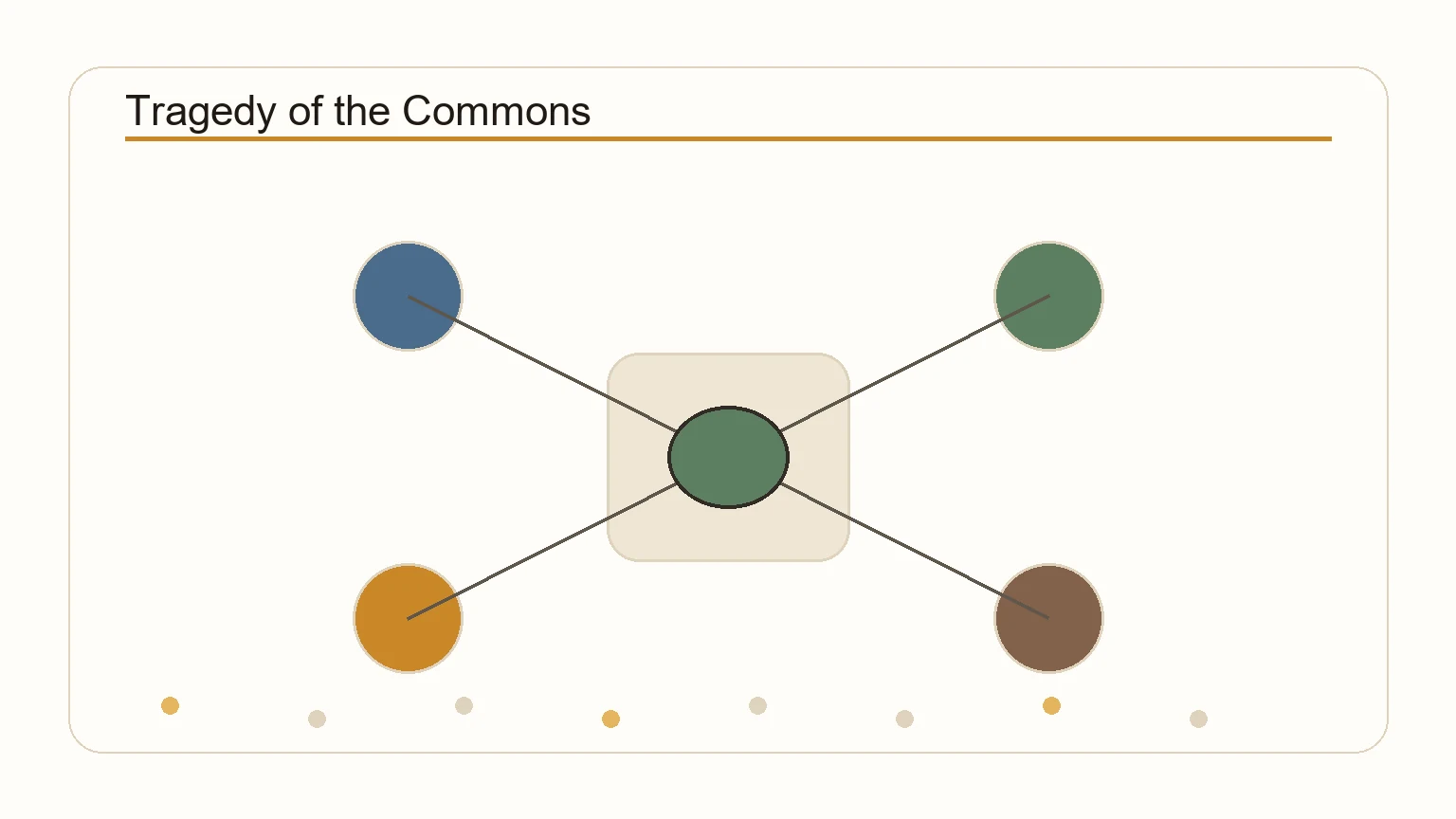

The small mechanism underneath the big idea.

01

The Story Behind the Tragedy of the Commons

In 1968, ecologist Garrett Hardin published an essay in Science magazine. He described a scenario: a shared pasture, open to all herders. Each herder adds more animals to maximize their own benefit. The pasture is overgrazed. It is destroyed. Everyone loses.

Hardin called this the tragedy of the commons. He argued that the situation was inevitable. Individuals act in their own self-interest. They cannot coordinate. The shared resource is ruined.

The essay became famous. It was cited, debated, and applied to everything from pollution to population growth. The tragedy of the commons became a foundational concept in economics and environmental policy.

02

Why the Tragedy of the Commons Became Famous

The tragedy of the commons became famous because it explains a universal problem. Shared resources are overused. The ocean is overfished. The atmosphere is polluted. The roads are congested. Hardin gave people a name for the pattern.

The essay was influential in environmental policy. It shaped the debate on population growth, resource management, and climate change. The concept is still cited today.

Today, the tragedy of the commons is one of the most important concepts in economics and environmental science. It is taught in universities and applied in policy.

Diagram showing the tragedy of the commons with overgrazing and collapse
A diagram showing a shared pasture being overgrazed by individual herders. Each herder adds animals. The pasture is destroyed. Everyone loses.

Where this idea shows up outside the textbook.

History

The classic example is the shared pasture. Each herder adds animals. The pasture is overgrazed. It is destroyed. Everyone loses.

Environment

Overfishing is a classic example. The ocean is shared. Each fisherman catches as many fish as possible. The fish population collapses. Everyone loses.

Everyday Life

Traffic congestion is a tragedy of the commons. The roads are shared. Each driver uses them. The roads become congested. Everyone loses.

Internet Culture

The internet is a shared resource. Spam and misinformation are overuse. They degrade the experience for everyone.

CONCEPT MAP

Every idea has neighbors. This is where the current concept sits in the TinyThat knowledge graph.

Current concept

Tragedy of the Commons

Shared resources get depleted when individual incentives dominate.

What people often get wrong about this idea.

The tragedy of the commons means people are selfish.

No. It means people respond to incentives. The system rewards overuse. Change the system. Change the outcome.

The tragedy of the commons only applies to environmental issues.

No. It applies to any shared resource. Roads, internet, public spaces. Anywhere there is a common pool resource.

The solution is to make people act selflessly.

No. The solution is to change the incentives. Private property, regulation, or community management. The system, not the people.

Useful ideas become dangerous when they are stretched too far.

Criticisms and Limitations of the Tragedy of the Commons

The tragedy of the commons is a powerful model, but it has limitations. It assumes people cannot coordinate. In reality, communities often manage shared resources effectively.

The concept is often oversimplified. Not all shared resources are ruined. Some are managed well. The tragedy is a tendency, not a law.

The solution is not always privatization. Regulation and community management can work. The tragedy is not inevitable. It is a warning.

Three simple ways to apply the idea without turning it into a slogan.

1

When you see a shared resource being degraded, ask: what are the incentives? Who benefits from overuse? Who bears the cost?

When you see a shared resource being degraded, ask: what are the incentives? Who benefits from overuse? Who bears the cost?

2

Design systems that align individual incentives with the common good

Design systems that align individual incentives with the common good. Private property, regulation, or community management can work.

3

Recognize that the tragedy is not about bad people

Recognize that the tragedy is not about bad people. It is about bad systems. Change the system. Change the outcome.

EXPLORE NEXT

The best next ideas to read after this one.

Quick answers to common questions.

What is the tragedy of the commons in simple terms?

A shared resource is overused because individuals act in their own self-interest. Everyone loses. The pasture is overgrazed. The ocean is overfished.

What is an example of the tragedy of the commons?

Overfishing is a classic example. The ocean is shared. Each fisherman catches as many fish as possible. The fish population collapses. Everyone loses.

How do you solve the tragedy of the commons?

Change the incentives. Private property, regulation, or community management can align individual interests with the common good.

Why is the tragedy of the commons a problem?

It leads to the destruction of shared resources. The ocean is overfished. The atmosphere is polluted. The roads are congested. Everyone loses.