
CLASSICAL PARABLE

What Does the Sword of Damocles Mean? The Anxiety Behind Every Throne

A flatterer tells a tyrant how lucky he is. The tyrant, unimpressed, offers to swap places for an evening — and hangs a sword directly over the man's head by a single strand of horsehair, just to make a point.

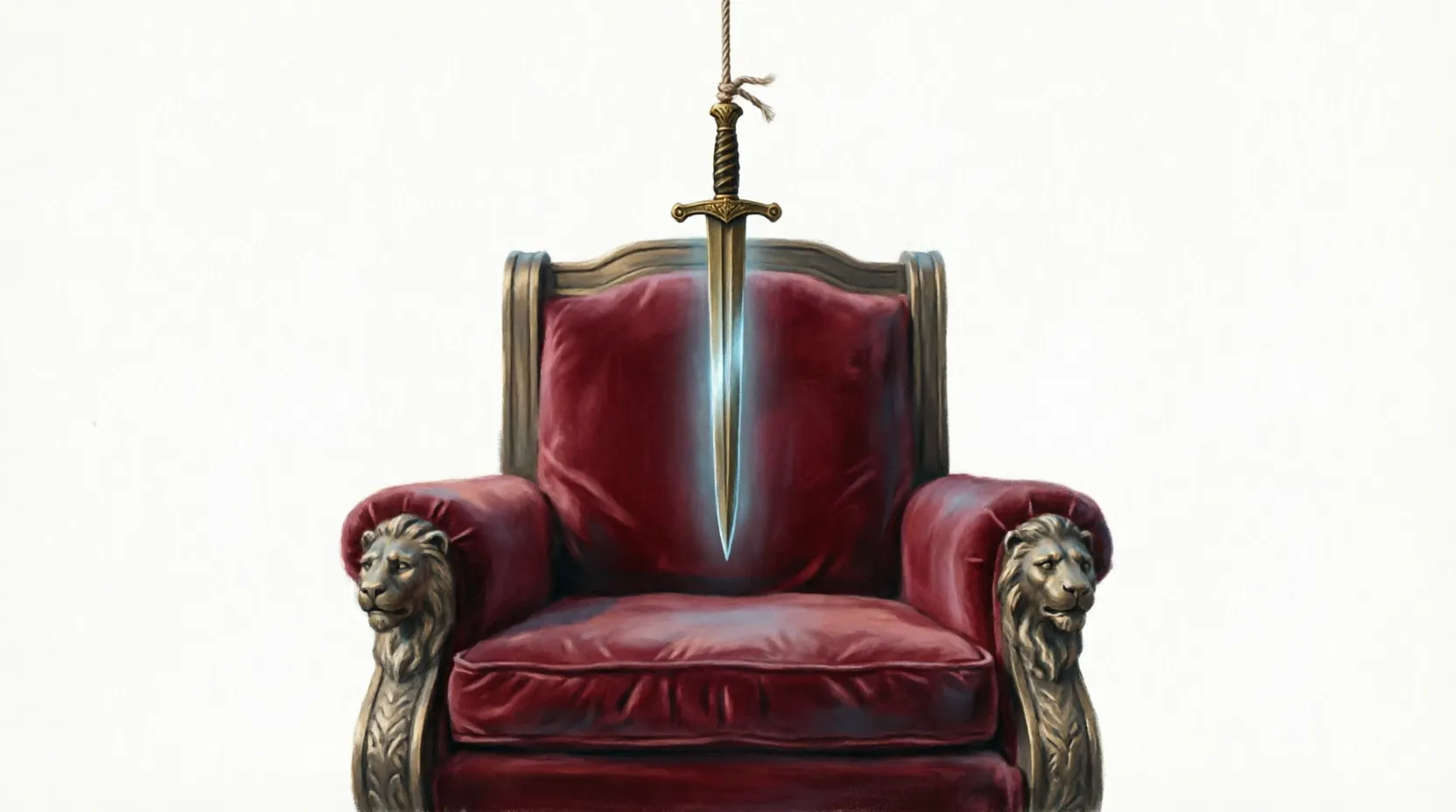
Editorial illustration of a sword hanging by a single thread above a golden throne
Main source Cicero's Tusculan Disputations (45 BCE)Setting Syracuse, Sicily (4th century BCE)Historical figure Dionysius II of Syracuse (real tyrant)Genre Moral parable, not a documented event

QUICK ANSWER

Here is the idea in plain English.

The Sword of Damocles is a story about a courtier, Damocles, who envies his king's wealth and power. The king lets him sit on the throne for a day — but suspends a sword above his head by a single horsehair, to show him that supreme power comes with supreme, constant, invisible risk. It's a parable, not a documented historical event: the story is preserved by the Roman philosopher Cicero, writing about a Sicilian tyrant named Dionysius II, roughly three centuries after Dionysius actually lived. Dionysius II was a real historical ruler of Syracuse; the sword anecdote about him is almost certainly a moralizing story rather than a recorded fact. Today the phrase means any ever-present, looming danger that threatens someone even in the midst of apparent success or power.

If you remember only a few things, remember these.

The basic move

It's best understood as a parable — a teaching story built around a real person's name and setting, the way Aesop's fables get attached to talking animals for the sake of the lesson rather than the zoology. Dionysius II of Syracuse was absolutely a real, documented historical ruler; we have independent evidence of his reign, his politics, his eventual overthrow. But the specific sword-and-horsehair episode shows up nowhere in the historical record except as a story told for its moral, generations after the fact, by a philosopher explicitly using it to illustrate a point in an argument about happiness.

Why it matters

That's worth sitting with for a second, because it's easy to lump 'Greek mythology' and 'Greek/Roman history' into one undifferentiated bucket of 'ancient stuff,' when really this sits in a third category entirely: a moralizing anecdote, closer in spirit to a modern parable or thought experiment than to either a myth about gods or a historical chronicle about kings. Cicero isn't claiming Damocles literally existed and this literally happened to him. He's using a vivid, memorable, plausible-sounding scene to make an abstract philosophical argument land — specifically, in Cicero's original context, the argument that a life of power without inner virtue and peace of mind is not actually a happy life, no matter how it looks from the outside.

Use it deliberately

Next time someone's success looks effortless or enviable from the outside, remember that Damocles's feast looked exactly the same way to everyone in the hall except him — worth assuming an invisible cost exists even when you can't see it.

CORE IDEA

The concept in its simplest useful form.

Is the Sword of Damocles a Real Story, a Myth, or a Parable?

It's best understood as a parable — a teaching story built around a real person's name and setting, the way Aesop's fables get attached to talking animals for the sake of the lesson rather than the zoology. Dionysius II of Syracuse was absolutely a real, documented historical ruler; we have independent evidence of his reign, his politics, his eventual overthrow. But the specific sword-and-horsehair episode shows up nowhere in the historical record except as a story told for its moral, generations after the fact, by a philosopher explicitly using it to illustrate a point in an argument about happiness.

That's worth sitting with for a second, because it's easy to lump 'Greek mythology' and 'Greek/Roman history' into one undifferentiated bucket of 'ancient stuff,' when really this sits in a third category entirely: a moralizing anecdote, closer in spirit to a modern parable or thought experiment than to either a myth about gods or a historical chronicle about kings. Cicero isn't claiming Damocles literally existed and this literally happened to him. He's using a vivid, memorable, plausible-sounding scene to make an abstract philosophical argument land — specifically, in Cicero's original context, the argument that a life of power without inner virtue and peace of mind is not actually a happy life, no matter how it looks from the outside.

The small mechanism underneath the big idea.

01

The Story Behind the Sword of Damocles

The story is set in Syracuse, a wealthy Greek city on the island of Sicily, under the rule of Dionysius II — a tyrant in the old, technical Greek sense of the word: not necessarily cruel, just a ruler who'd seized or inherited power outside the normal constitutional channels. Dionysius has a courtier, Damocles, who's rather too fond of flattering him, endlessly going on about how magnificent it must be to have Dionysius's army, his gold, his palace, his absolute authority over an entire city. Dionysius, who has presumably heard this speech before and is a little tired of it, makes an offer: would Damocles like to trade places for a day and find out?

Damocles, naturally, jumps at it. He's dressed in royal robes, seated on the throne, surrounded by servants, showered with the finest food and wine Syracuse can produce, fawned over by everyone in the hall exactly as he'd always imagined a king would be. And then, at some point in the celebration, he happens to glance up — and sees, directly above his own head, a genuine, unsheathed sword, point-down, suspended from the ceiling by nothing but a single strand of horsehair.

The feast, from that moment, is ruined. Damocles can't eat. He can't enjoy the music, the servants, the gold cups, or the flattery he was so recently so hungry for, because every second of it is happening underneath a blade that could fall at literally any instant, for no particular reason, killing him where he sits. He begs Dionysius to be allowed to leave, to go back to being an ordinary, unenvied man. Dionysius lets him go, point made without a word of lecture required.

We know this story almost entirely from a single source: the Roman statesman and philosopher Cicero, writing in his Tusculan Disputations around 45 BCE — more than three centuries after Dionysius II's actual reign in Syracuse. Cicero, in turn, says he got it from an earlier Sicilian historian named Timaeus, whose own writings on the subject haven't survived independently; we only have Cicero's retelling of Timaeus's retelling. That's a long chain of hands for a supposedly factual anecdote to pass through untouched, which is one of the strongest reasons historians treat it as illustrative rather than documentary — a philosophical fable wearing a historical figure's name, not a newspaper report.

02

Why the Story — and the Phrase — Stuck Around

The idea survived because it compresses a genuinely universal anxiety into a single, vivid image, rather than a lecture. You can explain, in the abstract, that power comes with risk, that the people who seem to have everything are often the ones lying awake at night — but nobody remembers the abstract version. Everybody remembers the sword and the horsehair, because the image does the philosophical work for you: a single strand, holding up something lethal, over the head of the one person in the room who thought he'd finally arrived.

It's also survived because it's endlessly reusable. Cicero built it to argue about the emptiness of tyrannical power specifically, but the shape of the story — precarious safety, held up by something absurdly fragile, invisible to everyone but the person underneath it — applies just as well to a nuclear stand-off, a fragile peace treaty, an executive one bad quarter away from being fired, or a life built on a secret that could unravel everything at any moment. The specific king and the specific courtier faded; the mechanism of the story didn't.

Diagram contrasting the outward luxury of Damocles's throne with the hidden sword above it
A simple illustration contrasting the outward appearance of Damocles's day as king — feast, gold, servants — with the single hidden fact (a sword on a horsehair) that undoes all of it.

Where this idea shows up outside the textbook.

Cicero's Tusculan Disputations

Our sole detailed ancient source for the story, written around 45 BCE as part of a philosophical argument about the true nature of happiness and power.

Cold War politics

President John F. Kennedy invoked 'a Sword of Damocles hanging over the head of every man, woman and child' in a 1961 UN speech about nuclear weapons — arguably the phrase's most famous modern use.

Medicine and diagnosis

Physicians sometimes describe an uncertain, unresolved diagnosis — a shadow on a scan that might be nothing, might be serious — as a 'sword of Damocles' hanging over a patient's daily life.

Business and leadership

Executives, founders, or public officials facing an ongoing, unresolved threat — a lawsuit, an audit, a hostile takeover attempt — are routinely described in the press as operating 'under a sword of Damocles.'

CONCEPT MAP

Every idea has neighbors. This is where the current concept sits in the TinyThat knowledge graph.

Current concept

What Does the Sword of Damocles Mean

The Sword of Damocles is a story about a courtier, Damocles, who envies his king's wealth and power. The king lets him sit on the throne for a day — but suspends a sword above his head by a single horsehair, to show him that supreme power comes with supreme, constant, invisible risk. It's a parable, not a documented historical event: the story is preserved by the Roman philosopher Cicero, writing about a Sicilian tyrant named Dionysius II, roughly three centuries after Dionysius actually lived. Dionysius II was a real historical ruler of Syracuse; the sword anecdote about him is almost certainly a moralizing story rather than a recorded fact. Today the phrase means any ever-present, looming danger that threatens someone even in the midst of apparent success or power.

What people often get wrong about this idea.

The Sword of Damocles and the Gordian Knot are basically the same story.

They're often confused because both are classical images about power and problems, but they're unrelated stories with opposite morals. The Gordian Knot, associated with Alexander the Great, is about decisively cutting through an impossible problem. The Sword of Damocles is about the ever-present, unresolved risk that comes with holding power — nobody 'solves' the sword; Damocles simply asks to leave.

This is a Greek myth, involving gods, like the Trojan Horse or Midas.

It has Greek settings and a Greek name, but it's a Roman-recorded moral anecdote about a real Sicilian tyrant's court, not a myth involving deities. It sits closer to a parable than to mythology proper.

The sword-and-horsehair scene is a documented historical event.

It survives through a single ancient source, Cicero, writing roughly three centuries after Dionysius II's reign, explicitly using the story to make a philosophical point — not reporting it as verified fact.

Three simple ways to apply the idea without turning it into a slogan.

1

Next time someone's success looks effortless or enviable from the outside, remember that Damocles's feast looked exactly the same way to everyone in the hall except him — worth assuming an invisible cost exists even when you can't see it

Next time someone's success looks effortless or enviable from the outside, remember that Damocles's feast looked exactly the same way to everyone in the hall except him — worth assuming an invisible cost exists even when you can't see it.

2

When you find yourself newly anxious after finally getting something you wanted — a promotion, a public profile, financial stability — recognize that as the sword becoming visible, not evidence that the achievement was a mistake

When you find yourself newly anxious after finally getting something you wanted — a promotion, a public profile, financial stability — recognize that as the sword becoming visible, not evidence that the achievement was a mistake.

3

Keep the Sword of Damocles and the Gordian Knot separate in your head: one is about living with an unresolved risk, the other is about cutting through an unsolvable problem

Keep the Sword of Damocles and the Gordian Knot separate in your head: one is about living with an unresolved risk, the other is about cutting through an unsolvable problem. They get used interchangeably in casual conversation, but they're pointing at opposite responses to difficulty.

EXPLORE NEXT

The best next ideas to read after this one.

Quick answers to common questions.

What does the Sword of Damocles mean?

A constant, ever-present danger that looms over someone even in the middle of apparent success, wealth, or power — the idea that great position always comes bundled with great, often invisible, risk.

What is the moral of the Sword of Damocles?

That power and privilege are never the unmixed blessing they appear to be from the outside; the constant risk that comes with high position can make genuine happiness harder, not easier, to hold onto.

Is the Sword of Damocles a true story?

Dionysius II of Syracuse was a real historical tyrant, but the specific sword-and-horsehair episode is preserved only by Cicero, writing roughly 300 years after Dionysius's reign, as a philosophical illustration rather than a documented event.

Is the Sword of Damocles Greek?

The setting (Syracuse, Sicily) and the characters are Greek, but our detailed account of the story comes from a Roman source, Cicero, drawing on an earlier Greek-Sicilian historian, Timaeus, whose own account hasn't survived.

Is the Sword of Damocles a myth, a metaphor, or a parable?

It's best described as a parable — a moral teaching story attached to a real historical figure's name. It functions today primarily as a metaphor for looming, ever-present danger, rather than as mythology involving gods, or as a verified historical record.

What's the relationship between the Gordian Knot and the Sword of Damocles?

They're unrelated stories from different periods that get confused because both are classical images involving power and a physical object. The Gordian Knot is about Alexander the Great decisively cutting through an unsolvable problem; the Sword of Damocles is about the unresolved, permanent risk that comes with holding power.