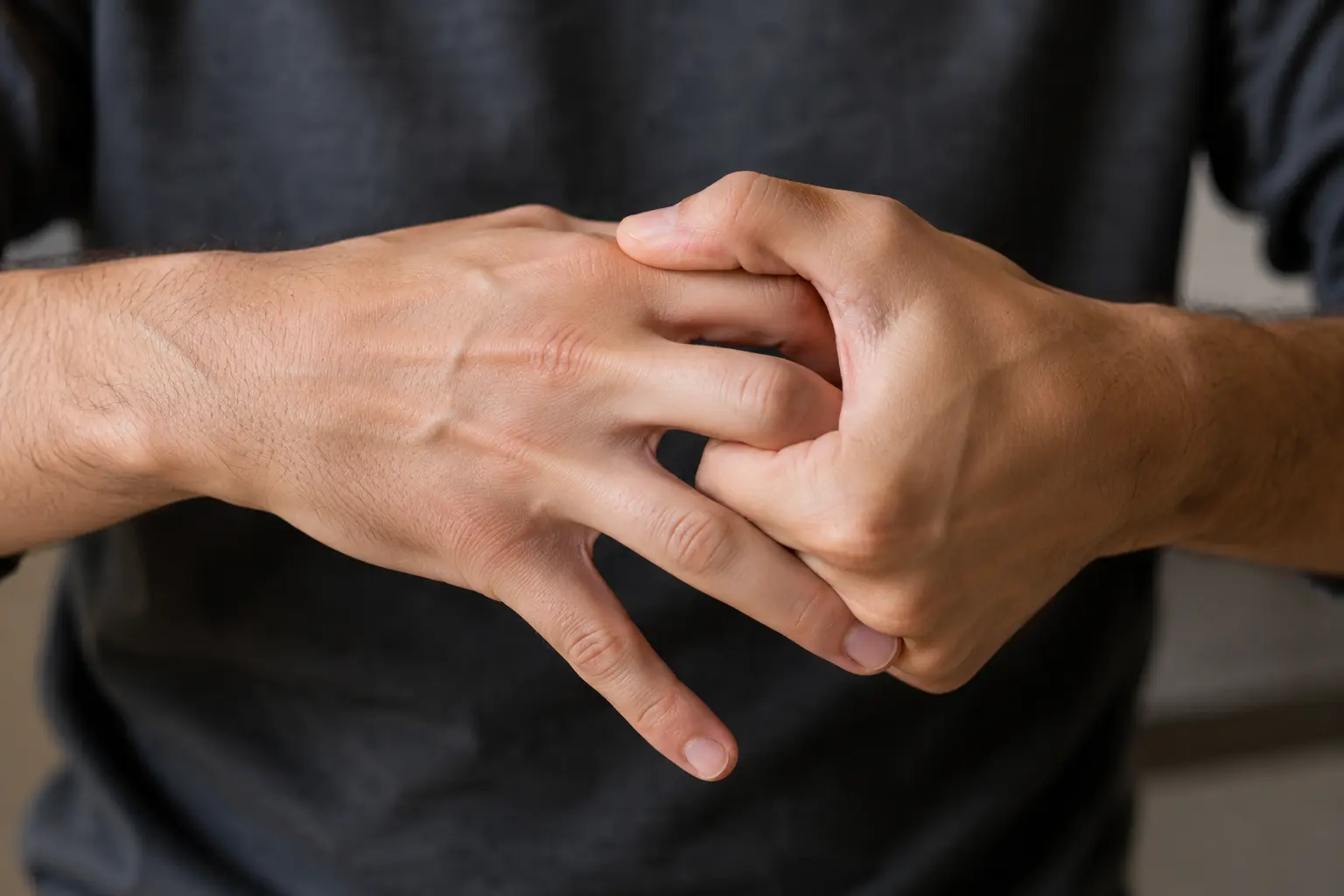
Visual answer
What Happens Inside a Knuckle When It Cracks
Gas, pressure, and a bubble, the full sequence.
Joint capsule stretches
You pull or bend the finger. The joint capsule surrounding the knuckle stretches, increasing the space inside the joint.
Pressure inside the joint drops
The increased space lowers pressure inside the synovial fluid, similar to opening a carbonated drink.
Dissolved gases form a bubble
Dissolved gases (mainly nitrogen) can no longer stay dissolved at the lower pressure. They rapidly form a gas bubble in the fluid.
Bubble pops, the crack sound
The bubble forms or collapses rapidly, generating the audible pop. After this, gases need 15–30 minutes to redissolve before the knuckle can crack again.
Real reason
Gas Bubbles in Joint Fluid, Not Bone on Bone
Your knuckle joints are enclosed in a capsule. Inside that capsule is synovial fluid, a thick, slippery liquid that lubricates the joint and keeps it moving smoothly. This fluid naturally has dissolved gases in it, mostly nitrogen.
When you stretch or manipulate the joint, the capsule expands slightly and the pressure inside drops. Under lower pressure, dissolved gases can't stay dissolved, they separate out and form a bubble. The audible pop comes from that bubble forming or rapidly collapsing.
Scientists have debated for years whether the sound comes from the bubble forming or bursting. More recent imaging studies, including MRI video of joints cracking, suggest the sound happens when the bubble forms. But this is still technically debated. Either way: gas bubbles, not bones.
Myth vs reality
Myth vs Reality
What people think
Cracking your knuckles will give you arthritis
This has been told to generations of kids by parents and teachers. It's not backed by evidence. Studies comparing habitual knuckle crackers with non-crackers found no significant difference in rates of hand arthritis.
What actually happens
No evidence links knuckle cracking to arthritis
Arthritis is caused by cartilage breakdown from aging, genetics, previous injury, autoimmune conditions, and accumulated joint stress. Gas bubbles forming in synovial fluid are not on that list. Cracking your knuckles does no structural damage to the joint if it doesn't hurt.
Common triggers
Cracking Knuckles vs Other Joint Sounds
Knuckle pop (classic crack)
Gas bubble forming or collapsing in synovial fluid, harmless if painless
Knee clicking when bending
Often tendon or ligament snapping over a bony prominence, also usually harmless
Grinding or grating sounds with pain
May indicate cartilage roughness or joint changes, worth getting checked if persistent
Quick answers
Common questions
Why can't I crack the same knuckle twice in a row? +
After the gas bubble forms or collapses, the gases need to redissolve back into the synovial fluid. This takes roughly 15 to 30 minutes. Until the gases are back in solution, there's nothing to form a new bubble.
Does cracking knuckles make them bigger? +
There is no good evidence that normal knuckle cracking enlarges knuckles. One informal study by a doctor who cracked only his right hand's knuckles for 60 years found no difference in arthritis between hands.
Why does cracking feel satisfying? +
The pressure change in the joint may stimulate nerve endings and provide a brief sensation of relief or release. Some people describe a feeling of increased mobility after cracking, which may be real, the brief drop in pressure and pressure equalization can temporarily increase the space in the joint.
Can you crack your knuckles louder? +
Pulling the joint faster and more abruptly tends to produce a louder sound, as the pressure change is more sudden. The size of the bubble formed and how quickly it collapses also affects the volume.
Why do some people crack and others don't? +
Joint capsule flexibility varies between people. Those with more lax ligaments can stretch their joint capsules more easily, which makes gas bubble formation easier. Some people's joints just resist cracking more.
Is cracking your back or neck the same thing? +
The same basic mechanism applies, synovial fluid gas bubbles in the small facet joints of the spine. Spinal joints are more complex and contain important structures, so forceful neck cracking in particular should be done carefully and not aggressively without professional guidance.