
PSYCHOLOGICAL CONCEPT

What Is Metacognition? Thinking About Your Thinking

You are reading this. You are also aware that you are reading this. You are thinking about your thinking. That is metacognition.

Editorial illustration of a person looking at their own mind in a mirror
Creator John FlavellOrigin PsychologyYear 1970sCategory Psychology

QUICK ANSWER

Here is the idea in plain English.

Metacognition is the ability to think about your own thinking. It involves self-awareness, self-regulation, and reflection. The concept was developed by John Flavell in the 1970s. Metacognition is what separates good learners from great ones. It is the foundation of self-improvement.

If you remember only a few things, remember these.

The basic move

Metacognition is simple: thinking about your thinking. It is self-awareness. You are aware that you are thinking. You are also aware of how well you are thinking.

Why it matters

Metacognition is what separates good learners from great ones. Good learners know what they know. They know what they do not know. They adjust their learning accordingly.

Use it deliberately

Ask yourself: what do I know? What do I not know? Am I thinking clearly?

CORE IDEA

The concept in its simplest useful form.

What Does Metacognition Mean in Simple Terms?

Metacognition is simple: thinking about your thinking. It is self-awareness. You are aware that you are thinking. You are also aware of how well you are thinking.

Metacognition is what separates good learners from great ones. Good learners know what they know. They know what they do not know. They adjust their learning accordingly.

The skill is learnable. Anyone can develop metacognition. The first step is awareness.
The small mechanism underneath the big idea.

01

The Story Behind Metacognition

John Flavell was a developmental psychologist. In the 1970s, he was studying how children learn. He noticed that some children were better at learning than others. The difference was not intelligence. It was awareness.

Flavell called this awareness metacognition. It is the ability to think about your own thinking. It is about knowing what you know and what you do not know.

Today, metacognition is a foundational concept in education and psychology. It is the basis of self-improvement.

02

Why Metacognition Became Famous

Metacognition became famous because it explains why some people learn faster than others. The difference is not intelligence. It is awareness.

The concept is widely used in education. Teachers teach metacognitive strategies to help students learn better.

Today, metacognition is a foundational concept in psychology and education.

Diagram showing the two levels of thinking: thinking and thinking about thinking
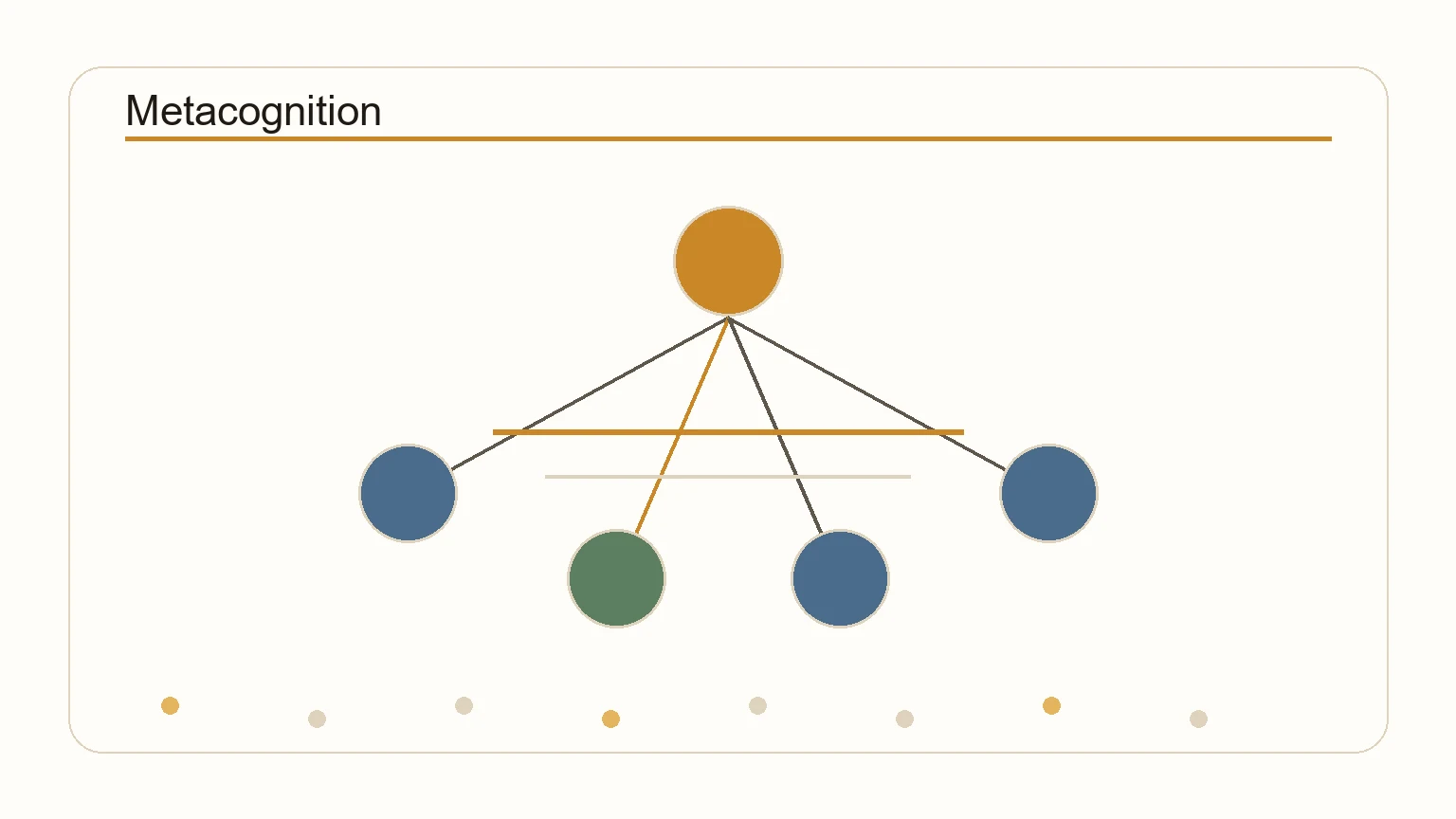
A diagram showing the two levels of thinking: the first level is thinking; the second level is thinking about thinking.

Where this idea shows up outside the textbook.

Education

A student knows they do not understand a concept. They ask a question. They are using metacognition.

Everyday Life

You realize you are making a bad decision. You stop and think. You are using metacognition.

Business

A leader recognizes their own bias. They adjust their decision-making. They are using metacognition.

Internet Culture

You realize you are being manipulated by an algorithm. You change your behavior. You are using metacognition.

CONCEPT MAP

Every idea has neighbors. This is where the current concept sits in the TinyThat knowledge graph.

Current concept

Metacognition

Thinking about and judging your own thinking.

What people often get wrong about this idea.

Metacognition is the same as intelligence.

No. It is a skill. Some intelligent people lack metacognition. Some less intelligent people have strong metacognition.

Metacognition is innate.

No. It is learnable. Anyone can develop it.

Metacognition is only for students.

No. It is for everyone. It applies to every area of life.

Useful ideas become dangerous when they are stretched too far.

Criticisms and Limitations of Metacognition

Metacognition is a powerful concept, but it has limitations. Some people overthink. They are too aware. The goal is balance.

The concept can be misused. Some people use it to avoid action. The goal is awareness, not paralysis.

The concept is a guide, not a rule. Use it to think about your thinking, not to obsess over it.

Three simple ways to apply the idea without turning it into a slogan.

1

Ask yourself: what do I know? What do I not know? Am I thinking clearly?

Ask yourself: what do I know? What do I not know? Am I thinking clearly?

2

Reflect on your own thinking

Reflect on your own thinking. Notice when you are biased. Notice when you are wrong.

3

Practice self-awareness

Practice self-awareness. The more you practice, the better you get.

EXPLORE NEXT

The best next ideas to read after this one.

Quick answers to common questions.

What is metacognition in simple terms?

Thinking about your thinking. It is self-awareness. You know what you know and what you do not know.

What is an example of metacognition?

You are studying. You realize you do not understand a concept. You ask for help. That is metacognition.

How do you develop metacognition?

Practice self-awareness. Ask yourself: what do I know? What do I not know? Reflect on your own thinking.

Why is metacognition a problem?

It can lead to overthinking. The goal is awareness, not paralysis.